
June 15, 2026
Why Some Drivers Pay 30% Less for the Same Coverage
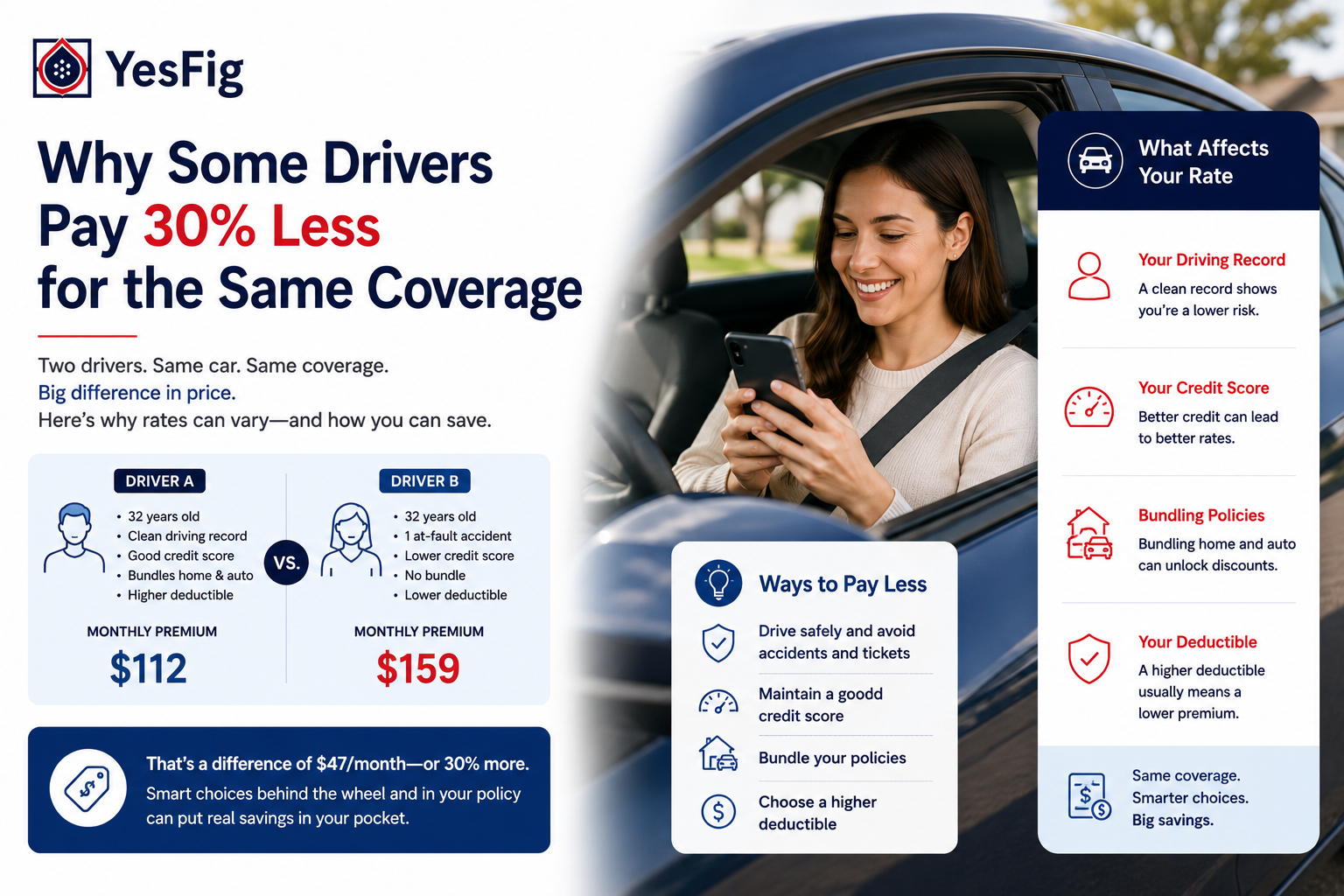
Two drivers, same coverage, very different prices. Here's what affects car insurance rates and how to land on the cheaper side, sometimes 30% lower.
Why Some Drivers Pay 30% Less for the Same Coverage
Quick answer: Car insurance rates are personalized, so two drivers with identical coverage can pay very different prices. Factors like driving record, location, vehicle, mileage, and the discounts you qualify for all shift the number. Insurers also weigh these differently, so comparing quotes is often what separates a driver paying 30% less from one paying full price.
Table of contents
- Why the same coverage costs different amounts
- What affects car insurance rates: the big factors
- The discounts that quietly lower car insurance rates
- California rules that change the math
- How to get on the cheaper side
- Frequently asked questions
Renata and her coworker drive nearly the same car, live in the same Oakland neighborhood, and carry identical coverage. Yet she pays close to a third more than he does, and for years had no idea why. It feels random, but it isn't. Car insurance rates are built from dozens of factors, and small differences between two drivers, or two insurers, can add up to a 30% gap on the very same coverage.
The encouraging part is that a lot of that gap is explainable, and some of it is in your control. Here's what's actually behind the number.
Why the same coverage costs different amounts
Insurance pricing isn't a flat menu. It's a personalized estimate of risk, and two people buying the same policy are really buying two different risk profiles. The coverage is identical; the person it's wrapped around is not.
On top of that, every insurer uses its own formula. One company may weigh your commute heavily while another cares more about your vehicle, so the exact same driver can get noticeably different quotes from different carriers. That's the hidden reason behind a lot of those 30% gaps.
So when two drivers pay different prices, it's rarely a mistake. It's the system doing exactly what it's designed to do, just not always in your favor. Understanding the inputs is how you tilt it back, starting with a real quote on a California auto insurance policy.
Suspect you're on the expensive side?
You might be, and it's easy to check. Fig can explain what's driving your rate and where the savings hide, in plain English. Start with the basics of auto insurance in California.
What affects car insurance rates: the big factors
A handful of inputs do most of the heavy lifting. These are the ones that move your number the most:
- Driving record. Tickets, at-fault accidents, and claims history are among the strongest factors. A clean record is your best rate.
- Location. Where you park and drive matters, since theft rates, accident frequency, and repair costs vary by area.
- Vehicle. What you drive affects the price through repair costs, theft risk, and safety ratings.
- Mileage. The more you drive, the more exposure to risk, so lower annual miles can mean a lower rate.
- Coverage and deductible. Higher limits cost more, and a higher deductible lowers your premium.
Some of these you can't change overnight, but several you can influence. The mix is exactly why two similar drivers can land in very different places.
The discounts that quietly lower car insurance rates
Discounts are where a lot of the 30% lives, and many go unclaimed simply because nobody asked. Stack every one you qualify for:
- Bundling. Combining auto with a homeowners policy or renters coverage often cuts both premiums.
- Safe driver. A clean record over time earns lower rates and loyalty perks.
- Telematics. Usage-based programs reward careful driving with real discounts.
- Low mileage. Drive less than average and you may pay less.
- Pay-in-full and paperless. Small administrative discounts that add up.
No single discount creates a 30% gap, but layered together they easily can. The driver paying less is often just the one who captured all of them.
Key takeaways
- Pricing is personalized, so identical coverage can cost very different amounts.
- Driving record, location, vehicle, and mileage are among the biggest factors.
- In California, credit and gender can't be used to set your rate.
- Comparing insurers is often the single biggest source of savings.
California rules that change the math
California is unusually strict about what's allowed to affect your rate, and that works in drivers' favor. Many factors used elsewhere simply aren't permitted here.
Good to know: California limits what can affect your auto rate. Thanks to Proposition 103, insurers can't use your credit history, and gender isn't a rating factor either. Your price is driven mainly by your driving record, annual mileage, and years of experience. Yesfig writes auto coverage in California and five other states.
In many states, a credit-based insurance score can swing your premium significantly. In California, it can't be used for auto insurance at all. That means the path to a lower rate here runs almost entirely through driving-related factors: a clean record, modest mileage, and experience behind the wheel. Yesfig Insurance, a brand of Focus Insurance Group based in Los Angeles, prices within those California rules.
How to get on the cheaper side
You can't control every factor, but you can control enough to move your number. Work these in order:
- Protect the controllables. Keep your driving record clean and avoid coverage lapses, since both quietly raise rates.
- Stack every discount. Confirm bundling, safe-driver, telematics, and low-mileage discounts are all actually applied.
- Right-size your policy. Match coverage limits and deductible to your real needs rather than overpaying.
- Compare insurers. Because each carrier weighs factors differently, the same driver can save substantially just by shopping around.
That last step is the one most people skip, and it's often where the biggest savings hide. If you'd rather not sort it alone, a licensed Yesfig advisor can check that nothing is left on the table.
Want to see if you're overpaying?
The only way to know is to compare. Yesfig can quote your exact coverage and show how your rate stacks up, so you stop guessing. Compare your auto coverage and find your real number.
Frequently asked questions
Why do two drivers pay different prices for the same coverage?
Because insurance is priced on personal risk, not just the policy. Two drivers with identical coverage can differ in driving record, location, vehicle, mileage, and discounts, all of which move the price. Insurers also use different formulas, so the same driver can get different quotes from different carriers, which explains many of the largest gaps.
What factors affect car insurance rates the most?
Driving record is one of the strongest, since tickets and at-fault accidents signal higher risk. Location, vehicle type, annual mileage, and your chosen coverage and deductible also play major roles. Discounts you qualify for further shift the number. In California specifically, driving-related factors carry the most weight because credit and gender aren't allowed.
Does my credit score affect my car insurance in California?
No. California prohibits insurers from using credit history to set auto insurance rates, thanks to Proposition 103. While many other states do allow credit-based insurance scores, California does not. Your rate here is based mainly on driving-related factors like your record, annual mileage, and years of driving experience, not your credit.
How can I lower my car insurance rate?
Keep your driving record clean, avoid coverage lapses, and make sure every discount you qualify for is applied, including bundling, safe-driver, telematics, and low-mileage discounts. Right-size your coverage and deductible to your actual needs. Most importantly, compare quotes from multiple insurers, since each prices the same driver differently and the spread can be large.
Why should I compare car insurance quotes?
Because insurers weigh rating factors differently, the identical driver and coverage can produce very different prices from one carrier to the next. Comparing quotes is often the single biggest lever for savings, sometimes the difference between paying full price and paying noticeably less. It costs nothing to check and can reveal a better rate quickly.
The gap isn't luck, it's information
The driver paying 30% less usually isn't lucky. They've protected the factors they control, claimed every discount, and compared insurers instead of accepting the first number. Car insurance rates reward the informed, and now you're one of them. Like Renata eventually did, you can find out exactly where you stand and close the gap.
Ready to get on the cheaper side?
Get an auto insurance quote with Yesfig in minutes. Coverage starts around $30/mo, and a licensed advisor can make sure every discount you qualify for is actually applied.
About the Author

Mathew Bahadori
CEO, Yesfig Insurance
Leading the company’s mission to make insurance more accessible, modern, and customer-focused. With a passion for innovation and personalized service, he continues to help individuals and families find smarter coverage solutions for life, auto, home, health, and business insurance.