
July 28, 2026
How to Update Your Home Insurance After a Renovation
A renovation can leave you underinsured without you knowing. Learn how to update your home insurance after remodeling, and which upgrades lower your premium.
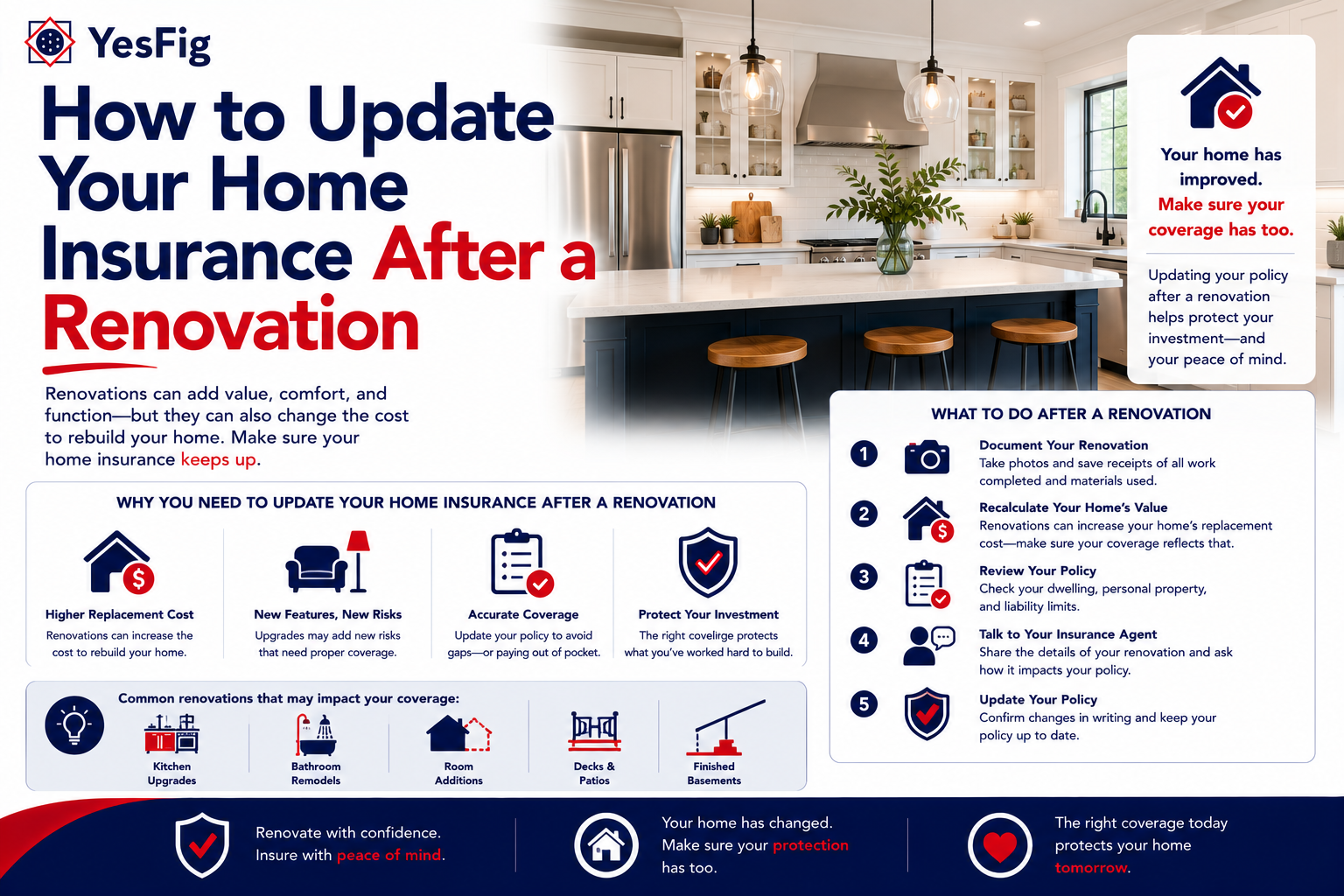
How to Update Your Home Insurance After a Renovation
Quick answer: A renovation usually raises your home's rebuild cost, so update your dwelling coverage to match or you'll be underinsured. Additions, finished spaces, and upgrades all increase what it costs to rebuild. Some improvements, like a new roof or updated wiring, can actually lower your premium. Tell your insurer before major projects and after they're done.
Table of contents
- Why a renovation can leave you underinsured
- What to update on your home insurance after a renovation
- The coinsurance penalty most homeowners miss
- When a renovation actually lowers your premium
- What California homeowners should know
- How to update your coverage after remodeling
- Frequently asked questions
Priya finished her basement and added a bathroom in Sacramento, thrilled with the extra space and never once thinking about her insurance. That's the trap: a renovation quietly changes what your home is worth to rebuild, but your coverage doesn't update itself. Knowing how to update home insurance after renovation work is what keeps a great remodel from turning into an underinsured house you don't discover until you file a claim.
The fix is simple, and some of it can even save you money. Here's why renovations create a coverage gap, what to tell your insurer, and the upgrades that might lower your premium instead of raising it.
Why a renovation can leave you underinsured
Your dwelling coverage is based on your home's rebuild cost, the amount it would take to reconstruct your house as it is. When you renovate, you often raise that cost, but your coverage limit stays wherever it was, which quietly leaves you underinsured for the improved home.
The gap is invisible until it matters. A finished basement, a new addition, or an upgraded kitchen all cost more to rebuild than what was there before, so if disaster struck, your existing limit might not cover the full replacement. Adding square footage or high-end finishes can also push your personal property value up, which is another reason to revisit your coverage. The renovation you're proud of is exactly the one your policy hasn't accounted for yet.
Just finished a remodel?
That's the moment to check your coverage. Fig can explain what to update and show you what California homeowners insurance covers, with no pressure to switch.
What to update on your home insurance after a renovation
Not all projects affect your policy equally, so focus on the ones that change your home's value or risk. Additions and finished spaces, like a new room, a finished basement, or a converted garage, add square footage and rebuild cost, so your dwelling coverage should rise to match.
Major system upgrades matter too. New electrical, plumbing, HVAC, or a roof changes both your rebuild cost and your risk profile, and often in your favor. High-value additions, like a renovated kitchen with premium finishes, a home theater, or expensive built-ins, may need higher coverage or scheduled items. And anything that changes your liability, such as adding a pool or starting a home-based business, should be reported. When in doubt, tell your insurer about the project, since they'd rather know than settle a surprise later. A homeowners policy is only accurate if it reflects your current home.
The coinsurance penalty most homeowners miss
Here's the consequence that catches people off guard. Many homeowners policies include a coinsurance requirement, meaning you must insure your home to a set percentage of its full rebuild cost, often 80%, to be fully covered. Renovate without updating your limit, and you can quietly fall below that threshold.
The sting is that this doesn't just affect total losses. If you're underinsured below the required percentage, the insurer can reduce even a partial claim by the same proportion you're underinsured. So a kitchen fire after an unreported addition could be paid at less than full value, not because of the addition itself, but because your overall coverage no longer meets the requirement. Keeping your dwelling limit current protects you on small claims, not just catastrophic ones.
Good to know: Being underinsured after a renovation can reduce even small claims, not just total losses. Many policies require you to insure your home to about 80% of its rebuild cost, and falling below that after a remodel can shrink what the insurer pays on any claim. Update your limit to stay above the line.
Want to make sure your coverage kept up?
That's a quick review. Yesfig can check your dwelling limit against your renovated home so nothing's underinsured. Compare California homeowners insurance in a few minutes.
When a renovation actually lowers your premium
Not every update raises your cost, and this is the part people don't expect. Several common improvements reduce your risk, which can lower your premium. A new roof is the big one, since roof damage drives so many claims that insurers often discount a recent replacement.
Updated electrical, plumbing, and HVAC systems cut fire and water-damage risk, which can help your rate, and adding security or fire alarms during a remodel often earns a discount too. So calling your insurer after a renovation isn't only about raising coverage, it can surface savings you'd otherwise miss. The key is to report the improvements, since your insurer can't credit upgrades it doesn't know about.
What California homeowners should know
California adds a valuable angle for anyone renovating. Under the state's Safer from Wildfires framework, insurers are required to recognize wildfire safety improvements, so a remodel that includes a fire-resistant roof, ember-resistant vents, or enclosed eaves can translate into real premium savings, not just added rebuild cost.
There's a cost consideration too. California is an expensive place to build, so adding square footage raises your rebuild cost more than you might expect, which makes updating your dwelling limit especially important here. Remember that earthquake and flood remain separate policies regardless of your renovations. Yesfig Insurance, a Los Angeles-based brand of Focus Insurance Group, offers homeowners coverage across California.
Key takeaways
- Renovations raise your rebuild cost, so update your dwelling coverage to match.
- Coinsurance rules can reduce even partial claims if you fall below the threshold.
- Some upgrades, like a new roof or updated systems, can lower your premium.
- Report projects that change your home's value or liability, before and after.
How to update your coverage after remodeling
Keeping your policy current takes one call. Here's the approach in three steps:
- Tell your insurer about the project. For major work, notify them before you start, since construction and a vacant home can affect coverage, and again when it's done.
- Raise your dwelling limit. Update your coverage to reflect the new rebuild cost, including additions and high-end finishes.
- Ask about discounts. Report roof, system, and safety upgrades, and any wildfire mitigation, to capture savings you've earned.
Do that and your policy matches your home again, protecting the improvements you invested in. For more on protecting your home, the Yesfig blog breaks it down without the jargon.
Frequently asked questions
Do I need to update my home insurance after a renovation?
Usually, yes. Most renovations raise your home's rebuild cost, and your dwelling coverage doesn't update automatically, so you can end up underinsured. Additions, finished spaces, and high-end upgrades all increase what it costs to rebuild. Notify your insurer and raise your coverage limit to match, so a claim would fully cover the improved home.
Will a renovation raise my home insurance premium?
Often, but not always. Adding square footage or high-value finishes raises your rebuild cost, which can increase your premium. But some upgrades lower it: a new roof, updated wiring or plumbing, and added alarms reduce risk and may earn discounts. Report all of it, since the net effect depends on what you changed.
What happens if I don't tell my insurer about a remodel?
You risk being underinsured. If a renovation raised your rebuild cost and you never updated your coverage, a claim might not cover the full loss. Because of coinsurance rules, falling below a required percentage of rebuild cost can even reduce partial claims. Unreported changes to liability, like a new pool, could also affect coverage.
Does adding a room affect my homeowners insurance?
Yes. A new room or addition increases your home's square footage and rebuild cost, so your dwelling coverage should rise to match. Without updating it, you'd be underinsured for the larger home. Additions can also raise your personal property value. Tell your insurer about the addition so your policy reflects the expanded structure.
Can a renovation lower my home insurance cost?
It can. Improvements that reduce risk often lower your premium, including a new roof, updated electrical, plumbing, or HVAC, and added security or fire alarms. In California, wildfire mitigation upgrades can also earn credits. Your insurer can only apply these savings if you report the upgrades, so tell them what you improved.
A renovation is worth protecting, which means making sure your policy grew along with your home. Priya called her insurer, raised her dwelling limit for the finished basement and new bathroom, and picked up a discount for the updated wiring she'd installed along the way. Update your coverage after you remodel, and the home you improved stays fully protected.
Ready to match your coverage to your renovated home?
Get a homeowners insurance quote in minutes with Yesfig. Coverage in California starts at $25/mo, and a licensed advisor can update your dwelling limit, capture any upgrade discounts, and make sure nothing's underinsured. Your improved home, fully covered.
About the Author

Mathew Bahadori
CEO, Yesfig Insurance
Leading the company’s mission to make insurance more accessible, modern, and customer-focused. With a passion for innovation and personalized service, he continues to help individuals and families find smarter coverage solutions for life, auto, home, health, and business insurance.