
May 22, 2026
Term vs Whole Life Insurance: Which Is Right?
Term vs whole life insurance, explained plainly. See why term wins for most California families on cost and coverage, starting at $9/mo.
Term vs Whole Life Insurance: Why Term Wins for Most People
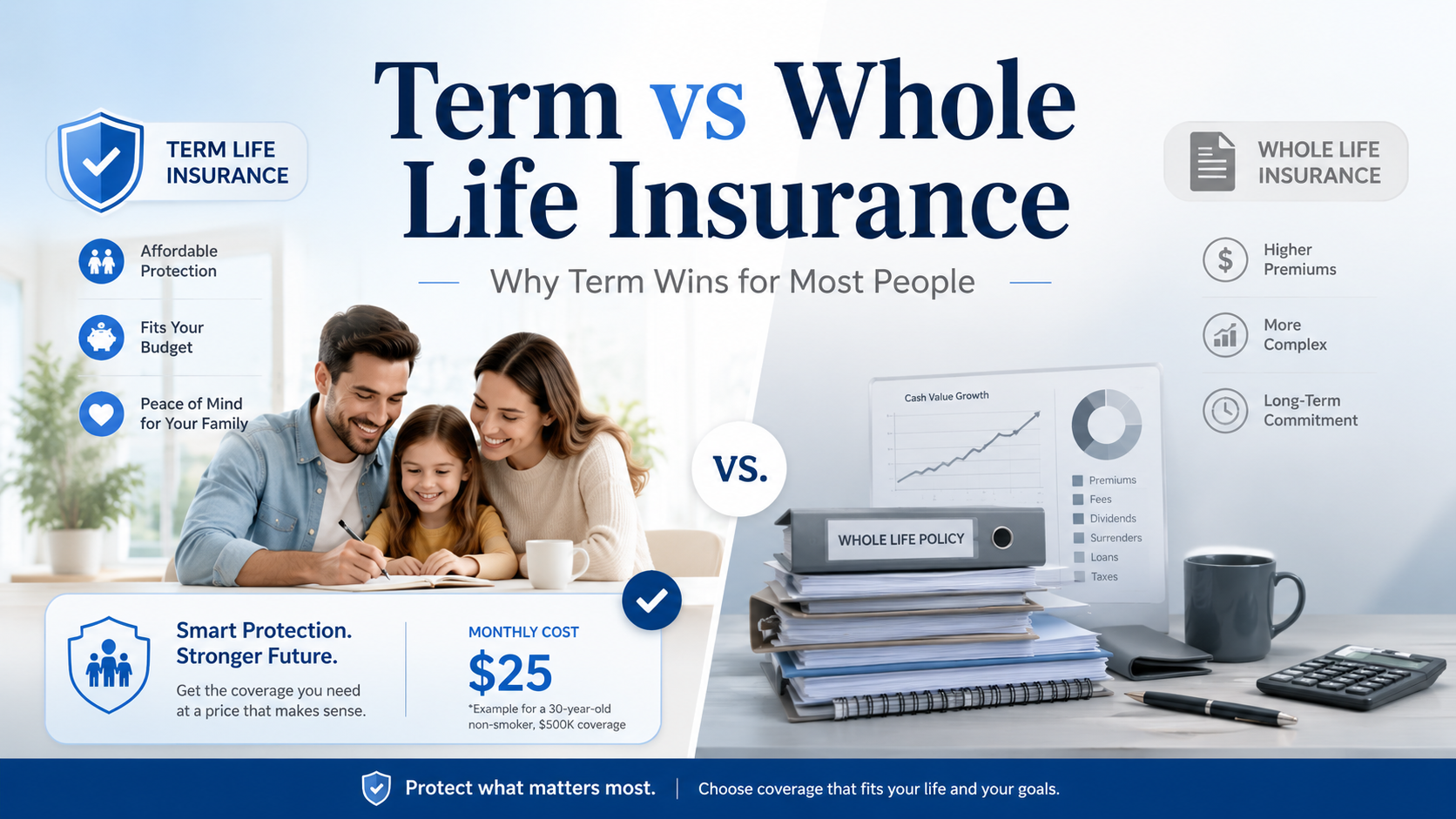
Quick answer: Term life insurance covers you for a set period (10, 20, or 30 years) at a low, fixed price, and it's the right fit for the vast majority of people protecting their income, mortgage, or kids. Whole life costs 5 to 15 times more for the same payout. For most California families, term is the smarter buy.
Table of contents
- Term vs whole life insurance at a glance
- How term life insurance works
- What whole life insurance actually is
- Cost: why term gives you more coverage per dollar
- Why term is the right call for most people
- A simple plan to get covered
- Frequently asked questions
You want your family to be okay if something happens to you. That's the whole reason you're reading this. The trouble is that life insurance comes in two big flavors, term and whole life, and the people who push the expensive one tend to be the loudest. So let's be straight with you up front.
This guide breaks down term vs whole life insurance in plain English, and it doesn't bury the answer. For most people, term life insurance is the better buy by a wide margin. Here's what each one does, what it costs, and why term protects your family for a fraction of the price.
Term vs whole life insurance at a glance
Term life insurance gives you coverage for a fixed number of years and pays out if you die during that window. Whole life insurance covers your entire life and bundles in a slow-growing savings account called cash value, which is the main reason it costs so much more. That's the core split: temporary and affordable versus permanent and expensive.
Here's the side-by-side:
| Feature | Term life | Whole life |
|---|---|---|
| Coverage length | Set term (10–30 yrs) | Entire life |
| Monthly cost | Low (from $9/mo) | Often 5–15x higher |
| Cash value | None | Yes, builds slowly |
| Best for | Most families: income, mortgage, kids | A narrow set of estate-planning cases |
For the everyday goal of protecting your income and the people who count on it, term life insurance does the job for less. Whole life solves a much narrower problem than its sales pitch suggests.
Good to know: California regulates life insurance through the California Department of Insurance. As of 2026, your term life rate depends mostly on your age, health, and the coverage amount you choose, so locking in young and healthy is where the real savings live.
Still figuring out which type you need?
No pressure to decide today. That's what Fig is for. Explore your term life options and get straight answers in plain English before you commit to anything.
How term life insurance works
Term life insurance is the simple one, and simple is exactly what you want here. You pick a coverage amount and a term length, you pay a fixed monthly premium, and if you pass away during that term, your beneficiaries (the people you name) receive the payout tax-free. Outlive the term and the policy just ends.
That simplicity is the strength. There's no investment account bolted on, no cash value to track, no moving parts a salesperson can hide fees inside. You're buying pure protection for the years your family leans on your income most: while the mortgage is still big and the kids are still home.
Most people match the term to a real obligation. A 30-year-old in San Diego with a new house and a baby often picks a 30-year term so the coverage lasts until the mortgage is gone and the kids are grown. Clean, predictable, and affordable.
What whole life insurance actually is
Whole life insurance is permanent coverage that never expires as long as you keep paying. Part of every premium buys the death benefit, and part funnels into a cash value account that grows slowly. You can borrow against that cash value later or surrender the policy for it.
There are real, narrow cases where it fits: a lifelong dependent who will always need support, a large estate with tax concerns, or someone who has already maxed out other tax-advantaged savings and wants another vehicle. If that's genuinely you, it's worth a real conversation with a licensed advisor.
But for most families, the cost is the dealbreaker, and the cash value crawls in the early years. The money you'd pour into whole life premiums usually does more for you in a plain retirement account. The honest version: anyone who tells you whole life is always better is often paid more to sell it.
Cost: why term gives you more coverage per dollar
Term life insurance costs a fraction of whole life because it has no cash-value component and no permanent payout obligation. The insurer is only on the hook if you die during a set window, so the math is cheaper for them and for you. At Yesfig Insurance, term life starts at $9/mo, though your real rate depends on your age, health, and coverage amount.
Whole life can run 5 to 15 times more for the same death benefit. Sit with that for a second. For the price of one whole life policy, you could often buy a much larger term life policy and invest the difference, ending up with more protection now and more money later.
Key takeaways
- Term is cheaper because you're buying temporary, pure protection with no savings account attached.
- The same dollars buy a far bigger death benefit with term than with whole life.
- Whole life fits only a narrow set of lifelong or estate-planning needs.
- For most California families protecting income or a mortgage, term is the clear winner.
Want to see how your current coverage stacks up?
Already have a policy and not sure it fits? Yesfig reviews what you've got, maps the gaps, and shows you where you can improve price or coverage. Compare your term life coverage in a few minutes.
Why term is the right call for most people
If your goal is to replace your income, cover the mortgage, or make sure your kids are provided for until they're independent, term life insurance gives you the most protection for the least money. That covers the situation the vast majority of buyers are actually in. Buy a generous term policy, invest what you'd have overpaid on whole life, and you come out ahead on both protection and savings.
The "buy term and invest the difference" approach isn't a gimmick. It's the same reasoning a fee-only financial planner would walk you through. Term handles the years your family is financially exposed, and your retirement accounts handle the long game, each tool doing the job it's best at.
So unless you have a specific, lifelong reason to pay for permanent coverage, term vs whole life insurance isn't a close call. Term wins for most people, and it wins on the thing that matters most: protecting your family without straining your budget.
A simple plan to get covered
You don't need to overthink this. Three steps:
- Get a term life quote in minutes so you see a real number, not a guess.
- Compare your options with Fig, who can walk you through term length and coverage amount in plain language.
- Lock in your rate while you're young and healthy, since premiums only climb with age.
Worth noting: term life and accidental death coverage from Yesfig Insurance are currently available in California only. If you're a California resident, you're in exactly the right place.
Without coverage, a single unexpected loss can turn into a financial weight your family carries for years. That's the quiet stake here, and it's exactly what an affordable term life policy is built to lift.
Frequently asked questions
Is term or whole life insurance better?
For most people, term life insurance is the better choice because it offers far more coverage per dollar. Whole life is better only in narrow cases, like estate planning or covering a lifelong dependent. If your goal is protecting your income or mortgage, term almost always wins on value.
What happens when term life insurance expires?
When your term ends, coverage stops and there's no payout. Many policies let you renew or convert to permanent coverage, though at a higher rate. The smart move is choosing a term that matches your obligations, so it lasts exactly as long as your family actually needs it.
Does term life insurance build cash value?
No, term life insurance does not build cash value, and that's a feature, not a flaw. You pay only for the death benefit, which is why it costs so much less. Most experts suggest buying term and putting the savings into a separate retirement account.
How much does term life insurance cost in California?
Term life insurance from Yesfig Insurance starts at $9 per month, though your actual rate depends on your age, health, coverage amount, and term length. Younger, healthier applicants pay the least, so locking in a rate early generally saves you real money over the life of the policy.
Should I ever choose whole life over term?
Whole life can make sense if you have a lifelong dependent, a large estate with tax concerns, or you've already maxed out other tax-advantaged savings. For most families, though, term life delivers more protection for less. A licensed advisor can help you confirm which situation you're actually in.
The bottom line
For most California families, term life insurance delivers the protection you actually need at a price that fits your budget, while whole life serves only a small set of lifelong and estate-planning cases. Match the policy to the obligation you're protecting and the answer usually gets obvious: term, for most people. Picture not having to worry about it again. That's what good coverage buys you, peace of mind, handled.
Ready to protect your family?
Get a term life insurance quote in minutes with Yesfig Insurance, a brand of Focus Insurance Group based in Los Angeles. Coverage starts at $9/mo, and a licensed advisor is there whenever you want a human in the loop.
About the Author

Mathew Bahadori
CEO, Yesfig Insurance
Leading the company’s mission to make insurance more accessible, modern, and customer-focused. With a passion for innovation and personalized service, he continues to help individuals and families find smarter coverage solutions for life, auto, home, health, and business insurance.