
July 30, 2026
How to Estimate How Long Your Family Needs Term Coverage
10, 20, or 30 years? Learn how to estimate the right term life insurance length by matching it to your kids, your mortgage, and your retirement.
How to Estimate How Long Your Family Needs Term Coverage
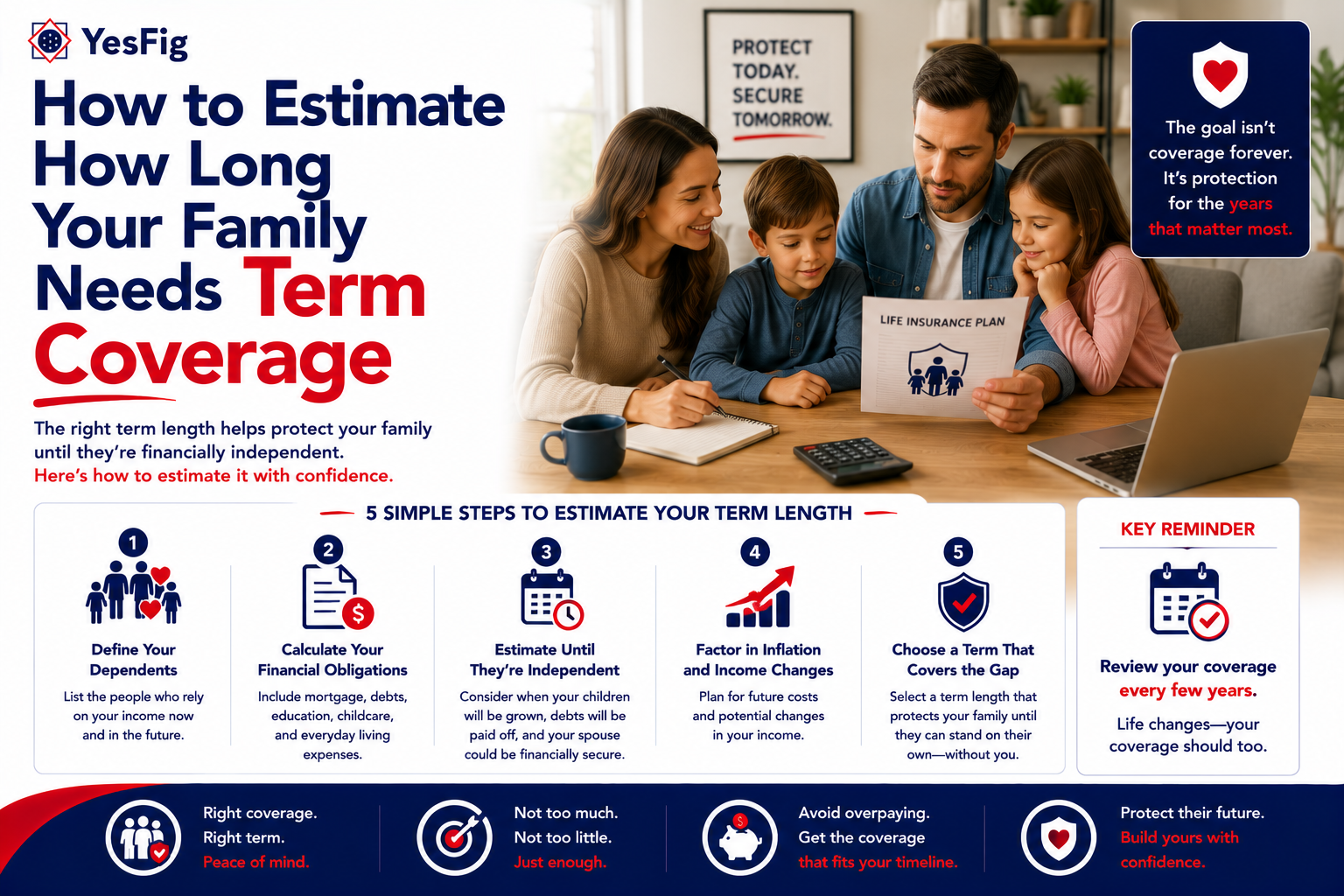
Quick answer: To estimate how long your family needs term coverage, match your term length to how long they financially depend on you. Identify when your major obligations end: your youngest child becoming independent, your mortgage being paid off, and your retirement. Take the longest of these, then round up to the next term. Err slightly long to avoid a coverage gap.
Table of contents
- Why term length matters more than you think
- How to figure out your term life insurance length
- The three milestones that set your term
- Choosing the right term life insurance length
- What California families should know
- How to lock in the right term length
- Frequently asked questions
Diego, a new dad in Sacramento, knew he needed term life insurance but froze at the first real choice: a 20-year term or a 30-year one. The premiums differed, and he had no framework for deciding. That's a common sticking point, and getting it right matters, because your term life insurance length determines whether your coverage is there for as long as your family actually needs it.
The decision is more logical than it feels once you know what to measure. Here's why the length matters, how to estimate the right one for your family, and how to choose with confidence.
Deciding how long your coverage should last?
That's exactly the right question. Fig can walk you through the calculation and show you what term life in California costs at different lengths, with no pressure to buy.
Why term length matters more than you think
Term life covers you for a set number of years, commonly 10, 15, 20, 25, or 30, and then ends. The goal is to have coverage that lasts exactly as long as your family financially depends on you, no more and no less. Too long, and you pay for years you don't need. Too short, and the coverage runs out while your family still needs it.
That second risk is the serious one. If your term ends while you still have dependents or a mortgage, you'd have to buy a new policy at an older age and possibly worse health, which costs more or may not be possible at all. So the length isn't a minor detail, it's what determines whether your protection is actually there when it counts, which is exactly what Diego needed to nail down.
How to figure out your term life insurance length
The method is straightforward: figure out when each of your major financial obligations ends, then choose a term that covers the longest of them. You're finding the point in the future where your family would no longer be financially derailed by losing you.
Three obligations usually drive the answer, and you simply take whichever stretches furthest out. Map each one to a number of years from today, compare them, and the largest number is your minimum term. Then you round up to an available length. A term life policy is easy to size once you've done this quick exercise, and it turns a guess into a calculation.
The three milestones that set your term
Here are the milestones to measure. First, your youngest child's independence. Count the years until your youngest can support themselves, often around age 22 to 25 if you want to cover them through college. A newborn might mean 22 to 25 years; a 10-year-old, around 12 to 15.
Second, your mortgage payoff. Count the years left on your mortgage, since you want coverage at least until the home is paid off. Third, your retirement. Estimate the years until you retire, because by then your savings and retirement accounts ideally replace your income, so your family no longer relies on it. Take the longest of the three. For example, a new parent with a newborn (about 24 years), 28 years left on a mortgage, and retirement in 25 years would take the 28-year figure and choose a 30-year term.
Want help matching a term to your timeline?
That's a quick conversation. Yesfig can help you translate your milestones into the right term length and benefit. Compare Yesfig term life in a few minutes.
Choosing the right term life insurance length
Once you have your longest need, choosing is simple, with one rule: when your number falls between two available terms, round up. If your longest obligation is 22 years and the options are 20 or 25, choose 25, since a small gap at the end could leave you exposed right when a shorter term expires.
Good to know: When your longest need falls between two term lengths, round up. A term that's a little too long costs slightly more but locks in your rate and avoids having to requalify at an older age, or worse health, if you still need coverage when a shorter term ends.
A longer term costs a bit more per year, but it locks in your rate for longer and protects you if your health changes, which is usually worth the modest difference. Two other options can help. Laddering means buying more than one policy, such as a 30-year policy for your mortgage alongside a 20-year policy for your child-rearing years, so your coverage shrinks as your needs do and you save money. And a convertible term lets you extend or convert later if you're unsure, giving you flexibility without guessing.
What California families should know
California's cost of living shapes this decision. High housing costs here often mean larger, longer mortgages, which can push your term length out, since you'll want coverage until that bigger mortgage is paid off. Sizing both your term and your benefit to California obligations matters.
Term life is the coverage Yesfig offers to California residents, and it's priced to make a longer, safer term affordable. Every policy also comes with a free look period, generally at least 10 days, so you can review the term you chose and adjust if needed. And it's worth reassessing your coverage after big life changes, like a new child or a new home. Yesfig Insurance, a Los Angeles-based brand of Focus Insurance Group, offers term life across California.
Key takeaways
- Match your term length to how long your family depends on you financially.
- Measure three milestones: youngest child, mortgage payoff, and retirement.
- Take the longest of the three, then round up to the next available term.
- Err slightly long, since a too-short term risks requalifying at an older age.
How to lock in the right term length
Turn the estimate into a decision in three steps:
- List your milestones and take the longest. Count the years to your youngest child's independence, your mortgage payoff, and your retirement, and use the largest number.
- Round up to the next term. Choose the next available length above your number, so you're never left with a gap.
- Buy convertible if you're unsure. A convertible term gives you room to adjust later, and consider laddering to save if your needs decline over time.
Do that and your coverage lasts exactly as long as your family needs it. For more plain-English coverage guidance, the Yesfig blog breaks it down without the jargon.
Frequently asked questions
How long should my term life insurance be?
Long enough to cover the years your family financially depends on you. Measure three milestones: when your youngest child becomes independent, when your mortgage is paid off, and when you retire and your assets replace your income. Take the longest of those, then round up to the next available term length so there's no gap.
Is a 20 or 30 year term life policy better?
It depends on your longest financial obligation. A 30-year term suits new parents with young children and a long mortgage, since it covers them through independence and payoff. A 20-year term fits families whose kids are older or whose mortgage has fewer years left. Choose based on which obligation stretches furthest out.
What happens if my term life insurance ends and I still need coverage?
You'd need to buy a new policy, but at your older age and current health, which usually means a higher premium, and it may be harder to qualify. This is why erring slightly long is wise. A convertible term also lets you convert to permanent coverage later without a new medical exam.
Should I match my term life policy to my mortgage?
Your mortgage is one of the three milestones to consider, and you want coverage at least until it's paid off. But it's not the only factor. Also weigh how long until your youngest child is independent and until you retire. Take whichever of these stretches furthest out as your minimum term length.
What is laddering term life insurance?
Laddering means buying more than one term policy of different lengths so your total coverage decreases as your needs decline. For example, a 30-year policy for your mortgage plus a 20-year policy for your child-rearing years. When the shorter policy ends, your coverage drops to match your reduced needs, which can save money over one large policy.
Choosing a term length is really about knowing when your family stops depending on your income. Diego mapped his newborn's timeline, his mortgage, and his retirement, saw that his mortgage stretched furthest, and chose a 30-year term that covers all three with room to spare. Measure your milestones, take the longest, and round up, and your coverage will be there for exactly as long as it's needed.
Ready to choose the right term for your family?
Get a term life quote in minutes with Yesfig. Coverage in California starts at $9/mo, and a licensed advisor can help you match your term length and benefit to your family's timeline. Coverage that lasts exactly as long as you need it.
About the Author

Mathew Bahadori
CEO, Yesfig Insurance
Leading the company’s mission to make insurance more accessible, modern, and customer-focused. With a passion for innovation and personalized service, he continues to help individuals and families find smarter coverage solutions for life, auto, home, health, and business insurance.