June 4, 2026
The Real Cost of Switching Car Insurance Mid-Term
Switching car insurance mid-term? Here's what it really costs in California, which fees are a myth, and how to switch without a coverage gap.
What Switching Car Insurance Mid-Term Actually Costs You
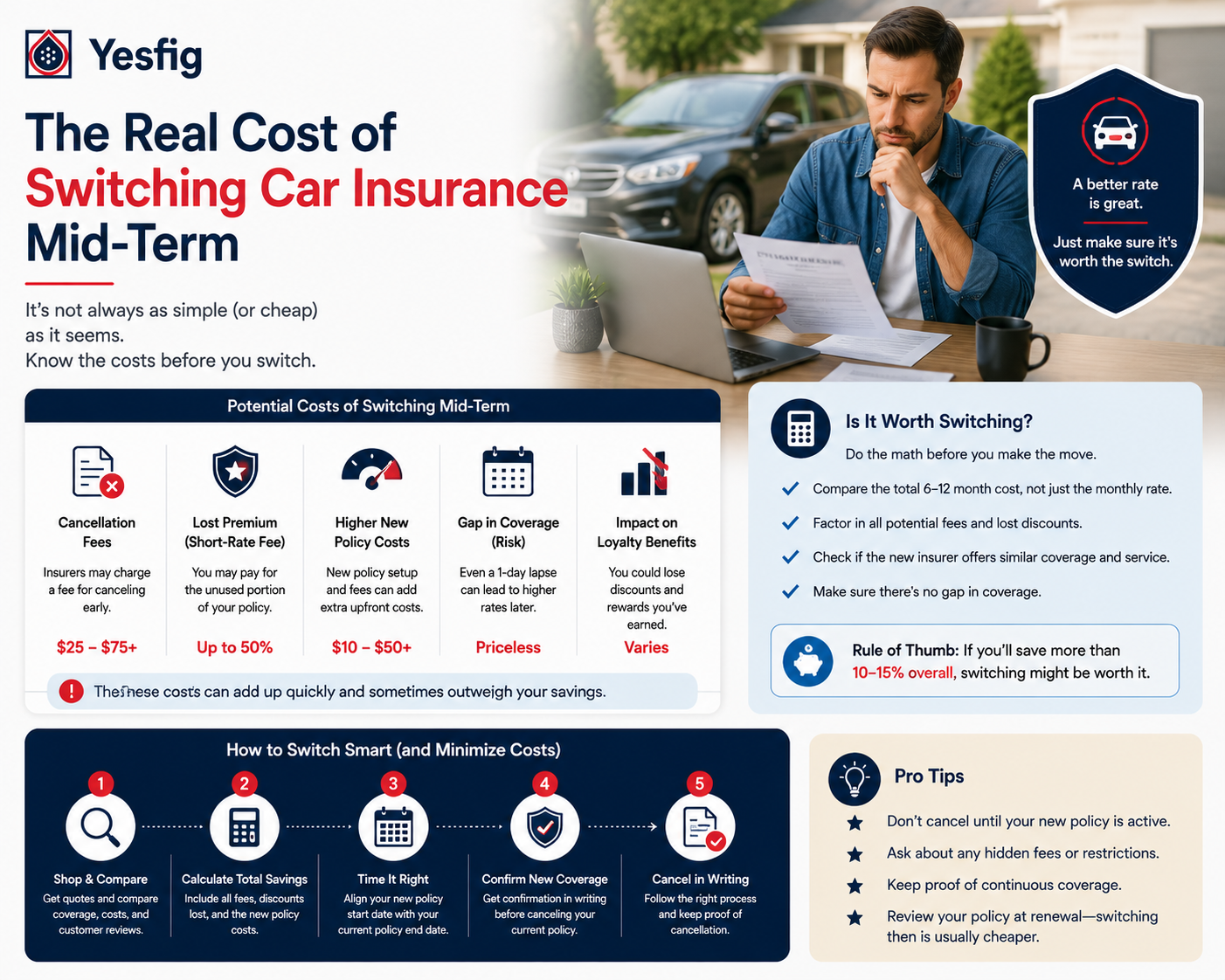
Quick answer: You can switch car insurance any time, not just at renewal. In California, the real cost is usually small: maybe a modest cancellation fee, offset by a prorated refund on the premium you already paid. The bigger danger is a coverage gap, so line up your new policy before you cancel the old one.
Table of contents
- Can you switch car insurance before your renewal date?
- What switching car insurance mid-term really costs
- The myth that keeps you overpaying
- The one real risk: a coverage gap
- How to switch car insurance mid-term without a gap
- When switching mid-term is worth it
- Frequently asked questions
- The bottom line
You're pretty sure you're overpaying for car insurance. A friend mentioned a better rate, or you saw a quote that was forty bucks cheaper a month. But your policy doesn't renew for another five months, and a little voice in the back of your head says: just wait it out, switching now will cost you more than it saves.
That voice is the villain of this whole story. The assumption that switching car insurance mid-term is expensive, complicated, and not worth the trouble is exactly what keeps drivers locked into overpriced policies for months longer than they need to be. So let's look at what switching mid-policy actually costs, in real dollars, right here in California.
Can you switch car insurance before your renewal date?
Yes. You can cancel and switch car insurance at any point in your policy term, not only at renewal. There's no law and no industry rule that locks you in until your renewal date rolls around.
Your policy is a six-month or month-to-month agreement you paid for, and you're allowed to end it early. The renewal date matters for shopping convenience, not for permission. So why does staying put feel mandatory? Because the villain thrives on inertia. The longer you assume you can't move, the longer you keep paying a rate you'd never sign up for today.
Not sure switching is even worth it for you?
No pressure, and no quote required yet. Fig can walk you through how mid-term switching works and what to check before you do anything. See how car insurance works at Yesfig and get plain-English answers first.
What switching car insurance mid-term really costs
For most California drivers, the real out-of-pocket cost of switching mid-term is small, and sometimes it's zero. Here's what can actually show up:
- A cancellation fee. Some insurers charge a small flat fee or a short-rate penalty (a few percent of the unused premium) for ending early. Many charge nothing at all. Check your declarations page or ask your current carrier.
- A new down payment. Your new policy may want the first month or a deposit up front, which can sting in the same week you're still waiting on a refund.
- A lost loyalty discount. If you've been with one carrier for years, you might give up a longevity perk. Weigh it against the lower rate you're moving to.
The part people forget is the refund. When you cancel mid-term, you don't forfeit the premium you already paid for coverage you won't use.
Good to know: In California, insurers must refund the unearned portion of your premium when you cancel mid-term. If you prepaid six months and cancel after two, you get roughly the remaining four months back, minus any short-rate fee your contract spells out.
Before you guess at the numbers, it's worth running a fresh quote so you can see the real spread. You can compare California car insurance rates in a few minutes and put an actual figure on what staying put is costing you.
The myth that keeps you overpaying
The single biggest cost of switching mid-term isn't a fee. It's the months of inflated premiums you pay while you talk yourself out of switching.
Picture the math. Say you're overpaying by $40 a month and your renewal is five months away. Waiting "to keep it tidy" costs you $200, far more than any cancellation fee a carrier is likely to charge. The villain's whole trick is making a $15 fee feel scarier than a $200 slow leak.
The other half of the myth is that switching is a paperwork nightmare. It isn't. Getting a quote takes minutes, and a licensed advisor can step in if you'd rather not handle the handoff yourself. Yesfig Insurance, a brand of Focus Insurance Group based in Los Angeles, built its process around this exact moment: review what you have, map the gaps, and make the switch boring.
If you want to see how that plays out in practice, the Yesfig insurance blog breaks the review-and-switch process down step by step.
Key takeaways
- You can switch car insurance any time, not just at renewal.
- The real fees are usually small or zero, and you get a prorated refund on unused premium.
- The costliest mistake is waiting, since overpaying month after month beats any cancellation fee.
- Never cancel your old policy until the new one is active.
Curious how your current policy actually stacks up?
Yesfig reviews the coverage you already have, flags where you're overpaying or underprotected, and lays it out side by side. Check your car insurance against a fresh quote and see the real difference in a few minutes.
The one real risk: a coverage gap
There's one cost that's genuinely serious, and it has nothing to do with fees: a coverage gap. A gap happens when your old policy ends before your new one begins, leaving you uninsured for a day, an hour, even a few minutes.
In California, driving uninsured is illegal, and even a short lapse can push your future rates up, because carriers read any break in coverage as added risk. This is the part of switching worth taking seriously. Not because switching is dangerous, but because sloppy timing is. The fix is simple, and it's the next section.
How to switch car insurance mid-term without a gap
Switching cleanly comes down to three steps, in this order:
- Quote and ready the new policy first. Lock in the coverage and the price, with a start date you choose, before you touch the old policy.
- Set the new policy's effective date to begin the same day your old one ends (or overlap by a day for a buffer). Never leave a gap between them.
- Cancel the old policy once the new one is active, and request your prorated refund in writing.
That's the whole plan. Do it in that order and you're never uninsured, not even for an afternoon.
When switching mid-term is worth it
Switching mid-term is worth it whenever the savings over your remaining term beat the cost of leaving. A few clear green lights:
- Your rate jumped at the last renewal and you never shopped it.
- Your situation changed (you moved, paid off the car, improved your credit, dropped a driver) in a way that should lower your rate.
- You found a quote that's meaningfully cheaper for the same coverage, not less.
A couple of times to pause: if you're mid-claim, or your renewal is only a week or two away, it's often cleaner to wait it out. Bundling can tip the math too. If you rent your place, pairing auto with California renters insurance sometimes trims enough off both premiums to make the switch obvious.
Frequently asked questions
Will I get charged a fee for canceling car insurance early?
Maybe a small one. Some California insurers charge a flat cancellation fee or a short-rate penalty worth a few percent of your unused premium, while many charge nothing. Check your declarations page or call your carrier. Either way, the fee is almost always smaller than what you save by switching to a lower rate.
Do I get money back if I switch car insurance mid-term?
Usually yes. In California, your insurer refunds the unearned portion of any premium you prepaid. If you paid six months upfront and cancel after two, you get roughly four months back, minus any short-rate fee in your contract. The refund typically arrives within a few weeks.
Will switching car insurance mid-term raise my rates?
Switching itself does not raise your rates. A coverage gap can, because carriers treat any lapse as added risk. As long as your new policy starts before the old one ends, there's no lapse and no penalty. Shopping more often usually lowers what you pay, not the reverse.
How long does it take to switch car insurance?
Often just a day. Getting a quote and binding a new policy can take minutes online, and you pick the start date. The slowest part is usually canceling the old policy and waiting on your refund, which can take a few weeks to fully process.
Can I switch car insurance if I have an open claim?
You can, but it's often worth waiting. Your current insurer keeps handling the open claim even after you cancel, but switching mid-claim can complicate records and timing. Once the claim is settled, you'll have a clearer picture and a smoother move to your new carrier.
The bottom line
The real cost of switching car insurance mid-term is almost never the fee you're afraid of. It's the money you quietly lose every month you wait. Beat the villain by checking your rate today, lining up the new policy before you cancel the old one, and keeping the difference. Picture not thinking about it again: covered, paying a fair price, free to just drive.
Ready to stop overpaying?
Get a car insurance quote with Yesfig in minutes. Coverage starts around $30/mo, you keep the same protection or better, and a licensed advisor is there if you want a human to handle the switch. No gap, no guesswork.
About the Author

Mathew Bahadori
CEO, Yesfig Insurance
Leading the company’s mission to make insurance more accessible, modern, and customer-focused. With a passion for innovation and personalized service, he continues to help individuals and families find smarter coverage solutions for life, auto, home, health, and business insurance.