
July 1, 2026
How to Switch Pet Insurance Carriers Without Losing Coverage
Switching pet insurance is easy, but existing conditions may not come with you. Learn how to switch pet insurance without a coverage gap and what you keep.
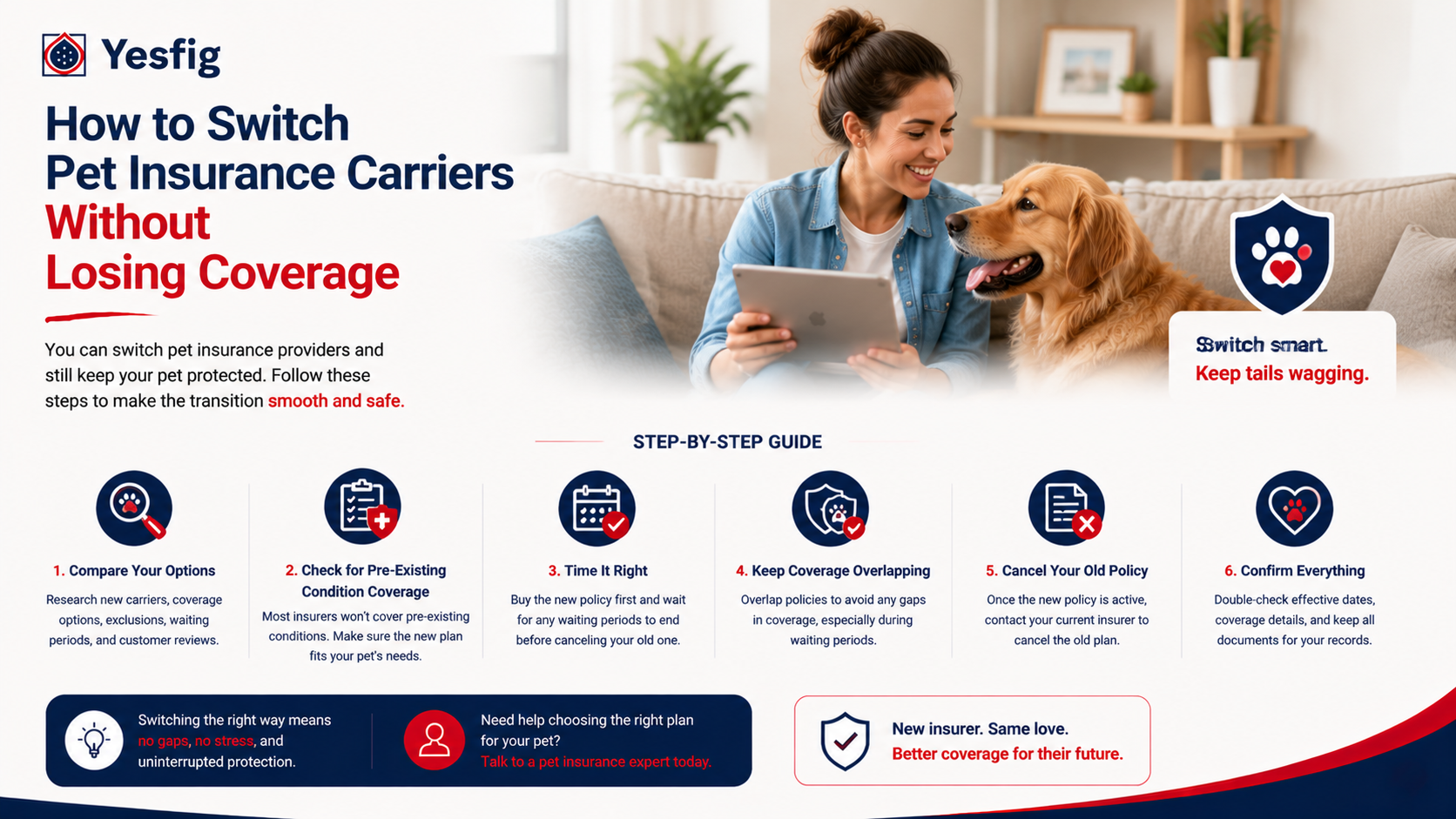
How to Switch Pet Insurance Carriers Without Losing Coverage
Quick answer: You can switch pet insurance carriers without a coverage gap by enrolling in the new policy and clearing its waiting periods before canceling the old one. The catch is pre-existing conditions: any illness your pet developed under the old plan will likely be excluded by the new insurer, so switching is easiest when your pet is healthy.
Table of contents
- Why switching pet insurance is trickier than it looks
- What you keep and what you lose when you switch
- How to switch pet insurance without a coverage gap
- How to compare carriers before you switch
- What California pet owners should know
- The smart way to switch pet insurance
- Frequently asked questions
Tess's pet insurance premium jumped at renewal, and her 3-year-old dog Pixel is perfectly healthy, so she started shopping for a better deal in Sacramento. Then she hit the question that stops a lot of owners: if she switches, does she risk losing coverage her pet already has? Knowing how to switch pet insurance the right way is what keeps a smart money move from becoming a costly mistake.
For a healthy pet like Pixel, switching is refreshingly low-risk. For a pet with existing conditions, it takes more care. Here's exactly what transfers, what doesn't, and how to make the move without leaving your pet uncovered for a single day.
Why switching pet insurance is trickier than it looks
Canceling one policy and starting another sounds simple, and mechanically it is. The complication is that your new insurer treats your pet as a brand-new applicant. Anything your pet has been diagnosed with or treated for becomes a pre-existing condition under the new policy, which usually means it's excluded.
That's the heart of the issue. If your pet developed, say, an allergy or a joint problem while on your old plan, the old insurer covered it, but a new insurer generally won't. Switching doesn't carry your pet's history with it, so the coverage you built up for existing conditions can disappear the moment you change carriers.
Thinking about switching but not sure what you'd lose?
That's the right question to ask first. Fig can explain exactly how a new policy would treat your pet's history and show you what Yesfig pet coverage includes, with no pressure to switch.
What you keep and what you lose when you switch
Whether switching makes sense comes down to your pet's health. If your pet is young and healthy with no diagnosed conditions, there's essentially nothing to lose, since there are no existing conditions to carry over. Tess and Pixel fall squarely in this camp, which makes shopping for a better price an easy call.
If your pet has developed a condition, the math changes. Switching can mean losing coverage for that condition permanently, because the new insurer will treat it as pre-existing. In that case, weigh the savings or better service against what you'd give up. Sometimes staying put, even at a higher price, protects coverage that's worth more than the difference.
How to switch pet insurance without a coverage gap
Once you've decided to switch, timing is everything. The golden rule is to get your new policy active before you cancel the old one. If you cancel first and there's a gap, an injury or illness during that window could be covered by neither insurer.
There's a second layer: your new policy has its own waiting periods, often a few days for accidents and around two weeks for illness, sometimes longer for specific conditions. Your pet isn't covered for new issues until those clear. So the safe sequence is to enroll in the new plan, let its waiting periods pass, confirm it's fully active, and only then cancel the old one.
Good to know: Never cancel your old policy until the new one is active and past its waiting periods. Overlapping the two for a short stretch costs a little extra, but it guarantees your pet is never left uncovered during the switch.
How to compare carriers before you switch
A better price only matters if you're comparing the same thing. When you evaluate a new carrier, line up the reimbursement percentage, the annual deductible, and the annual coverage limit, since a cheaper premium can hide a lower payout when you actually claim.
Also read the fine print on waiting periods and exclusions, especially how the new insurer defines pre-existing and whether it ever covers curable conditions again. Then compare the total picture, not just the monthly cost. You can compare a Yesfig pet insurance plan against your current one on coverage and price before you commit to anything.
Want to see how a new plan stacks up?
A quick comparison shows you the real difference. Yesfig lines up coverage, reimbursement, and price next to your current policy so you can tell if switching is actually worth it. Compare pet insurance options in a few minutes.
What California pet owners should know
California gives you a helpful edge when comparing. State law requires pet insurers to clearly disclose how they define and handle pre-existing conditions and waiting periods, so the exact terms you need to evaluate a switch have to be spelled out in the policy. Read those disclosures closely before you move.
That transparency makes it easier to confirm what a new plan would and wouldn't cover for your pet. If your pet is healthy and you're mainly after a better rate or better service, switching in California is straightforward. Yesfig Insurance, a Los Angeles-based brand of Focus Insurance Group, offers pet coverage across California, and the terms are laid out up front.
Key takeaways
- Switching resets your pet's history, so existing conditions usually become pre-existing.
- Switching is low-risk for a healthy pet and higher-risk for one with conditions.
- Keep the old policy until the new one is active and past its waiting periods.
- Compare reimbursement, deductible, and limits, not just the monthly premium.
The smart way to switch pet insurance
Here's the whole move in three steps:
- Check what you'd lose. Confirm which of your pet's conditions, if any, would become pre-existing with a new insurer.
- Compare full coverage, then enroll. Match reimbursement, deductible, and limits, sign up for the new plan, and let its waiting periods clear.
- Cancel the old policy last. Only end your old coverage once the new one is fully active.
Follow that order and you switch on your terms, with no gap and no surprises. For more on choosing pet coverage, the Yesfig blog breaks down the details without the jargon.
Frequently asked questions
Can I switch pet insurance without losing coverage?
You can switch without a coverage gap by timing it right, but any conditions your pet already has usually won't transfer. The new insurer treats existing conditions as pre-existing and typically excludes them. If your pet is healthy with no diagnosed conditions, there's nothing to lose, so switching is low-risk.
Will I lose coverage for pre-existing conditions if I switch pet insurance?
Most likely, yes. When you switch, the new insurer treats any condition your pet was diagnosed with or treated for as pre-existing, and usually excludes it. Your old policy may have covered it, but that coverage doesn't carry over. This is the main reason to think twice before switching a pet with existing conditions.
How do I avoid a gap when switching pet insurance?
Enroll in the new policy and let its waiting periods pass before you cancel the old one. Keeping both active for a short overlap ensures your pet is never uninsured during the transition. If you cancel first, an accident or illness in the gap could be covered by neither insurer, so always switch in that order.
What should I compare before switching pet insurance carriers?
Compare the reimbursement percentage, the annual deductible, and the annual coverage limit, since a lower premium can mean a smaller payout. Also check the waiting periods and how each insurer defines pre-existing conditions. Look at the total value, not just the monthly cost, so you know exactly what you're getting.
Is it worth switching pet insurance if my pet is healthy?
Often, yes. A healthy pet with no diagnosed conditions has nothing to lose in a switch, since there are no existing conditions to carry over. If a new carrier offers a better price, better reimbursement, or better service, switching can be a clear win. Just time it so there's no gap in coverage.
Switching carriers doesn't have to mean gambling with your pet's coverage. Because Pixel is healthy, Tess compared plans on full coverage, enrolled with a new carrier, waited out the waiting periods, and only then canceled her old policy, landing a better rate with zero gap. Know what transfers and time the move well, and you keep your pet protected the whole way through.
Ready to compare a better pet plan?
Get a pet insurance quote in minutes with Yesfig. Coverage in California starts at $9/mo, and a licensed advisor can help you compare coverage, time the switch, and avoid any gap. Better protection, no guesswork.
About the Author

Mathew Bahadori
CEO, Yesfig Insurance
Leading the company’s mission to make insurance more accessible, modern, and customer-focused. With a passion for innovation and personalized service, he continues to help individuals and families find smarter coverage solutions for life, auto, home, health, and business insurance.