
July 20, 2026
How to Switch Life Insurance Carriers Without Losing Coverage
Switching life insurance is easy to get wrong. Learn how to switch life insurance without a coverage gap, and what you could lose by reapplying.
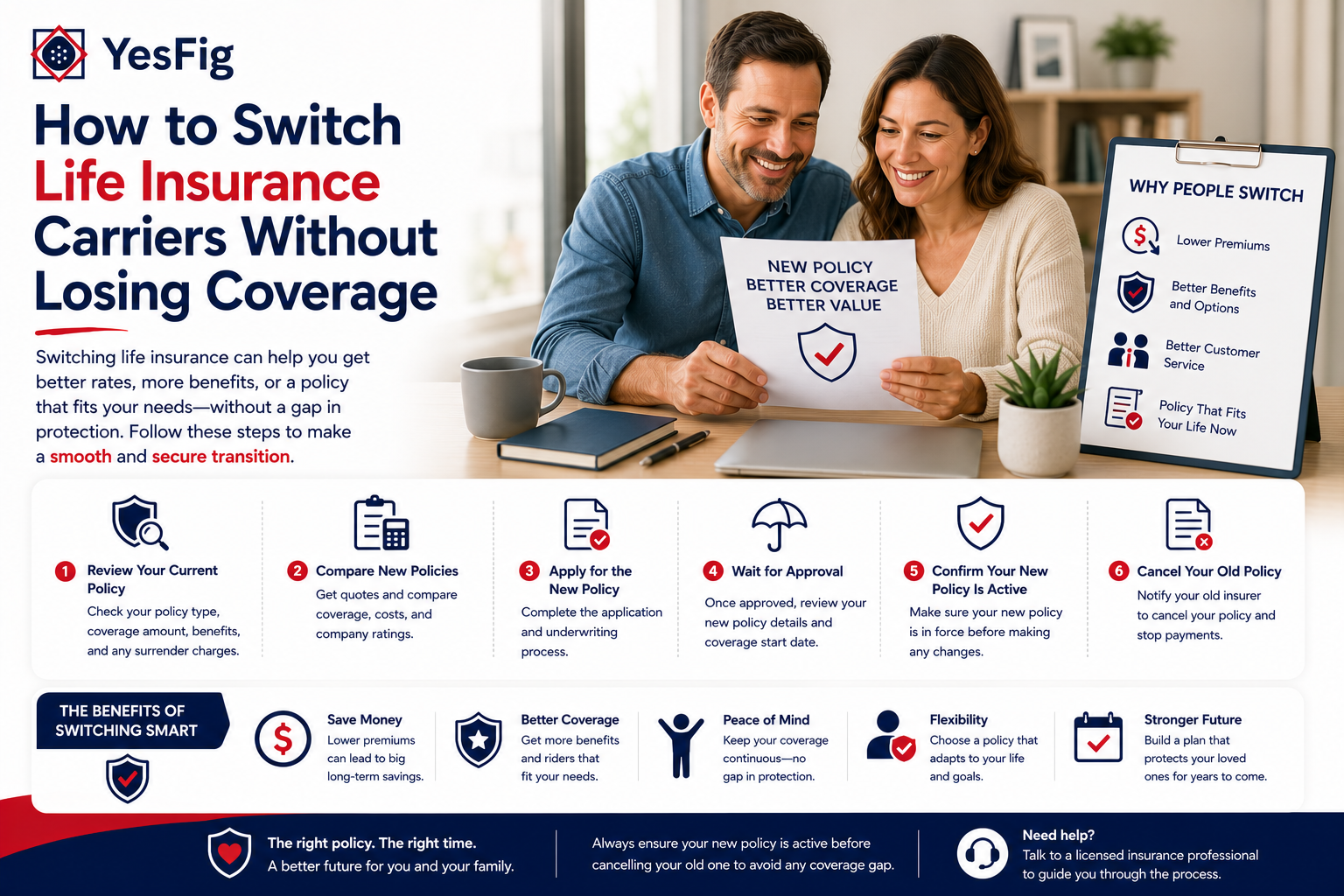
How to Switch Life Insurance Carriers Without Losing Coverage
Quick answer: To switch life insurance carriers without losing coverage, get your new policy fully approved and in force before canceling the old one, since a quote isn't a guaranteed offer until underwriting is done. Weigh what you'd give up too: if your health has declined, a new policy could cost more or deny you, so switching isn't always worth it.
Table of contents
- Why switching life insurance is different
- How to switch life insurance without a coverage gap
- What you could lose by switching
- When switching makes sense, and when to keep your policy
- What California policyholders should know
- The smart way to switch life insurance
- Frequently asked questions
Reggie quit smoking two years ago in San Diego, and he figured his term life rate should be a lot cheaper now that he's a non-smoker. He was right, and switching could save him real money. But he almost made the mistake that turns a smart move into a costly one: canceling his old policy too soon. Knowing how to switch life insurance the right way is what protects both your savings and your coverage.
Switching life insurance isn't like switching car insurance, because a new policy means reapplying and requalifying. Here's what makes it different, how to avoid a coverage gap, and the one question that decides whether switching is even a good idea.
Why switching life insurance is different
With most insurance, switching is mechanical. With life insurance, it's medical. A new policy requires underwriting, meaning you answer health questions and often take a medical exam, and your rate is based on your current age and health, not the age and health you had when you bought your original policy.
That changes everything about the process. You're not just moving an account, you're reapplying as a new applicant. If you're healthier now, like Reggie after quitting smoking, that works in your favor. If your health has declined, it can work against you. Either way, nothing is guaranteed until the new policy is actually issued, which is exactly why timing matters so much.
Thinking about switching to a better rate?
That's worth doing carefully. Fig can explain how the process works and show you what term life in California would cost you now, with no pressure to switch.
How to switch life insurance without a coverage gap
The golden rule is simple: never cancel your old policy until the new one is fully in force. That means approved, issued, and active, with your first payment made, not just quoted or applied for. Cancel too early and you could be left uninsured, or worse, uninsured after a health change that makes new coverage harder to get.
The safe sequence is to apply for the new policy, complete underwriting, get it approved and active, confirm it's in force, and only then cancel the old one. Keeping both active for a short overlap costs little and guarantees you're never without coverage. Rushing this step is the most common way a switch goes wrong.
Good to know: A quote is not an offer. Life insurance requires underwriting, so your new policy's real rate isn't set until you've completed the health questions and any exam. Never cancel your old policy based on a quote, only once the new one is approved and active.
What you could lose by switching
Even a smooth switch can cost you something, so it's worth knowing what. Your original policy locked in a rate based on how young and healthy you were when you bought it. If your health has changed since, a new policy is priced on the older, current you, which can mean a higher rate or, in some cases, a decline.
There's also a subtle reset. A new policy generally starts a fresh two-year contestability period, during which the insurer can investigate and deny a claim for a misrepresentation on your application. Your old policy may already be past that window. None of this means don't switch, it means switch for a real reason, not just a slightly lower quote that might not survive underwriting.
Want to see if switching actually pays off?
That's exactly what a real quote shows. Yesfig can price term life for you now and help you weigh it against your current policy. Compare Yesfig term life in a few minutes.
When switching makes sense, and when to keep your policy
Switching is often smart if you're still healthy and can genuinely beat your current rate, if you quit smoking or improved your health, if your term is ending and you need new coverage, or if you simply want a bigger or different policy. In those cases, requalifying works in your favor.
It's often a mistake if your health has declined, since you'd likely pay more or struggle to qualify, or if you locked in an excellent rate years ago that a new policy can't match. Sometimes the best move is keeping what you have. If you have term coverage and your health has changed, ask about a conversion option, which lets you convert to permanent coverage without a new medical exam. Some people also add an affordable accidental death policy rather than replacing their whole policy.
What California policyholders should know
California builds in some protections when you replace a life policy. Under the state's replacement rules, when you switch from one life policy to another, you're entitled to disclosures comparing the old and new coverage, so you can see clearly what you're giving up and gaining. Read those before you cancel anything.
New policies also come with a free look period, typically a couple of weeks, during which you can cancel the new policy for a full refund if you change your mind. It's a helpful safety net, but don't use it to bridge a gap. Term life is the coverage Yesfig offers to California residents, and Yesfig Insurance, a Los Angeles-based brand of Focus Insurance Group, can quote it for you before you touch your old policy.
Key takeaways
- Switching life insurance means reapplying, since a new policy requires underwriting.
- Never cancel your old policy until the new one is approved and in force.
- A quote isn't an offer, so don't cancel based on a price that underwriting could change.
- Switching can cost you a locked-in rate and restart the two-year contestability period.
The smart way to switch life insurance
Done in the right order, switching is safe and can save you money. Here's the approach in three steps:
- Apply and get approved first. Complete underwriting and get the new policy issued and active before doing anything with the old one.
- Then cancel the old policy. Once the new coverage is confirmed in force, cancel your old policy in writing.
- Update your beneficiaries. Make sure your beneficiaries are named correctly on the new policy, since they don't carry over.
Do it in that order and you switch with no gap and no surprises. For more on managing your coverage, the Yesfig blog breaks it down without the jargon.
Frequently asked questions
Can I switch life insurance without a coverage gap?
Yes, if you time it right. Apply for the new policy, complete underwriting, and get it fully approved and in force before canceling your old one. Keeping both active for a short overlap guarantees you're never uninsured. The mistake to avoid is canceling the old policy before the new coverage is confirmed active.
Should I cancel my old life insurance before getting a new policy?
No. Never cancel your old policy until the new one is approved, issued, and active. Because life insurance requires underwriting, a quote isn't a guaranteed offer, and canceling early could leave you uninsured if the new policy costs more than expected or is declined. Always let the new coverage take effect first.
Will switching life insurance cost me more?
It depends on your health and age now. Your new policy is priced on your current profile, not the one you had originally. If you've stayed healthy or improved, like quitting smoking, you may pay less. If your health has declined or you're older, you could pay more or face a decline, which is why switching isn't always worth it.
When is it a bad idea to switch life insurance?
Switching is often unwise if your health has declined since your original policy, since you'd likely pay more or struggle to qualify, or if you locked in an excellent rate years ago. In those cases, keeping your current coverage is usually better. If you have term life, a conversion option may let you keep coverage without reapplying.
Does switching life insurance restart the contestability period?
Usually, yes. A new life insurance policy generally starts a fresh two-year contestability period, during which the insurer can investigate and deny a claim for a misstatement on your application. If your old policy is already past that window, switching resets the clock. It's one more reason to switch only for a genuinely good reason.
Switching life insurance can absolutely save you money, as long as you protect your coverage while you do it. Reggie priced a non-smoker rate, got the new policy fully approved, and only then canceled his old one, pocketing real savings without a single day uninsured. Reapply first, cancel second, and switch only when the numbers and your health actually support it.
Ready to see your new rate before you switch?
Get a term life quote in minutes with Yesfig. Coverage in California starts at $9/mo, and a licensed advisor can price your coverage now and help you time the switch so you never lose a day of protection. New rate, no gap.
About the Author

Mathew Bahadori
CEO, Yesfig Insurance
Leading the company’s mission to make insurance more accessible, modern, and customer-focused. With a passion for innovation and personalized service, he continues to help individuals and families find smarter coverage solutions for life, auto, home, health, and business insurance.