June 9, 2026
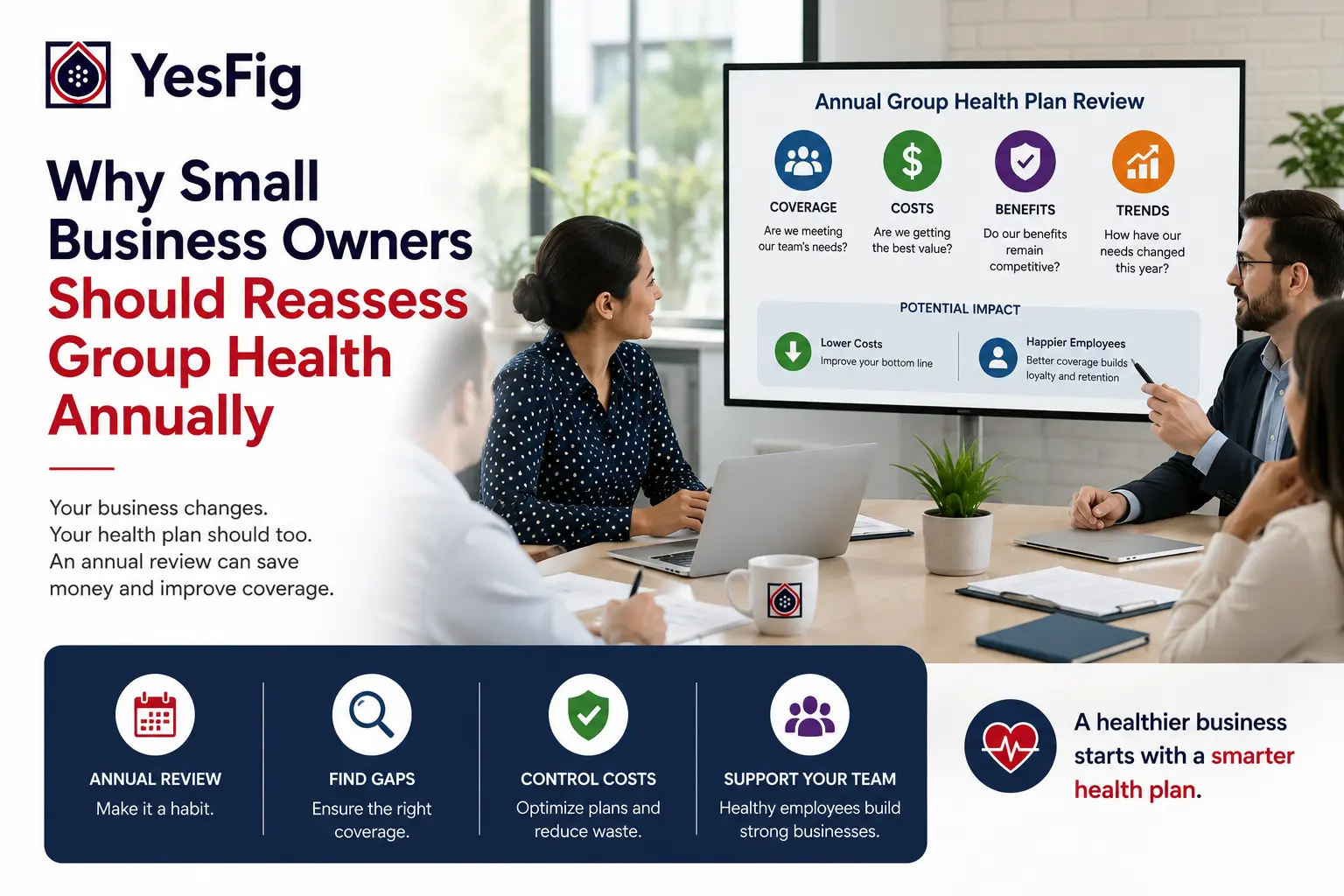
Why Small Business Owners Should Reassess Group Health Annually
Why small business group health insurance deserves an annual review: costs creep, networks shift, and your team changes. Here's what to reassess each year.
Why Small Business Owners Should Reassess Group Health Annually
Quick answer: Small business owners should reassess their group health plan every year at renewal, because premiums, provider networks, and your team's needs all shift annually. Review your renewal increase, plan design, contribution strategy, and alternatives like a different carrier or an HRA before you auto-renew the same coverage.
Table of contents
- What group health insurance is for a small business
- Why "set it and forget it" quietly costs you
- What to reassess in your small business group health insurance each year
- The signs it's time to shop your plan
- When to run your annual review
- How small business group health insurance reassessment saves money
- Frequently asked questions
Renee runs a 12-person design studio in San Diego. Every year the group health renewal lands in her inbox, the rate ticks up, and she signs off on the same plan because picking it apart sounds like a part-time job she doesn't have. It's the most common move small business owners make, and it's quietly one of the most expensive. If you treat small business group health insurance as a set-it-and-forget-it line, here's why one honest annual look pays for itself.
The plan that fit your team two years ago may be the wrong size, the wrong network, or simply overpriced today. You only find out by checking.
What group health insurance is for a small business
Group health insurance is employer-sponsored coverage you offer your employees, usually with the business paying a share of the monthly premiums and the team covering the rest. It's one of the strongest tools you have for hiring and keeping good people, especially when you're competing with larger employers.
Unlike a one-time purchase, a group plan renews every year. At each renewal, your carrier can adjust the rate, tweak the provider network, and change what prescriptions or services are covered. Your business changes too. Put those together and the plan you signed last year is rarely the best fit by the next.
That's the whole case for an annual review. Not because something is broken, but because the pieces keep moving.
Not sure your current plan still fits?
That's exactly what an annual look is for. Fig can help you understand what your group health renewal is really telling you, in plain English, before you sign anything. Start with the basics of small business group health insurance.
Why "set it and forget it" quietly costs you
Auto-renewing feels efficient. In practice, it's how small businesses overpay for years without noticing. Carriers count on inertia, and the renewal letter is designed to be easy to accept.
Here's what slips by when you don't look. Premiums tend to climb at renewal, and an increase that sounds routine may be well above what other carriers would charge your group. Meanwhile, your census shifts: people join, people leave, families grow, and the plan stops matching who's actually on it.
The cost isn't only money. A network that dropped your team's favorite clinic, or a plan that's too rich for a young staff, shows up as frustration and wasted budget. None of it announces itself. You have to go looking.
What to reassess in your small business group health insurance each year
A full review doesn't take a weekend. Walk through these five before you accept a renewal, in this order.
- Your team's makeup. New hires, departures, ages, and growing families all change what coverage makes sense.
- The renewal increase. Compare your new rate against the broader market, not just last year's number.
- Plan design. Revisit deductibles, copays, networks, and prescription coverage against how your team actually uses care.
- Your contribution strategy. Reexamine how much the business pays versus employees, and whether that split still works.
- The alternatives. Look at other carriers, level-funded options, or a reimbursement arrangement before defaulting to renewal.
Five questions, and the first one drives the rest. Once you know who's on the plan, the right design usually becomes clear.
Key takeaways
- Group health renews annually, and the renewal rate is negotiable territory, not a fixed bill.
- Your team changes every year, so the plan should be checked against it.
- A different carrier, plan design, or HRA can beat an automatic renewal.
- Reviewing before open enrollment gives you time to actually act on what you find.
The signs it's time to shop your plan
Some years a renewal really is fair and you keep it. Other years the signals are loud. Treat any of these as a reason to compare carriers:
- A renewal rate increase that outpaces what you'd expect from the market
- Employees complaining their doctors or medications dropped out of network
- A team that's grown, shrunk, or changed shape since you last chose the plan
- A plan that's either too thin to attract talent or richer than your staff needs
If two or more of these are true, an automatic renewal is probably leaving money or goodwill on the table. The same logic applies if you're a very small team weighing an individual health plan against a group option, since the better choice can flip as you grow.
When to run your annual review
Timing is what turns a good intention into actual savings. The mistake is opening the renewal the week it's due, when there's no runway to change anything.
Good to know: In California, the small-group market generally covers employers with up to 100 employees, and businesses with fewer than 50 full-time-equivalent workers usually aren't required to offer coverage at all. That gives most small employers real room to shop, switch, or restructure each year. Yesfig offers group health in California and five other states.
Start your review 60 to 90 days before renewal. That window lets you gather quotes, compare plan designs, and make a clean decision before open enrollment, instead of rubber-stamping the easy option under deadline pressure.
How small business group health insurance reassessment saves money
A yearly review pays off in a few concrete ways, none of which require slashing benefits.
Carrier competition. Simply putting your current plan next to other quotes can surface a better rate for the same coverage, and it gives you leverage at renewal.
Right-sizing the plan. Matching the design to your actual team, rather than carrying coverage no one uses, trims premium without hurting the benefit people value.
Smarter funding and credits. Depending on your size, options like level-funded plans or a reimbursement arrangement may fit better, and some very small employers who buy through the marketplace may qualify for a tax credit. Confirm the specifics with a tax professional. Yesfig Insurance, a brand of Focus Insurance Group based in Los Angeles, can help you weigh these against your renewal.
Renewal increase higher than you expected?
You don't have to just accept it. Yesfig can put your current plan next to other options at matching coverage levels, so you see whether you're still getting a fair deal. Review your group health options before you auto-renew.
Frequently asked questions
How often should a small business review its group health plan?
At least once a year, ahead of each renewal. Premiums, networks, and your team all change annually, so a plan that fit last year may not fit now. Starting your review 60 to 90 days before renewal gives you time to compare carriers and adjust the plan design before open enrollment closes.
What changes can affect my group health premiums each year?
Several things. Carriers adjust rates at renewal based on medical cost trends and your group's profile, and your own census matters: the ages, headcount, and dependents on the plan all influence the price. Plan design choices, like deductibles and network type, move the premium too, which is why an annual review is worth the effort.
Is my business required to offer group health insurance?
Generally only larger employers must offer coverage. Under federal rules, the employer mandate applies to businesses with 50 or more full-time-equivalent employees. Most smaller businesses are not required to offer a group plan, though many do to attract and keep staff. Requirements can vary, so confirm your situation with a licensed advisor.
Can a small business get a tax credit for group health insurance?
Possibly. A federal tax credit may be available to employers with fewer than 25 full-time-equivalent employees, with average wages below a set threshold, who pay a meaningful share of premiums and enroll through the small business marketplace. Eligibility rules are specific, so confirm whether you qualify with a tax professional before counting on it.
What are alternatives to traditional group health insurance?
Beyond a standard fully-insured group plan, smaller employers sometimes use level-funded plans, which can return savings in low-claim years, or health reimbursement arrangements that let you give employees tax-advantaged money to buy their own coverage. The right fit depends on your size, budget, and team, so it's worth comparing options each year.
A small habit with an outsized payoff
Reassessing group health once a year isn't busywork. It's the difference between a plan that drifts out of fit and one that keeps earning its cost. Check your team, your renewal rate, your plan design, and your alternatives before you sign. Do that, and like Renee, you stop auto-renewing on autopilot and start choosing on purpose.
Ready to reassess with a pro in your corner?
Talk to Yesfig about your group health plan and a licensed advisor can walk through your renewal, compare carriers, and flag savings you might be leaving on the table. A short review now can shape your whole next plan year.
About the Author

Mathew Bahadori
CEO, Yesfig Insurance
Leading the company’s mission to make insurance more accessible, modern, and customer-focused. With a passion for innovation and personalized service, he continues to help individuals and families find smarter coverage solutions for life, auto, home, health, and business insurance.