July 30, 2026
Why Self-Employed Workers Often Overpay for Health Coverage
Self-employed and paying too much for coverage? Learn why self-employed health insurance costs more than it should, and the common mistakes.
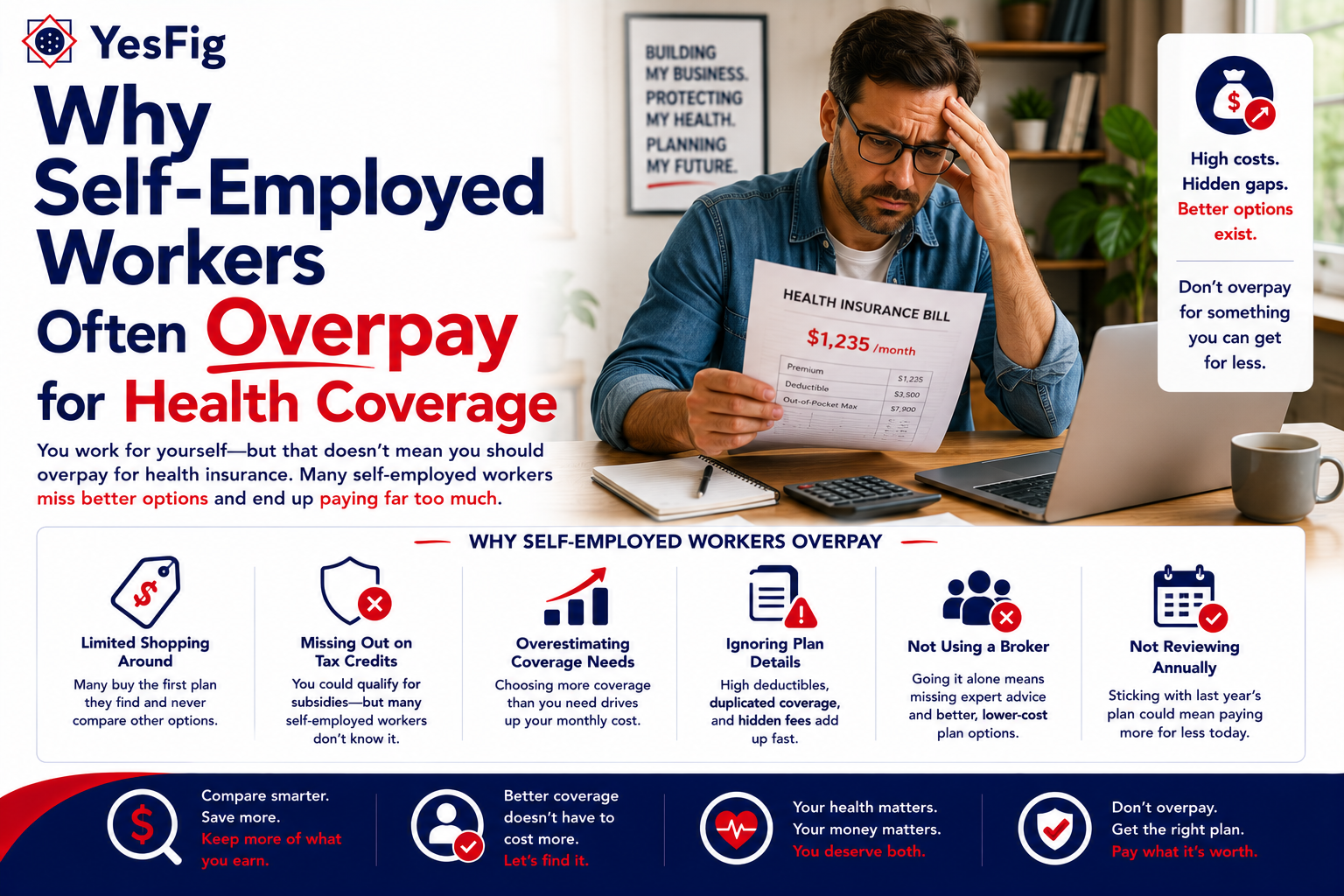
Why Self-Employed Workers Often Overpay for Health Coverage
Quick answer: Self-employed workers often overpay because they skip subsidies they'd qualify for by buying off the marketplace, overestimate their income, or don't lower it with business deductions and retirement contributions. Others buy more coverage than they use, skip the self-employed tax deduction, or overpay for COBRA. Checking subsidy eligibility with an accurate income figure is the biggest fix.
Table of contents
- Why self-employed workers end up overpaying
- How self-employed health insurance subsidies work
- The income mistake that costs subsidies
- The other ways self-employed workers overpay
- What California self-employed workers should know
- How to lower your self-employed health insurance cost
- Frequently asked questions
Carla, a self-employed graphic designer in Sacramento, bought a health plan directly from an insurer and had been paying a hefty premium every month, assuming that was simply the price of covering herself. It wasn't. She was overpaying for reasons she never knew about, and fixing them cut her cost significantly. Self-employed health insurance feels expensive to a lot of freelancers, but much of that cost comes from avoidable mistakes rather than the coverage itself.
The good news is that every one of those mistakes has a fix. Here's why self-employed workers so often pay more than they need to, and exactly how to stop.
Paying a lot for coverage on your own?
That's worth a second look. Fig can explain where self-employed workers overpay and show you what California health plans could cost you, with no pressure to switch.
How self-employed health insurance subsidies work
The single biggest overpayment comes from skipping subsidies. Premium tax credits, which lower your monthly cost based on your income, are available only through the ACA marketplace, and self-employed workers with moderate or variable income often qualify for meaningful help.
Here's the trap Carla fell into: buying a plan off the marketplace, directly from an insurer, forfeits those subsidies entirely, even if your income would have qualified. Same coverage, higher price, no credit. Many self-employed people also assume they earn too much to qualify without ever checking. Before buying anything, look up your subsidy eligibility on the marketplace, since comparing California health plans there could reveal a far lower cost than the sticker price you're paying now.
The income mistake that costs subsidies
This is where it gets subtle, and where real money hides. Subsidies are based on your Modified Adjusted Gross Income, or MAGI, which is your income after certain deductions, not your gross revenue. Self-employed workers who look only at their gross income often conclude they earn too much for subsidies, when their MAGI tells a different story.
Legitimate moves lower your MAGI and can unlock or increase a subsidy. Business deductions, contributions to a self-employed retirement account like a SEP-IRA or Solo 401(k), and HSA contributions all reduce your MAGI. Overestimating your income on the application also costs you, since a too-high estimate shrinks your credit. Getting your income figure right, and optimizing it with the deductions you're entitled to, is one of the most powerful ways to lower your cost.
Good to know: Subsidies are based on your MAGI, which is your income after business deductions, retirement contributions, and HSA contributions. Many self-employed people think they earn too much to qualify, when lowering their MAGI through legitimate deductions actually makes them eligible for real savings.
Want to see what you'd actually pay?
That's exactly what a real quote shows. Yesfig can compare marketplace and off-exchange plans and help you find your true cost after subsidies. Compare California health coverage in a few minutes.
The other ways self-employed workers overpay
Beyond subsidies, a few more habits inflate the bill. Buying more plan than you use is common: paying for a rich, high-premium plan when you're healthy and rarely see a doctor, where a lower-tier plan, sometimes paired with an HSA, would cost far less. Match the plan to your actual care.
Not shopping is another. Auto-renewing the same plan every year, without comparing, means missing price changes and better options, so re-shop at open enrollment. Many also miss the self-employed health insurance deduction, which lets those not eligible for an employer or spouse's plan deduct their premiums and lower their real cost, so confirm it with a tax professional. And some overpay for COBRA after leaving a job, when a subsidized marketplace plan would often be cheaper. Each of these is money left on the table.
What California self-employed workers should know
California gives self-employed residents strong options to avoid overpaying. Covered California is the state marketplace where you access subsidies, and California has at times offered additional state subsidies on top of federal ones, so checking here is worth it. If your income is low, Medi-Cal may cost even less.
California also restricts short-term health plans, which protects you from wasting money on limited junk coverage that doesn't count as real insurance, so private coverage here means full ACA-compliant plans. Getting your subsidy and plan right through the right channel is how you stop overpaying. Yesfig Insurance, a Los Angeles-based brand of Focus Insurance Group, can help self-employed Californians compare and find their real cost.
Key takeaways
- The biggest overpayment is skipping marketplace subsidies by buying off-exchange.
- Subsidies use your MAGI, so deductions and retirement contributions can unlock savings.
- Avoid buying more coverage than you use, and re-shop instead of auto-renewing.
- Claim the self-employed health insurance deduction and skip overpriced COBRA.
How to lower your self-employed health insurance cost
Stop overpaying with three moves. Here's the approach:
- Check your subsidy with an accurate income. Start at the marketplace, and calculate your MAGI after deductions and retirement contributions, not your gross income.
- Match your plan to your care. Choose a metal tier that fits how much you actually use healthcare, and consider an HSA-eligible plan if you're healthy.
- Take the deduction and compare yearly. Deduct your premiums if you're eligible, and re-shop at every open enrollment rather than auto-renewing.
Do that and you pay for the coverage you need, not a dollar more. For more on choosing a plan, the Yesfig blog breaks it down without the jargon.
Frequently asked questions
Why do self-employed people pay so much for health insurance?
Often because of avoidable mistakes rather than the coverage itself. Common ones include buying off the marketplace and forfeiting subsidies, overestimating income, not lowering MAGI with deductions, buying richer coverage than they use, and missing the self-employed tax deduction. Fixing these can significantly reduce what a self-employed worker pays.
How can self-employed workers lower their health insurance costs?
Check your subsidy eligibility on the marketplace using your MAGI after deductions, not your gross income, since many qualify who assume they don't. Match your plan to how much care you actually use, consider an HSA-eligible plan if you're healthy, claim the self-employed health insurance deduction, and compare plans each year instead of auto-renewing.
Do business deductions affect my health insurance subsidy?
Yes. Subsidies are based on your Modified Adjusted Gross Income, or MAGI, which is your income after certain deductions. Legitimate business deductions, along with retirement account and HSA contributions, lower your MAGI, which can qualify you for a subsidy or increase one you already receive. Confirm the details with a tax professional.
Should I buy health insurance off the marketplace if I'm self-employed?
Usually not without checking the marketplace first. Premium tax credits are only available on the marketplace, so buying off-exchange forfeits any subsidy you'd qualify for, even if your income is eligible. Off-exchange plans can offer more options, but if you might qualify for a subsidy, compare on the marketplace before deciding.
Is COBRA or a marketplace plan cheaper for the self-employed?
Often a marketplace plan. COBRA lets you keep your former employer's plan but usually at full price, which can be expensive. Leaving a job is a qualifying event that opens a special enrollment window, and a subsidized marketplace plan is frequently cheaper. Compare both before defaulting to COBRA, since the savings can be substantial.
Self-employed coverage feels expensive largely because of mistakes that are entirely fixable. Carla checked her subsidy using her MAGI after deductions, switched to a plan that matched her actual care, and started deducting her premiums, cutting a bill she'd assumed was fixed. Get your income figure right, buy through the right channel, and you'll stop paying more than you need to.
Ready to stop overpaying for coverage?
Get a health insurance quote in minutes with Yesfig. Coverage in California starts at $50/mo, and a licensed advisor can check your subsidy, compare your options, and help you find your real cost. Pay for coverage, not for mistakes.
About the Author

Mathew Bahadori
CEO, Yesfig Insurance
Leading the company’s mission to make insurance more accessible, modern, and customer-focused. With a passion for innovation and personalized service, he continues to help individuals and families find smarter coverage solutions for life, auto, home, health, and business insurance.