
May 31, 2026
Pet Insurance vs Vet Savings Account: Which Wins?
Pet insurance vs a vet savings account: which protects your wallet better? Compare cost, coverage, and risk in this plain-English Yesfig guide.
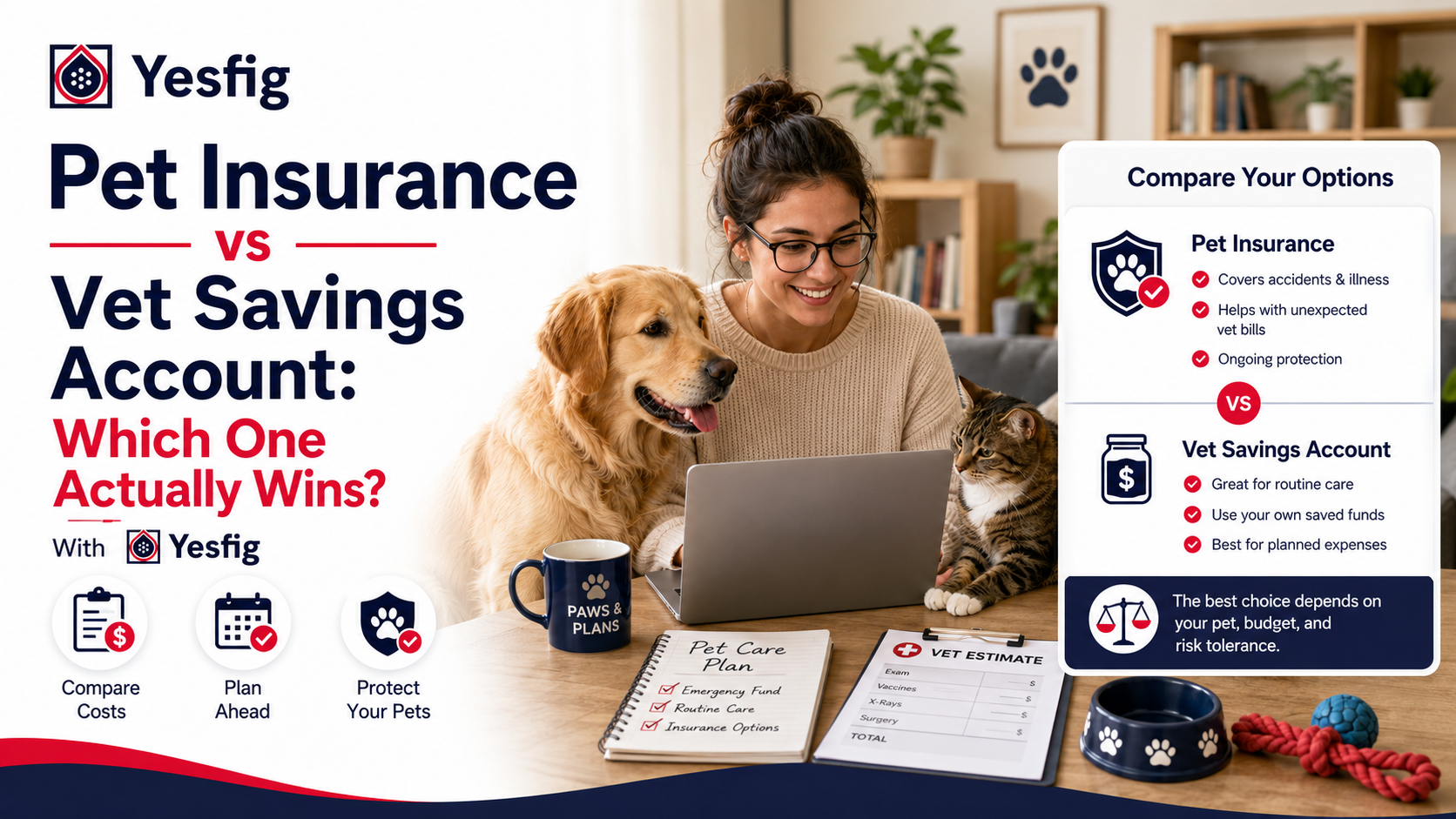
Pet Insurance vs Vet Savings Account: Which One Actually Wins?
Quick answer: Pet insurance vs a vet savings account comes down to risk. A savings account is cheaper and flexible but caps out at whatever you've banked, leaving you exposed to a big emergency. Pet insurance costs a small monthly premium (from around $9/mo) but covers large, unexpected vet bills. For most California pet owners, insurance wins on the costs that actually hurt.
Table of contents
- The real question behind the comparison
- What a vet savings account is
- What pet insurance is
- Head-to-head: cost, coverage, and risk
- When a savings account makes sense
- When pet insurance wins
- The case for doing both
- Frequently asked questions
Marco adopted a rescue lab named Biscuit in Long Beach last spring. A friend told him to skip insurance and just stash $40 a month in a "vet fund" instead. It sounded smart, until Biscuit ate a sock at month three and the surgery bill came to $4,200. Marco's fund had $120 in it.
That gap is the whole debate. The question of pet insurance vs vet savings account isn't really about which is cheaper month to month. It's about who covers the bill on the worst day. Here's how the two stack up, and how to pick the one that fits your pet and your budget.
The real question behind the comparison
Both options exist to solve the same problem: vet care is expensive and emergencies don't warn you. A vet savings account self-funds that risk. Pet insurance transfers it to an insurer. Everything else is detail.
The villain in this story isn't either tool. It's the surprise four-figure bill, the swallowed object, the torn ligament, the sudden illness that hits before you've saved enough. Your job is to pick the defense that's still standing when that bill lands. So let's look at what each one actually does.
What a vet savings account is
A vet savings account is just money you set aside, usually in a separate high-yield savings account, earmarked for your pet's care. You contribute a fixed amount each month, and when a vet bill shows up, you pay from that pot.
The appeal is real. There's no premium, no deductible, no claims process, and no insurer deciding what's covered. Anything pet-related is fair game, from routine checkups to grooming to a true emergency. If your pet stays healthy, the money is still yours.
The catch is equally real: you're only protected up to whatever you've banked so far. A young pet with a sudden $5,000 emergency can wipe out a fund that's barely started. The math only works if nothing serious happens early, and that's exactly what you can't control.
Still weighing your options?
That's what Fig is for. See how pet coverage works and get plain-English answers before you decide how to protect Biscuit, or whoever's curled up at your feet.
What pet insurance is
Pet insurance is a policy that reimburses you for covered vet costs, typically accidents and illnesses, after a deductible. You pay a monthly premium, and when a covered bill hits, you file a claim and get a percentage back (often 70 to 90 percent, depending on the plan).
Through Yesfig, pet coverage starts around $9 per month, though your actual premium depends on your pet's age, breed, and where you live in California. The trade is straightforward: you give up a small predictable amount each month so a large unpredictable bill doesn't land entirely on you.
Two honest caveats. Most policies don't cover pre-existing conditions, so insuring early matters, and routine care like vaccines is usually an add-on, not standard. Insurance shines on the big stuff, not the $60 annual checkup.
Head-to-head: cost, coverage, and risk
Here's the comparison side by side.
| Factor | Vet savings account | Pet insurance |
|---|---|---|
| Monthly cost | Whatever you choose to save | Premium from ~$9/mo |
| Big emergency | Only covered up to what you've saved | Covered up to plan limits, even early on |
| Routine care | Fully usable for it | Usually an add-on, not standard |
| Pre-existing conditions | No restrictions | Typically excluded |
| If your pet stays healthy | You keep the money | Premiums are spent |
| Protection on day one | Minimal until funded | Full (after any waiting period) |
The pattern is clear. A savings account wins on flexibility and on the scenario where nothing bad happens. Pet insurance wins on the scenario that actually bankrupts people: a major, early, unexpected bill. You're really choosing which risk you'd rather carry.
Key takeaways
- A vet savings account is flexible and cheap but only protects you up to what you've banked.
- Pet insurance costs a small monthly premium (from ~$9/mo) and covers large bills from day one, after any waiting period.
- Insurance usually excludes pre-existing conditions, so enrolling a young, healthy pet matters.
- For most owners, the smartest setup is insurance for emergencies plus a small fund for routine costs.
Want to see what a plan would cost for your pet?
Yesfig looks at your pet's age, breed, and your budget, then shows you real numbers next to your savings plan. Compare California pet insurance options in a few minutes, no pressure.
When a savings account makes sense
A vet savings account can be the right call in a few specific situations. It works best when:
- Your pet has pre-existing conditions that insurance won't cover anyway, so a fund is your only real option.
- You're highly disciplined about saving and won't dip into the fund for non-pet expenses.
- You already have a large emergency cushion that could absorb a $5,000 bill without strain.
- Your pet is older and premiums have climbed to where self-funding pencils out better.
The thread running through all of these: you can genuinely cover the worst case from your own pocket. If you can, a savings account gives you total control. If you can't, you're betting against an emergency you can't afford to lose.
When pet insurance wins
Pet insurance usually wins when a single bad day could blow up your finances, which describes most pet owners. It's the stronger choice when:
- Your pet is young and healthy, so you can lock in coverage before any conditions exist.
- You couldn't comfortably absorb a sudden $4,000 to $7,000 emergency.
- You have a breed prone to expensive issues (hip problems, heart conditions, and so on).
- You'd rather pay a small fixed amount than gamble on timing.
Marco's sock situation is the textbook case. A fund hadn't had time to grow, but a policy would have covered most of that $4,200 from the start. That's the difference insurance buys: protection that doesn't depend on how long you've been saving.
The case for doing both
For a lot of California pet owners, the real answer to pet insurance vs vet savings account isn't either-or. It's both, with each tool doing the job it's good at. Here's a simple plan:
- Insure for the emergencies. A policy from around $9/mo covers the catastrophic bills you can't predict.
- Save for the routine. A small monthly transfer covers checkups, dental cleanings, and minor visits that insurance often doesn't.
- Review yearly. As your pet ages and your finances change, adjust the mix.
This combo caps your downside while keeping flexibility for everyday care. It's the same layered logic Yesfig applies across coverage lines, the way you'd pair an emergency fund with renters or auto coverage rather than relying on savings alone. Yesfig Insurance, a brand of Focus Insurance Group based in Los Angeles, offers pet coverage in California, Texas, Illinois, Pennsylvania, Ohio, and Florida, and you can read more in the Yesfig blog if you want to go deeper on any line.
Frequently asked questions
Is pet insurance or a vet savings account cheaper?
A vet savings account can be cheaper month to month since there's no premium, and you keep unused money. But it only protects you up to what you've banked. Pet insurance costs a small premium from around $9/mo and covers large bills immediately, so it's cheaper on the emergencies that actually hurt financially.
Does pet insurance cover pre-existing conditions?
Generally no. Most pet insurance policies exclude conditions your pet had before coverage started, which is why enrolling a young, healthy pet matters. If your pet already has a chronic or diagnosed condition, a vet savings account may be your more practical option since it has no coverage restrictions.
How much should I put in a vet savings account?
There's no fixed rule, but many owners aim to build toward at least $3,000 to $5,000, since that range covers most single emergencies. The challenge is that emergencies can happen before the fund grows. Saving a steady monthly amount and starting early gives the account time to actually protect you.
Can I have both pet insurance and a vet savings account?
Yes, and for many owners it's the strongest setup. Pet insurance handles large, unpredictable emergency bills, while a small savings fund covers routine care that insurance often excludes, like checkups and dental cleanings. Pairing them caps your financial downside while keeping flexibility for everyday expenses.
When is the best time to buy pet insurance?
The best time is when your pet is young and healthy, before any conditions develop that could be excluded as pre-existing. Premiums are also typically lower for younger pets. Waiting until a problem appears usually means that problem won't be covered, which is the most common pet insurance regret.
So which one wins?
For most owners, the honest answer is that pet insurance wins on the bills that can actually derail you, while a savings account wins on flexibility and routine care. Marco insures Biscuit now and keeps a small fund on the side, so the next swallowed sock is the vet's problem, not his bank account's. Pick the tool that's still standing on the worst day, and you can stop bracing for it.
Ready to protect your pet?
Get a pet insurance quote in minutes with Yesfig. Coverage starts at $9/month, and a licensed advisor is there the moment you want a human to help you weigh it against a savings plan.
About the Author

Mathew Bahadori
CEO, Yesfig Insurance
Leading the company’s mission to make insurance more accessible, modern, and customer-focused. With a passion for innovation and personalized service, he continues to help individuals and families find smarter coverage solutions for life, auto, home, health, and business insurance.