
June 3, 2026
Pet Insurance for Senior Dogs: What's Actually Covered
Pet insurance for senior dogs can cover accidents, illness, and surgery, but pre-existing conditions are out. See what's covered and get a quick quote.
Pet Insurance for Senior Dogs: What's Actually Covered (and What Isn't)
Quick answer: Pet insurance for senior dogs typically covers new accidents and illnesses, including cancer, surgery, diagnostics, and prescription meds, usually reimbursing 70 to 90 percent after your deductible. What it won't cover is any pre-existing condition diagnosed before the policy started. Premiums run higher for older dogs, but coverage is still available in California.
Table of contents
- What pet insurance actually covers for senior dogs
- What senior dog coverage usually leaves out
- Can you still insure an older dog?
- How much does pet insurance for senior dogs cost?
- Is pet insurance worth it for a senior dog?
- How to pick a plan for your senior dog
- Frequently asked questions
Diane's Lab, Rufus, just turned ten. He's grayer around the muzzle, slower on the stairs, and still convinced he's a puppy at dinnertime. He's also at the age when vet bills start climbing, and Diane is wondering whether pet insurance for senior dogs is still worth getting, or if she's already missed the window.
If you're in the same spot with an aging dog, here's the real picture: what these policies cover, what they quietly leave out, and how to tell if it's worth the monthly cost.
What pet insurance actually covers for senior dogs
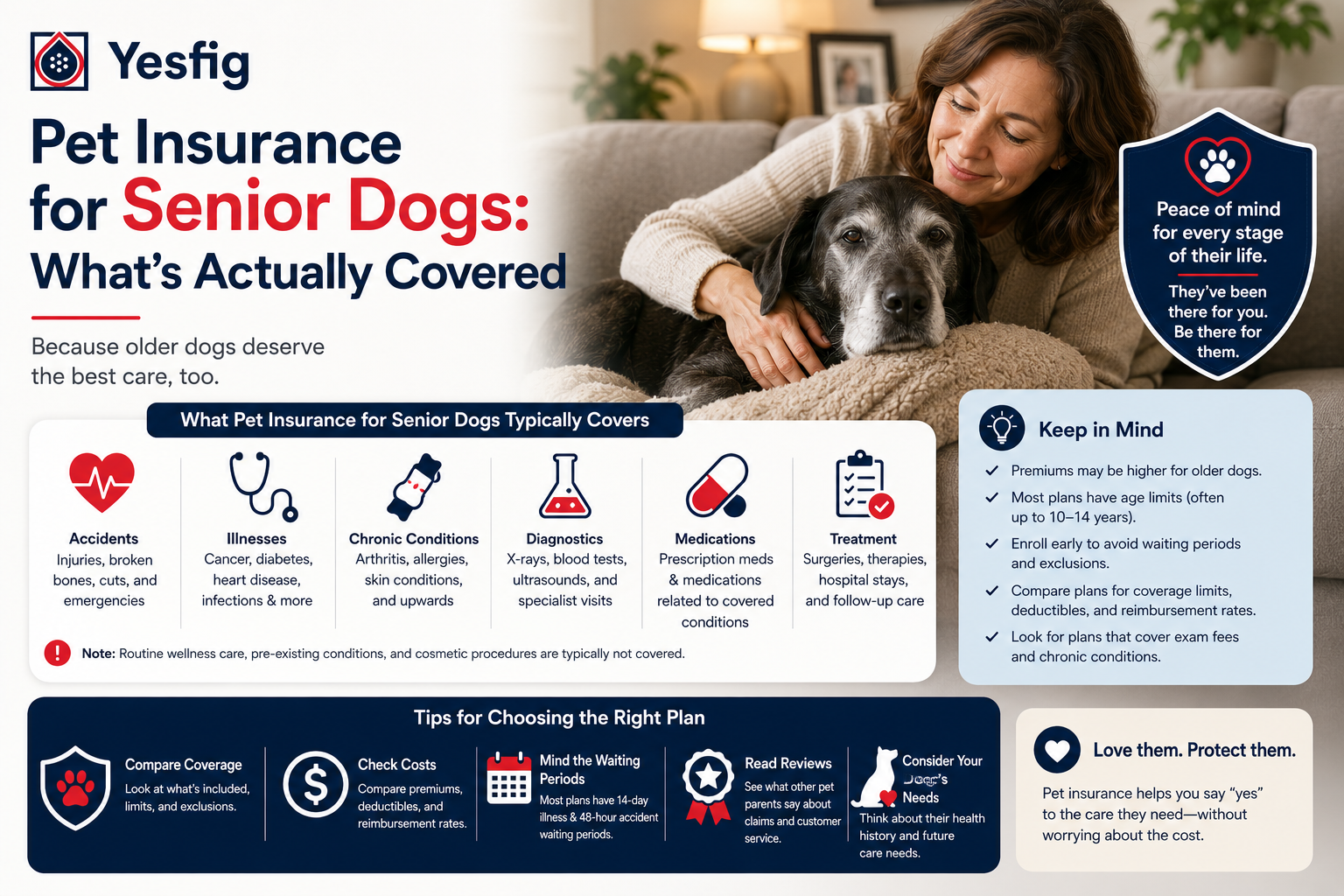
Most pet insurance for senior dogs is an accident-and-illness plan, and that's the part that matters as a dog ages. It covers the new, unexpected health problems that send you to the emergency vet at 9 p.m. with a scared dog and a racing heart.
A typical accident-and-illness plan covers:
- Accidents: broken bones, swallowed objects, bite wounds, torn ligaments.
- Illnesses: cancer, infections, digestive trouble, kidney and heart disease.
- Diagnostics: bloodwork, X-rays, ultrasounds, and MRIs.
- Surgery and hospitalization.
- Prescription medications tied to a covered condition.
For an older dog, cancer treatment and major surgery are the big-ticket items, and a single course of care can run several thousand dollars. A solid plan reimburses 70 to 90 percent of those costs after your deductible, up to your annual limit. You pay the vet, file a claim, and get money back.
New to all this? Start with the basics.
Figuring out coverage for an older dog is genuinely confusing, and most people put it off until there's an emergency. With Yesfig, you can see how pet coverage works in plain English first, no pressure to buy anything.
What senior dog coverage usually leaves out
The single biggest thing pet insurance won't cover is a pre-existing condition, meaning any illness or injury your dog showed signs of before the policy started or during the waiting period. For senior dogs, this is the catch that trips people up.
If Rufus already has arthritis in his medical file, a new policy won't pay to treat that arthritis. But it can still cover unrelated new problems, like a sudden tumor or a swallowed sock. That's exactly why timing matters, and why it pays to look at pet insurance options in California before a small issue becomes a documented one.
Other things most plans leave out:
- Pre-existing conditions, including symptoms noted before coverage began.
- Waiting periods at the start (often a few days for accidents, longer for illnesses).
- Routine and wellness care like dental cleanings, vaccines, and checkups, unless you add a wellness plan.
- Elective or cosmetic procedures.
Good to know: A pre-existing condition isn't always permanent. Some carriers will cover a previously cured, curable issue (say, a one-time ear infection) if your dog stays symptom-free for a defined period, commonly around 180 days. Chronic conditions like arthritis or diabetes usually stay excluded for good.
Can you still insure an older dog?
Yes, you can usually still insure an older dog, though your options narrow as your dog ages. Many insurers treat a dog as "senior" around age seven, and large breeds like Great Danes or Mastiffs hit that mark even earlier.
Here's where carriers differ. Some have no upper age limit for accident-and-illness coverage. Others cap new enrollments at a certain age, or offer only accident-only plans to the oldest dogs. Accident-only is cheaper and still covers the swallowed-object and broken-bone emergencies, just not illnesses.
So the answer for a ten-year-old like Rufus isn't "too late." It's "check which plans he still qualifies for, and enroll before the next thing lands in his medical record."
Not sure what your dog still qualifies for?
Yesfig can check which plans fit your dog's age and history, then show you the tradeoffs between full accident-and-illness and accident-only coverage. Compare pet insurance plans in a few minutes.
How much does pet insurance for senior dogs cost?
Pet insurance for senior dogs costs more than it does for a puppy, because older dogs are statistically more likely to need care. Your premium tracks your dog's age, breed, location, and the coverage level you choose.
Yesfig lists pet coverage starting at $9/mo, but that's an entry point for younger, healthy pets. For a senior dog, expect to pay more, and the exact figure depends on your dog's profile. Vet care in California metros like Los Angeles, the Bay Area, and Sacramento tends to run higher, which nudges premiums up too.
Three levers control your monthly cost:
- Your deductible (a higher deductible means a lower premium).
- Your reimbursement rate (70%, 80%, or 90%).
- Your annual limit (the cap on what the policy pays each year).
Adjust those three and you can usually land on a premium that fits your budget without gutting the coverage.
Is pet insurance worth it for a senior dog?
It's worth it when the cost of one serious treatment would be hard to absorb out of pocket, which is exactly the situation senior dogs tend to create. A single cancer diagnosis or emergency surgery can run several thousand dollars.
Run the simple math. Add up a year of premiums, then compare that to what you'd pay if Rufus needed a $5,000 procedure tomorrow. If writing that check would mean a payment plan, a maxed-out credit card, or an impossible choice, insurance is doing its job: turning a scary, unpredictable bill into a steady monthly one.
The honest tradeoff: if your dog stays healthy, you'll pay premiums you didn't "use." That's true of every kind of insurance, and it's the price of not having to base your dog's care on your bank balance. You can weigh this against other coverage decisions on the Yesfig insurance blog.
Key takeaways
- Pet insurance for senior dogs covers new accidents and illnesses, not pre-existing conditions.
- Most plans reimburse 70 to 90 percent after your deductible, up to an annual limit.
- You can usually still enroll an older dog, though some carriers limit options to accident-only.
- Premiums run higher for seniors, but you control cost through deductible, reimbursement rate, and annual limit.
- The best time to enroll is now, before a new issue becomes a pre-existing one.
How to pick a plan for your senior dog
You don't need to overthink this. Here's a simple plan:
- Get a quote for your dog's exact age and breed, so you're working with real numbers, not averages.
- Compare your options, weighing accident-and-illness against accident-only and adjusting your deductible and limit.
- Enroll before the next vet visit, so today's healthy dog locks in the widest coverage.
Yesfig Insurance, a brand of Focus Insurance Group based in Los Angeles, offers pet coverage across California, Texas, Illinois, Pennsylvania, Ohio, and Florida. If you'd rather talk it through, a licensed Yesfig advisor can step in at any point.
Frequently asked questions
At what age is a dog considered senior for pet insurance?
Most insurers treat dogs as senior around age seven, though it varies by size. Large breeds like Mastiffs and Great Danes are often considered senior by six, while small breeds may not earn the label until eight or nine. Senior status mainly affects your premium and which plans your dog qualifies for.
Does pet insurance cover pre-existing conditions in older dogs?
No. Pet insurance does not cover pre-existing conditions, meaning anything your dog showed signs of before the policy started or during the waiting period. Some carriers make an exception for a cured, curable condition if your dog stays symptom-free for a set period, often around 180 days. Chronic conditions stay excluded.
Can I get pet insurance for a 10-year-old dog?
Usually yes. Many insurers still offer coverage to a ten-year-old dog, though some cap new accident-and-illness enrollments at a certain age or limit older dogs to accident-only plans. The best move is to get a quote for your dog's exact age and see which options are actually available.
How much does pet insurance cost for a senior dog?
It costs more than for a young dog and depends on your dog's age, breed, location, and coverage level. Yesfig lists pet coverage starting at $9 a month for younger pets, with senior dogs running higher. You can lower the premium by raising your deductible or adjusting your reimbursement rate.
Is pet insurance worth it for an old dog?
It's worth it if one large vet bill would be hard to cover out of pocket. Senior dogs are more likely to need expensive care like cancer treatment or surgery, so insurance turns an unpredictable bill into a steady monthly cost. If your dog stays healthy, you simply pay for peace of mind.
The window probably isn't closed
Diane didn't miss her chance with Rufus, and you probably haven't either. Insuring a senior dog isn't betting on disaster, it's making sure that if something happens, you're choosing the best care instead of the cheapest. Picture not having to hesitate at the vet's desk. That's what a good policy buys you.
Ready to cover your senior dog?
Get a pet insurance quote for your dog in minutes with Yesfig. You'll see real numbers for your dog's age and breed, and a licensed advisor is there if you want a human in the loop.
About the Author

Mathew Bahadori
CEO, Yesfig Insurance
Leading the company’s mission to make insurance more accessible, modern, and customer-focused. With a passion for innovation and personalized service, he continues to help individuals and families find smarter coverage solutions for life, auto, home, health, and business insurance.