
July 13, 2026
How Pet Insurance Deductibles Actually Work
Pet insurance deductibles trip up a lot of owners. Learn the two types, how they work with reimbursement, and how to pick a deductible that fits your pet.
How Pet Insurance Deductibles Actually Work
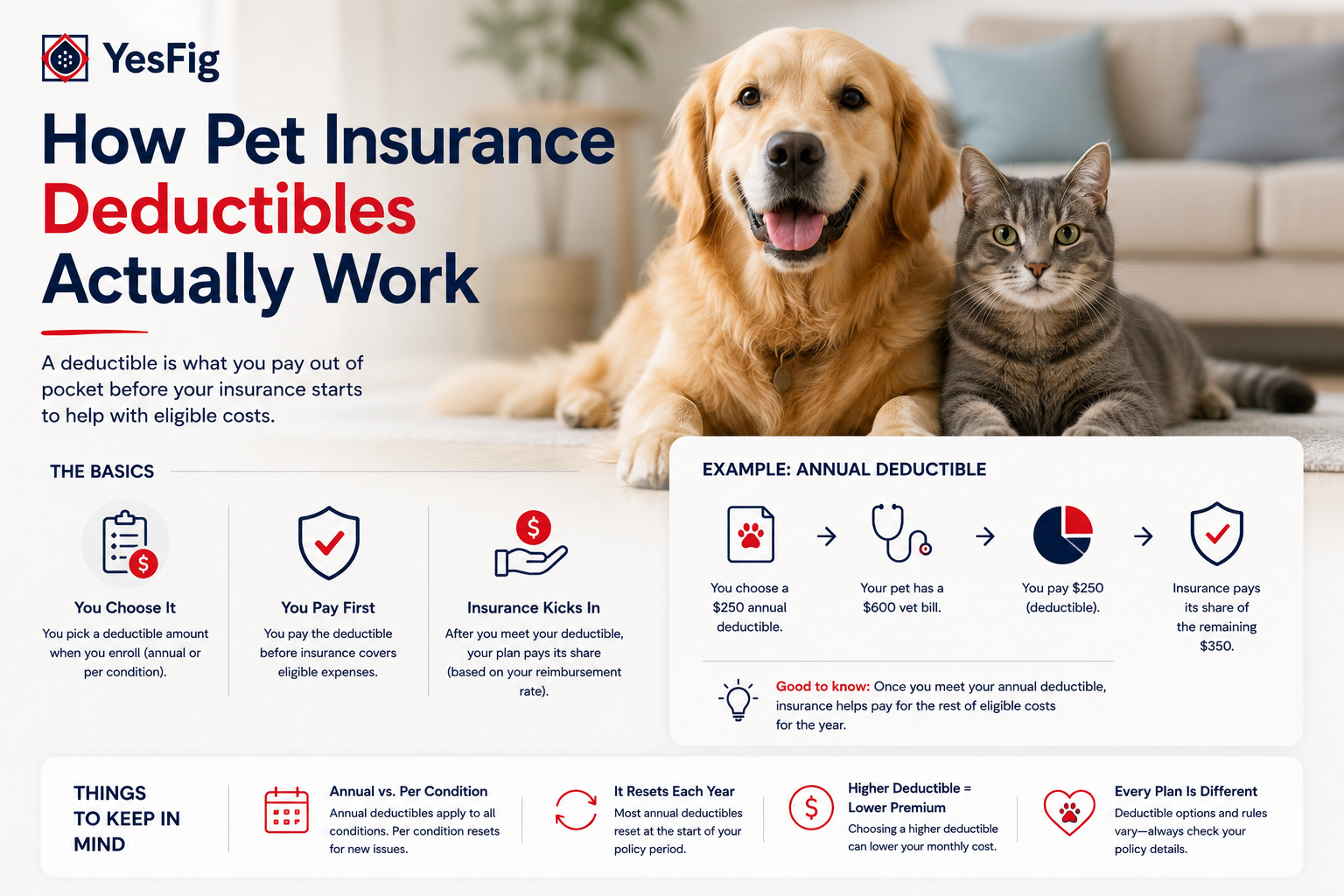
Quick answer: A pet insurance deductible is the amount you pay out of pocket before your insurer reimburses covered vet costs. There are two types: an annual deductible you pay once per year, and a per-condition deductible you pay for each new illness or injury. After you meet it, the insurer reimburses your covered costs up to your annual limit.
Table of contents
- What a pet insurance deductible actually is
- The two types of pet insurance deductibles
- How the deductible works with reimbursement
- How pet insurance deductibles shape your premium
- What California pet owners should know
- How to pick the right deductible for your pet
- Frequently asked questions
Nora was comparing pet insurance plans in Sacramento when she kept hitting the same wall: every plan asked her to pick a deductible, and none of them explained what that actually meant for her wallet. She's far from alone. Pet insurance deductibles are one of the most misunderstood parts of a policy, partly because they don't work the way human health insurance does.
Once you see how they function, though, the choice gets a lot clearer. Here's what a deductible really is, the two types you'll run into, and how it all connects to what your insurer pays and what you pay out of pocket.
What a pet insurance deductible actually is
A deductible is the amount you pay yourself before your insurer starts chipping in. Until you've hit that number in covered costs, the insurer reimburses nothing, and once you have, it starts covering its share of your vet bills.
The part that surprises people is how the money actually moves. Pet insurance is almost always reimbursement-based, meaning you pay the vet the full bill first, then submit a claim and get money back afterward. The deductible is subtracted from what you get reimbursed, not something you hand over at the vet's office.
Good to know: Unlike human health insurance, pet insurance usually works by reimbursement. You pay the full vet bill upfront, then submit a claim and get money back after your deductible, at your reimbursement percentage. Budget for covering that upfront cost while your claim processes.
The two types of pet insurance deductibles
This is the distinction that changes everything, and most policies use one of two types. An annual deductible is paid once per policy year, across all your claims combined. Once you've met it, you're done with the deductible for the rest of that year, no matter how many conditions come up. It resets each year.
A per-condition deductible works differently, and it's the one that catches people off guard. You pay a separate deductible for each new illness or injury. If your pet develops three unrelated issues in a year, you could pay the deductible three times. Pick a per-condition plan without realizing it, and a pet with several problems could have you paying that deductible over and over.
Not sure which deductible type a plan uses?
That's exactly the thing to check. Fig can explain how a plan's deductible works and show you what Yesfig pet insurance offers, with no pressure to enroll.
How the deductible works with reimbursement
Your deductible is only one of three numbers that decide what you actually pay. After you meet it, the insurer reimburses covered costs at your reimbursement percentage, often 70, 80, or 90 percent, up to your annual limit.
Here's how that plays out. Say you have a $250 annual deductible and 80% reimbursement. Your dog has a $1,000 covered vet bill. You cover the first $250, and the insurer reimburses 80% of the remaining $750, which is $600. Later that year, a second unrelated bill is already past the deductible, so you'd be reimbursed 80% of that full amount. You can set up a Yesfig pet insurance plan with the deductible, reimbursement, and limit that fit how you want those numbers to land.
Want to see how different deductibles change your cost?
A quick quote makes it concrete. Yesfig lets you adjust the deductible and see how it affects your premium and reimbursement. Compare pet insurance options in a few minutes.
How pet insurance deductibles shape your premium
Your deductible amount directly affects your monthly cost. A higher deductible means you absorb more before coverage kicks in, so your premium is lower. A lower deductible means the insurer starts paying sooner, so your premium is higher.
Common deductible amounts range from around $100 up to $1,000 or more, depending on the insurer. The right choice depends on your budget and how you'd rather balance the tradeoff: pay more each month for a smaller out-of-pocket hit when you claim, or pay less each month and cover more yourself if something happens. Neither is wrong, they just suit different situations.
What California pet owners should know
California gives you a helpful safeguard when comparing deductibles. State law requires pet insurers to clearly disclose how their deductible works, including whether it's annual or per-condition, along with the reimbursement and coverage terms. That means the details you need to compare plans have to be spelled out in the policy.
So before you pick, read those disclosures and confirm the deductible type, since it makes a real difference. Yesfig Insurance, a Los Angeles-based brand of Focus Insurance Group, offers pet insurance across California with clear deductible and reimbursement options laid out up front.
Key takeaways
- A pet insurance deductible is what you pay before your insurer reimburses covered costs.
- An annual deductible is paid once a year; a per-condition one applies to each new issue.
- After the deductible, you're reimbursed at your percentage, up to your annual limit.
- A higher deductible lowers your premium; a lower one raises it.
How to pick the right deductible for your pet
Choosing well comes down to three quick checks:
- Confirm the deductible type. Make sure you know whether the plan uses an annual or per-condition deductible before anything else.
- Weigh deductible against premium. Decide how you want to balance a lower monthly cost against a higher out-of-pocket amount when you claim.
- Factor in your pet. A pet prone to multiple issues may fare better with an annual deductible, so match the choice to your situation.
Get those right and there are no surprises when you file a claim. For more on choosing pet coverage, the Yesfig blog breaks it down without the jargon.
Frequently asked questions
How do pet insurance deductibles work?
A deductible is the amount you pay out of pocket before your insurer reimburses covered vet costs. Pet insurance is reimbursement-based, so you pay the vet first, then get money back after meeting the deductible, at your reimbursement percentage, up to your annual limit. The deductible is subtracted from what you're reimbursed.
What's the difference between an annual and per-condition deductible?
An annual deductible is paid once per policy year across all claims, then you're done with it until the year resets. A per-condition deductible applies separately to each new illness or injury, so you pay it again for every new condition. Annual deductibles are simpler and often better for pets with multiple issues.
Does a higher deductible lower my pet insurance premium?
Yes. A higher deductible means you cover more of a vet bill yourself before the insurer reimburses you, so it charges a lower premium in return. A lower deductible does the opposite, raising your monthly cost but reducing what you pay out of pocket when you claim. Choose based on your budget and preference.
Do pet insurance deductibles reset every year?
Annual deductibles do. They reset at the start of each new policy year, so you meet the deductible again in the next year. Per-condition deductibles work differently, applying to each condition rather than the year. Always confirm which type your plan uses, since it affects how often you'll pay the deductible.
How do I choose the right pet insurance deductible?
First confirm whether the plan uses an annual or per-condition deductible. Then weigh a higher deductible with a lower premium against a lower deductible with a higher premium. Factor in your pet, since one prone to several issues often does better with an annual deductible. Match the deductible to your budget and situation.
A deductible only feels confusing until you know which type you're dealing with and how it fits the rest of your plan. Nora confirmed her plan used an annual deductible, picked an amount that balanced her premium and her budget, and knew exactly what to expect when she filed a claim. Understand the mechanics first, and the right deductible is an easy call.
Ready to pick a plan with a deductible that fits?
Get a pet insurance quote in minutes with Yesfig. Coverage in California starts at $9/mo, and a licensed advisor can walk you through how the deductible, reimbursement, and limit work together. Clear numbers, no surprises.
About the Author

Mathew Bahadori
CEO, Yesfig Insurance
Leading the company’s mission to make insurance more accessible, modern, and customer-focused. With a passion for innovation and personalized service, he continues to help individuals and families find smarter coverage solutions for life, auto, home, health, and business insurance.