
July 20, 2026
How to Add Personal Property Coverage to Your Renters Policy
Personal property coverage is already the core of your renters policy. Learn how much you need, how to cover valuables, and how to raise your limit.
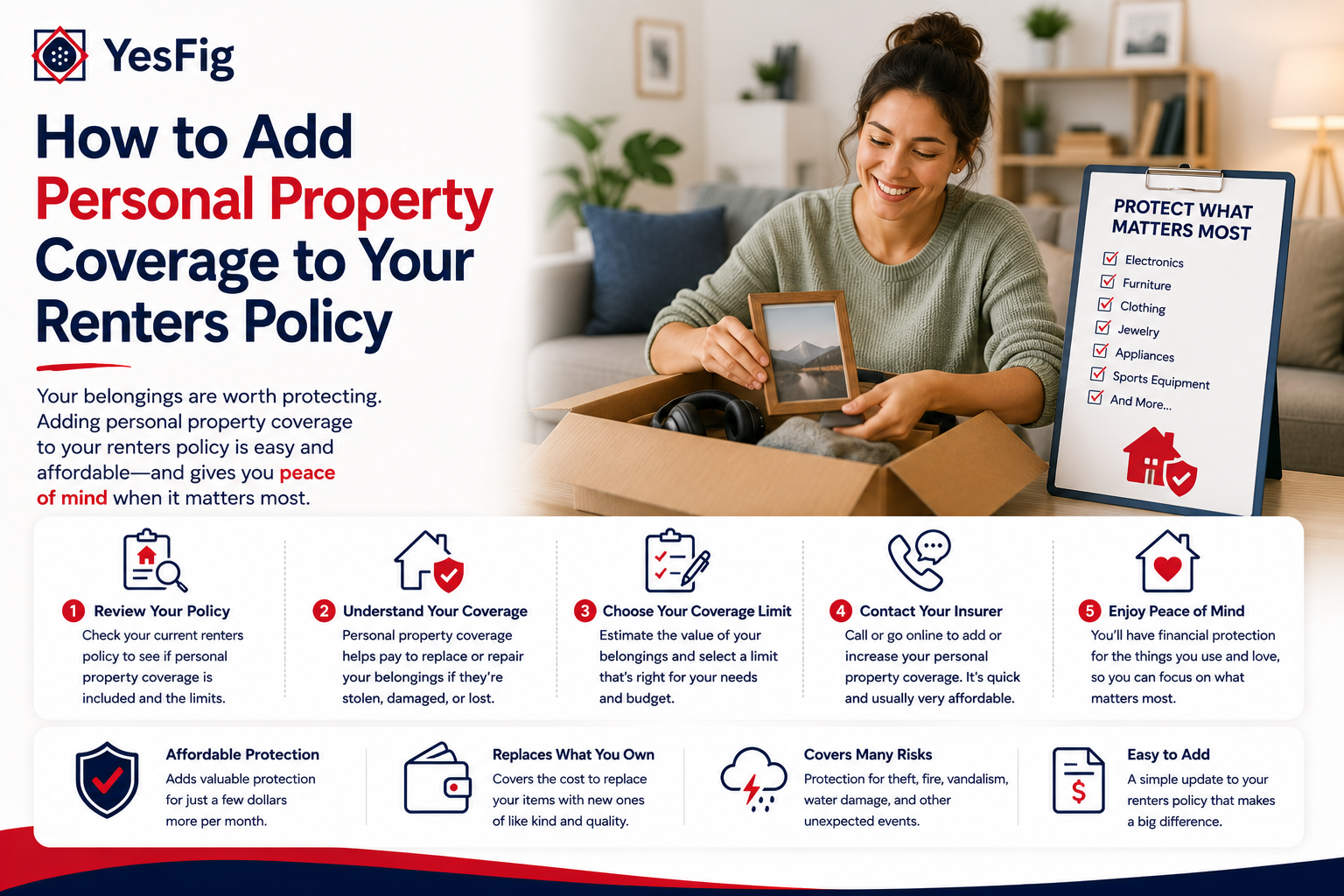
How to Add Personal Property Coverage to Your Renters Policy
Quick answer: Personal property coverage isn't an add-on to renters insurance, it's the core of the policy, covering your belongings against theft, fire, and more. To get more, you can raise your coverage limit, add scheduled coverage for high-value items like jewelry that exceed standard sub-limits, and upgrade from actual cash value to replacement cost.
Table of contents
- Personal property coverage is already in your policy
- How much personal property coverage do you need?
- The sub-limits that leave valuables underinsured
- How to increase your personal property coverage
- What California renters should know
- How to add coverage for your belongings
- Frequently asked questions
When Devon got engaged in Anaheim, he wanted to make sure his fiancée's ring was covered on his renters policy, and he went looking for how to "add" personal property coverage. What he found surprised him: he already had it. Personal property coverage is the heart of every renters policy, not an extra you bolt on. The real question was whether his coverage was big enough and whether the ring was fully protected.
That distinction changes everything about how you approach this. Here's what your policy already covers, why your most valuable items might be underinsured anyway, and how to actually get more protection for your belongings.
Personal property coverage is already in your policy
Every renters policy is built on three parts, and personal property coverage is the main one. It protects your belongings, your furniture, electronics, clothes, and everything else, against covered events like theft, fire, vandalism, and certain water damage, both at home and away.
So you don't add it, because it's already there. What you can do is make it bigger or better. That means raising the dollar limit if you own more than your policy covers, scheduling high-value items that a standard policy caps, and choosing how claims are paid. Those are real, useful moves, and they're what people usually mean when they talk about adding coverage.
Not sure your belongings are fully covered?
That's worth checking. Fig can review your coverage and show you what California renters insurance includes, with no pressure to switch.
How much personal property coverage do you need?
Start with a number most people get wrong: the total value of everything you own. Walk through your place and add up your furniture, electronics, kitchen gear, clothes, and everything in between. It climbs faster than you'd expect, and a quick photo or video inventory makes it concrete.
Your policy's personal property limit should cover that total, since it's the maximum the insurer will pay for your belongings. Set it too low and a major loss leaves you short. A home inventory also makes any future claim far smoother, because you can prove what you had. If your total exceeds your current limit, raising it usually costs only a little more per month.
The sub-limits that leave valuables underinsured
Here's the catch that gets Devon and a lot of renters. Even with a healthy overall limit, standard policies apply sub-limits to certain categories. Jewelry, watches, and furs are often capped around $1,500 for theft. Electronics, firearms, cash, art, and collectibles have their own caps too.
That means a $6,000 engagement ring might only be covered to a fraction of its value under the base policy, no matter how high your total limit is. The sub-limit, not your overall coverage, is what applies. This is exactly where people discover a gap at the worst possible moment, so it's worth checking the special limits in your policy before you assume your valuables are safe.
Good to know: To fully cover a high-value item like an engagement ring, camera gear, or a musical instrument, add scheduled personal property, sometimes called a floater or rider. It covers the item for its full appraised value, often with a lower deductible and broader protection than your base policy.
Want to cover your valuables properly?
That's a quick fix. Yesfig can help you set the right limit and schedule high-value items so nothing important is underinsured. Compare California renters insurance in a few minutes.
How to increase your personal property coverage
There are three ways to strengthen your coverage, and you can use any or all of them. First, raise your limit so it matches the full value of your belongings, which is the simplest fix if you own more than you're insured for.
Second, add scheduled personal property for anything valuable that exceeds a sub-limit, like jewelry, cameras, or instruments. You list the item, usually with an appraisal or receipt, and it's covered for its full value against a broader set of risks. Third, choose replacement cost coverage instead of actual cash value, so claims pay what it costs to buy a new equivalent today rather than the depreciated value. Each of these is a small change with a real payoff, and if you have a car, bundling renters with auto insurance can offset the cost.
What California renters should know
California renters get personal property coverage the same way as everyone else, and it works well, with one thing to remember. Standard renters insurance excludes earthquake and flood damage, both of which need separate coverage, and California is earthquake country, so it's worth considering.
The upside is that California law requires insurers to clearly disclose your coverage terms, including your limits and how claims are paid, so you can confirm exactly what you have. Yesfig Insurance, a Los Angeles-based brand of Focus Insurance Group, offers renters coverage across California and makes it easy to set your limit and schedule valuables.
Key takeaways
- Personal property coverage is the core of renters insurance, not an add-on.
- Set your limit to the full value of your belongings using a home inventory.
- Sub-limits cap categories like jewelry, so valuables often need scheduling.
- Scheduled personal property and replacement cost coverage close the gaps.
How to add coverage for your belongings
Getting this right takes about half an hour. Here's the approach in three steps:
- Inventory your belongings. Photograph what you own and total the value so you know how much coverage you need.
- Check your limits and sub-limits. Confirm your overall limit covers the total, and note the caps on jewelry, electronics, and other categories.
- Add what's missing. Raise your limit if needed, schedule high-value items, and consider replacement cost coverage.
Do that and your policy actually reflects what you own. For more renter-friendly coverage tips, the Yesfig blog breaks it down without the jargon.
Frequently asked questions
Do I need to add personal property coverage to renters insurance?
No, because it's already included. Personal property coverage is the core of every renters policy, protecting your belongings against theft, fire, and other covered events. What you can do is raise your coverage limit if you own more than you're insured for, and schedule high-value items that exceed the policy's standard sub-limits.
How much personal property coverage should I have?
Enough to cover the full value of your belongings. Do a home inventory by photographing and totaling what you own, from furniture to electronics to clothes, since most people underestimate. Set your policy limit to match that total. If it exceeds your current limit, raising it usually adds only a little to your premium.
What is scheduled personal property?
Scheduled personal property, also called a floater or rider, is extra coverage for specific high-value items like jewelry, cameras, art, or instruments. You list each item, often with an appraisal, and it's covered for its full value, usually with a lower deductible and broader protection than your standard policy provides. It closes the gap left by sub-limits.
What's the difference between actual cash value and replacement cost?
Actual cash value pays the depreciated value of an item, what it's worth now after age and wear. Replacement cost pays what it costs to buy a new equivalent today, so your payout is higher. Replacement cost coverage costs a bit more in premium but is usually worth it for a fuller claim.
Does renters insurance cover jewelry and electronics?
Yes, but often with limits. Your policy covers these items, but standard sub-limits cap how much it pays for categories like jewelry, sometimes around $1,500 for theft. A valuable ring or expensive camera can exceed that cap. To cover them fully, add scheduled personal property for those specific items.
Personal property coverage is the reason renters insurance exists, so the goal isn't adding it, it's making sure it fits your life. Devon inventoried his belongings, scheduled the ring for its full value, and switched to replacement cost, so a loss would actually make him whole. Know what you own and how your policy pays, and your coverage stops being a guess.
Ready to cover everything you own?
Get a renters insurance quote in minutes with Yesfig. Coverage in California starts at $5/mo, and a licensed advisor can set your limit, schedule your valuables, and add replacement cost coverage. Your belongings, fully covered.
About the Author

Mathew Bahadori
CEO, Yesfig Insurance
Leading the company’s mission to make insurance more accessible, modern, and customer-focused. With a passion for innovation and personalized service, he continues to help individuals and families find smarter coverage solutions for life, auto, home, health, and business insurance.