June 22, 2026
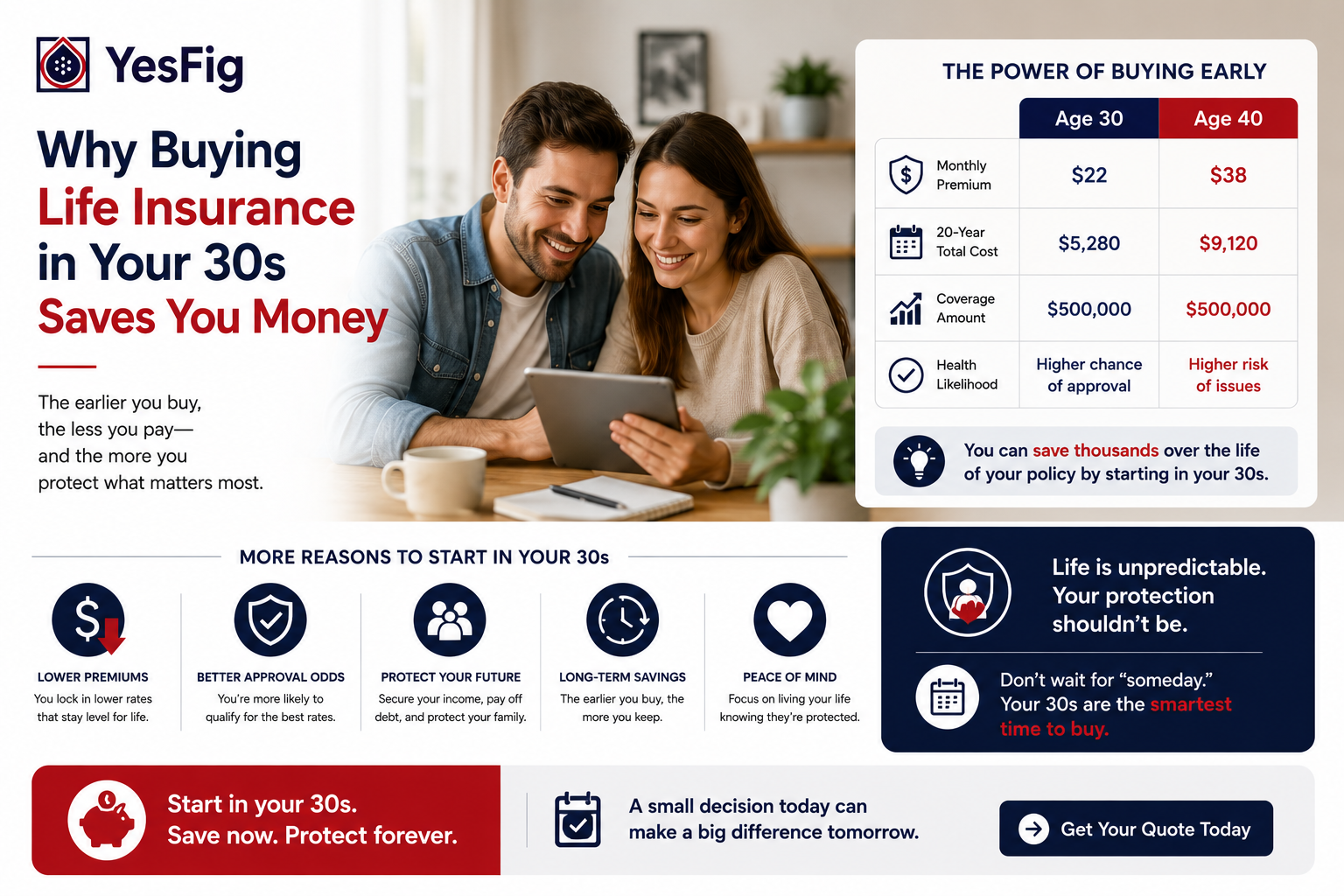
Why Buying Life Insurance in Your 30s Saves You Money
Buying life insurance in your 30s locks in lower rates for decades. Here's why waiting costs more, what term coverage runs, and how to start with Yesfig.
Why Buying Life Insurance in Your 30s Saves You Money
Quick answer: Buying life insurance in your 30s saves money because premiums are based largely on your age and health, and both are usually at their best now. Lock in a level term policy today and your rate stays fixed for the whole term, even as you get older or your health changes.
Table of contents
- Why life insurance in your 30s is so affordable
- How much does life insurance in your 30s cost?
- Why waiting costs you more every year
- Term vs. whole life: which fits your 30s?
- How much coverage do you actually need?
- How to lock in a low rate in three steps
- Frequently asked questions
Marcus is 33, just bought a place in Sacramento with his partner, and only started thinking about life insurance when the mortgage paperwork made the stakes feel real. His first assumption was the common one: that life insurance in your 30s is something you can safely put off until later. It's the opposite. Your 30s are usually the cheapest decade you'll ever have to buy it, and every year you wait quietly raises the price.
If anyone depends on your income, a partner, a kid, a co-signer on that mortgage, this is the money question worth answering now. Here's why buying early saves you real money, what coverage actually costs, and how to lock in a low rate before your next birthday does it for you.
Why life insurance in your 30s is so affordable
The price of life insurance comes down mostly to risk, and at 33 you're a low risk to insure. Insurers price a policy on your age, your health, and how long the coverage lasts, and in your 30s those first two are usually working in your favor. You're young enough that serious health conditions are statistically uncommon, so a term life policy bought now starts cheap.
That's the quiet advantage Marcus almost missed. A level term policy locks your monthly premium for the entire term, often 10, 20, or 30 years. Buy a 30-year term at 33 and you could still be paying that same low rate at 63, long after your risk profile has changed. Yesfig Insurance, a Los Angeles-based brand of Focus Insurance Group, offers term life in California starting at $9/mo, though your real rate depends on your profile.
New to this and not sure where to start?
That's normal, and it's exactly what Fig is for. Get plain-English answers about how term life coverage works before you commit to anything, with no pressure to buy today.
How much does life insurance in your 30s cost?
Honestly, less than most people guess. Term life is the most affordable type because it's pure coverage with no investment or cash-value component attached, so you're only paying for the protection itself. Your premium is set by your age, your health, the coverage amount, and the term length, which means two 33-year-olds can pay very different rates.
In your 30s, a healthy non-smoker often pays a modest monthly figure for a meaningful amount of coverage, far less than the same policy would cost a decade later. Rather than guess, it's worth pulling a real quote, since the number is personal to you. You can compare Yesfig's term life options for California in a few minutes and see where you land.
Good to know: Life insurance in California is regulated by the California Department of Insurance, and rates are based on real underwriting factors like age and health, not guesswork. A quote is an estimate until underwriting confirms it, so treat any starting price as a floor, not a promise.
Why waiting costs you more every year
Here's the part that turns this from interesting to urgent: the price only moves one direction. Each birthday nudges your rate up a little, because age is one of the biggest pricing factors. Wait from 33 to 43 and you're not paying the 33-year-old price anymore, even for the exact same policy.
Health is the other moving piece. A condition that shows up in your 40s, high blood pressure, a borderline lab result, a new prescription, can raise your rate or make coverage harder to qualify for. Lock in a level term policy while you're healthy and you freeze today's price against tomorrow's surprises. That's the real cost of waiting, not just a higher number but the risk that the door narrows.
The stakes are simple and worth stating plainly once. Without coverage, the people who count on you could be left covering a mortgage or debts on one income instead of two. You can browse more coverage guides on the Yesfig insurance blog if you want to think it through first.
Already have a policy or a quote in hand?
Smart move to double-check it. Yesfig reviews what you've got, flags any gaps, and shows you whether you can do better on price or coverage. Compare your term life coverage and see how it stacks up.
Term vs. whole life: which fits your 30s?
The choice usually comes down to two types, and for most people in their 30s, term life is the practical winner. Term covers you for a set number of years and costs less, which makes it ideal for the stretch when others depend on you most: the mortgage years, the kid-raising years, the building-savings years.
Whole life (a type of permanent coverage) lasts your whole life and builds cash value, but it costs significantly more for the same death benefit. It can make sense for specific estate or long-term planning goals, though it's overkill for the typical 33-year-old who mainly wants to protect an income. Many people add a complementary accidental death policy later if they want an extra layer.
For Marcus, a 20- or 30-year term lined up perfectly with the years his partner would lean on his paycheck. That's the honest rule of thumb: match the term length to how long someone needs your income, and don't pay for more structure than you'll use.
How much coverage do you actually need?
A common starting point is to replace several years of your income, then add anything your family would still owe without you. Think the mortgage balance, any loans, and a cushion for everyday costs. Some people use a rough multiple of annual salary as a first pass, but the right number is the one that actually clears your real obligations.
Run a quick tally: outstanding debts, the years until your kids are independent, and what your household needs to stay afloat. It doesn't have to be perfect on the first try. A licensed Yesfig advisor can walk through it with you and adjust the coverage amount so you're not underinsured or paying for more than you need.
Key takeaways
- Buying life insurance in your 30s locks in lower rates while your age and health are on your side.
- A level term policy freezes your premium for the full term, often 10 to 30 years.
- Waiting raises the price every year and risks a health change closing the door.
- Term life fits most 30-somethings better than pricier whole life.
How to lock in a low rate in three steps
You don't need to overthink this. Here's the whole path in three steps:
- Figure out your number. Add up the income years, debts, and the mortgage you'd want covered.
- Get a term quote in minutes. Answer a few questions and see a real rate for your age and health.
- Lock it in. Once you're approved, your level term premium is fixed, and you're done thinking about it.
That's it. Marcus finished all three in an afternoon and hasn't had to revisit it since. The hardest part is starting, and starting is the part that saves you the most.
Frequently asked questions
Is it really cheaper to buy life insurance in your 30s?
Yes. Premiums are based heavily on age and health, and both are typically at their best in your 30s. A level term policy bought now locks in that low rate for the whole term, so you keep paying the younger-you price even decades later, even as your age and health change.
How much life insurance do I need in my 30s?
Enough to replace several years of your income and cover what your family would still owe, like the mortgage and other debts. A common first pass is a multiple of your annual salary, but the right amount is the one that clears your real obligations. A licensed advisor can help you fine-tune it.
Should I get term or whole life in my 30s?
For most people in their 30s, term life makes more sense. It costs far less and covers the years others depend on your income, like the mortgage and child-raising years. Whole life builds cash value but costs much more, so it suits specific long-term planning goals rather than basic income protection.
Does Yesfig offer life insurance outside California?
Yesfig's term life and accidental death coverage are available in California only. Several other Yesfig lines, including auto, home, renters, pet, and health, are offered in California, Texas, Illinois, Pennsylvania, Ohio, and Florida. For life insurance specifically, Yesfig serves California residents.
What happens to my rate if my health changes after I buy?
Nothing, as long as you keep a level term policy in force. Your premium is locked when you're approved, so a condition that develops later does not raise it. That's the main reason to buy while you're young and healthy, before a health change can affect your price or eligibility.
The math really is this simple: the younger you lock in, the less you pay, for the entire life of the policy. Your 30s give you a window where coverage is cheap and qualifying is easy, and that window narrows a little every year. Like Marcus, you can settle it in an afternoon and stop carrying the worry.
Ready to lock in a low rate?
Get a term life quote in minutes with Yesfig. Coverage in California starts at $9/mo, and a licensed advisor is there if you want a real person in the loop. Future-you will thank you.
About the Author

Mathew Bahadori
CEO, Yesfig Insurance
Leading the company’s mission to make insurance more accessible, modern, and customer-focused. With a passion for innovation and personalized service, he continues to help individuals and families find smarter coverage solutions for life, auto, home, health, and business insurance.