
June 18, 2026
How to Read an Auto Insurance Declarations Page
Learn how to read an auto insurance declarations page: what each section means, your coverages and limits, deductibles, and how to spot gaps or errors fast.
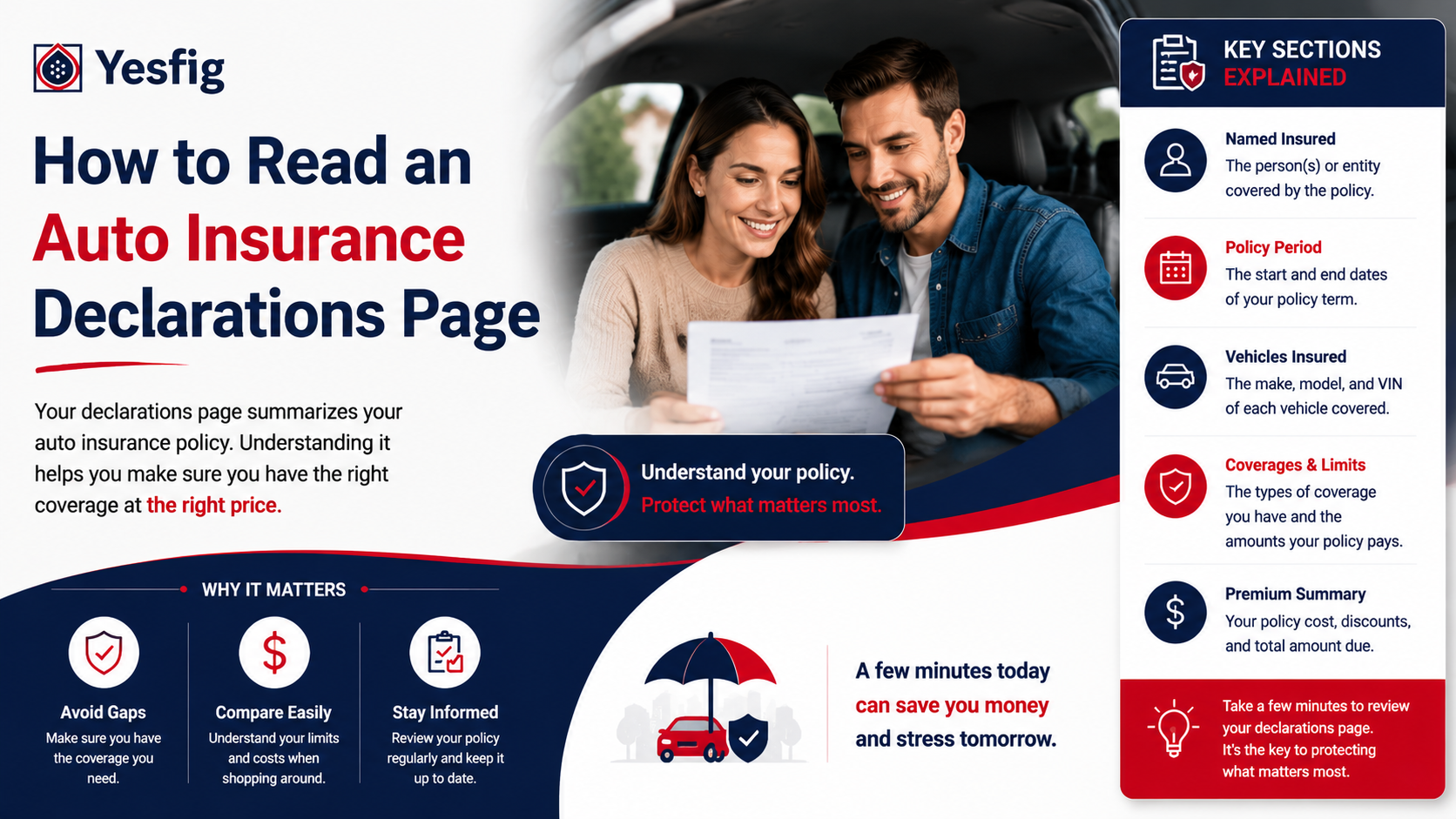
How to Read an Auto Insurance Declarations Page
Quick answer: An auto insurance declarations page is the one-page summary of your policy. It lists who's insured, the policy period, your vehicles, your coverages and limits, your deductibles, the premium, and any lienholder. Reading it tells you exactly what you're covered for, and checking it catches errors or gaps before they cost you.
Table of contents
- What an auto insurance declarations page is
- The key sections, line by line
- Understanding your coverages and limits
- What to check on your auto insurance declarations page
- When you'll need your declarations page
- Frequently asked questions
Vivian's auto lender asked her to send over her "declarations page," and she froze. She had a dozen insurance PDFs and no idea which one that was, or what it was supposed to tell her. If insurance paperwork makes your eyes glaze, you're not alone. Learning to read an auto insurance declarations page takes about five minutes and turns a confusing document into the single clearest summary of what you're actually covered for.
Once you know what each section means, you can spot a missing coverage or a wrong limit at a glance. Here's the whole page, decoded.
What an auto insurance declarations page is
Your declarations page, often called the "dec page," is the summary sheet at the front of your policy documents. Think of it as the cover page that tells you, in one place, the essentials of your coverage without the dense legal language.
It's important to know what it isn't, too. The dec page is a summary, not the full policy contract. The complete contract spells out definitions, conditions, and exclusions in detail, while the dec page gives you the quick, personalized snapshot: your specifics filled into the policy.
That makes it the first thing to read whenever you want to understand or confirm your coverage on a California auto insurance policy. It answers the question "what do I actually have?" faster than anything else in the file.
Staring at your policy and lost?
The dec page is the part to start with. Fig can walk you through each line so you know exactly what you're covered for, in plain English. Start with the basics of auto insurance in California.
The key sections, line by line
Most dec pages follow a similar layout. Here's what you'll find and what each part means:
- Named insured and address. Who the policy covers and where the vehicles are garaged.
- Policy number and period. Your reference number and the exact start and end dates of coverage.
- Insured vehicles. Each car by year, make, model, and VIN, so you know precisely what's covered.
- Coverages and limits. Every coverage you carry, with the maximum the insurer will pay for each.
- Deductibles. What you pay out of pocket before collision or comprehensive coverage kicks in.
- Premium. The total cost, sometimes broken down by coverage or vehicle.
- Discounts and lienholder. Any discounts applied, plus a finance company or lessor if your car is financed or leased.
Run your eyes down those sections and you've read the whole page. Each one is a fact about your coverage, not a riddle.
Understanding your coverages and limits
The coverages section is the heart of the page, and the limits are what matter most. Liability is usually shown as three numbers, a format worth knowing.
Good to know: Your declarations page is a summary, not the full policy contract, which contains the detailed terms. Liability limits often appear as three numbers, like 100/300/100, for bodily injury per person, per accident, and property damage. In California, the minimum is 30/60/15 as of 2026. Yesfig writes auto coverage in California and five other states.
Beyond liability, you'll see collision (repairs to your car after a crash) and comprehensive (non-crash damage like theft or weather), each with its own deductible. You may also see uninsured/underinsured motorist coverage, medical payments, rental reimbursement, and roadside assistance. If a coverage you expected isn't listed, you don't have it, which is exactly the kind of thing the dec page reveals.
Key takeaways
- The dec page is the quick summary of your entire auto policy.
- It shows your named insured, vehicles, coverages, limits, and deductibles.
- Liability limits usually appear as a three-number split, like 100/300/100.
- Checking it regularly catches errors, gaps, and missing discounts.
What to check on your auto insurance declarations page
Reading the page is most valuable when you use it to catch problems. Run this quick audit whenever a new dec page arrives:
- Confirm the basics. Check that the named insured, address, and policy period are all correct.
- Verify your vehicles. Make sure every car and its VIN is listed accurately, with none missing or wrong.
- Check coverages and limits. Confirm your liability limits, collision, comprehensive, and deductibles match what you think you bought.
- Review the lienholder. If you finance or lease, make sure the lender or lessor is listed correctly, since they often require it.
An error here can mean a denied claim or a coverage gap you didn't know about. Catching it on the page beats discovering it after an accident. A licensed Yesfig advisor can review yours if anything looks off.
When you'll need your declarations page
This document comes up more often than you'd think, so it helps to know where yours lives. You'll typically need it when:
- A lender or lessor asks for proof you're carrying required coverage.
- You're filing or discussing a claim and need to confirm your limits.
- You're switching insurers and want to match your current coverage exactly.
- You simply want to review what you have at renewal time.
Keep a current copy somewhere easy to reach, digitally or on paper. When you switch or shop, matching the coverages on your dec page is the cleanest way to compare quotes fairly.
Frequently asked questions
What is an auto insurance declarations page?
It's the summary sheet at the front of your auto policy that lists your key details: the named insured, policy number and period, insured vehicles, coverages and limits, deductibles, premium, and any lienholder. It gives you a quick, personalized snapshot of your coverage, separate from the full policy contract, which contains the detailed terms and conditions.
Where do I find my declarations page?
It's usually the first page or two of your policy documents, whether mailed or downloaded from your insurer's website or app. If you can't locate it, your insurer can resend it quickly. It's worth keeping a current copy handy, since lenders, claims, and plan comparisons all tend to require it.
What information is on a declarations page?
The named insured and address, policy number and period, each insured vehicle with its VIN, your coverages and their limits, deductibles, the total premium, any discounts, and any lienholder or lessor. Some pages also list rated drivers and the policy forms attached. Together it's a complete snapshot of what your policy covers and for how much.
Is a declarations page the same as proof of insurance?
They're related but not identical. The dec page summarizes your full coverage, while the small insurance ID card is what you usually carry as proof in the car. That said, lenders and some agencies often accept or specifically request the declarations page as proof of the coverage you carry, since it shows the details an ID card doesn't.
What should I check on my declarations page?
Confirm the named insured, address, and policy dates are correct, that every vehicle and VIN is listed accurately, and that your coverages, limits, and deductibles match what you intended to buy. If you finance or lease, verify the lienholder is listed. Catching an error or gap here prevents denied claims and surprises after an accident.
Five minutes that pay off
An auto insurance declarations page isn't paperwork to fear, it's the clearest map of your coverage you'll ever get. Learn the sections, check the basics, verify your limits, and you'll know exactly what you have and spot anything missing. Like Vivian found out, the document that looked intimidating turned out to be the most useful page in the whole file.
Ready for a policy you fully understand?
Get an auto insurance quote with Yesfig in minutes, and get a declarations page that's easy to read with a licensed advisor to explain every line. Coverage starts around $30/mo.
About the Author

Mathew Bahadori
CEO, Yesfig Insurance
Leading the company’s mission to make insurance more accessible, modern, and customer-focused. With a passion for innovation and personalized service, he continues to help individuals and families find smarter coverage solutions for life, auto, home, health, and business insurance.