
June 6, 2026
How to Compare Pet Insurance Plans Across Carriers
Learn how to compare pet insurance plans across carriers in California, from reimbursement rates to fine print, so you pick the right coverage for your pet.
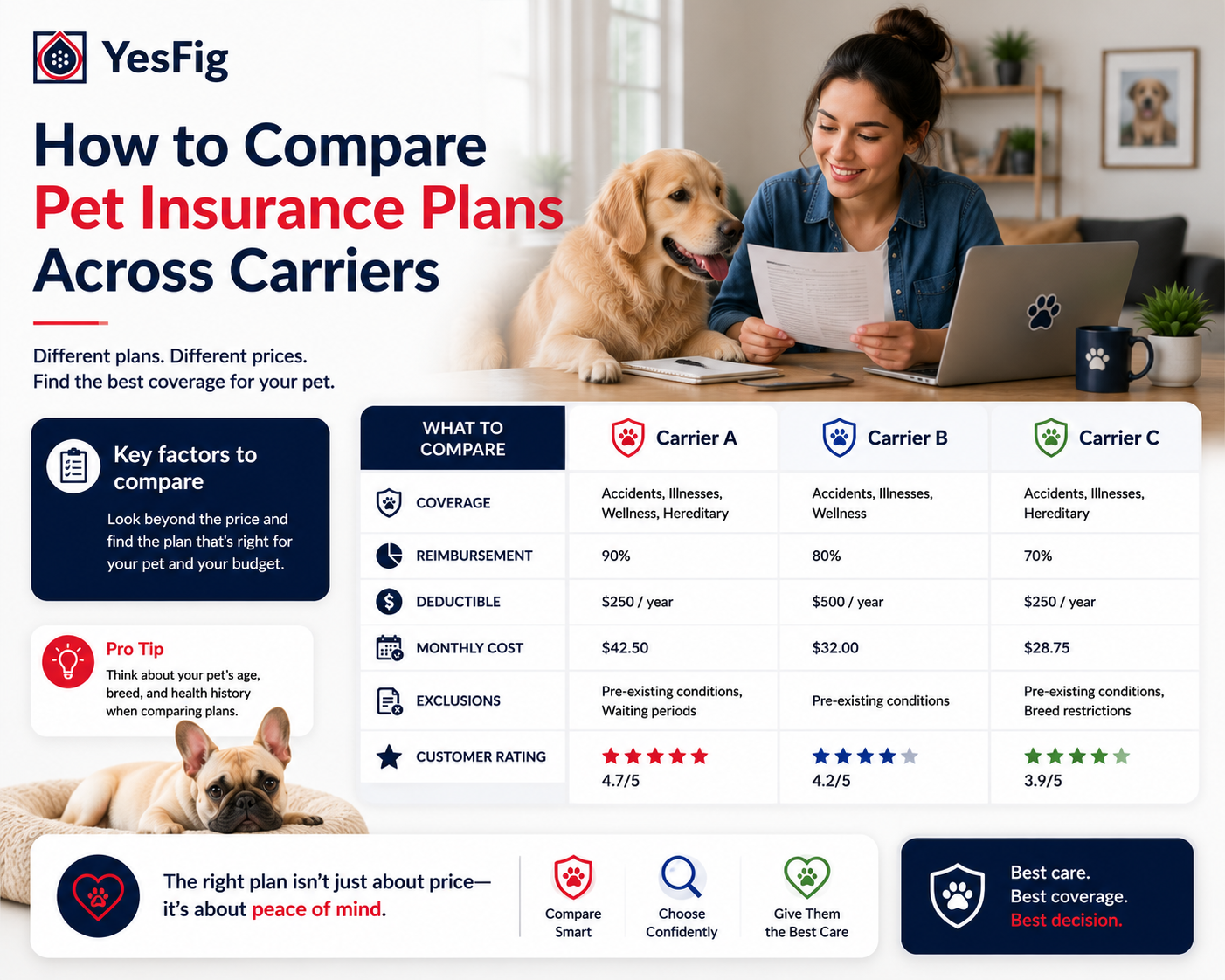
How to Compare Pet Insurance Plans, Carrier by Carrier
Quick answer: To compare pet insurance plans across carriers, line them up on the same five points: what's covered, the reimbursement rate, the deductible, the annual payout limit, and the waiting periods. Then read each plan's exclusions before you commit, since that's where two "similar" plans really differ.
Table of contents
- Start with what your pet actually needs
- The five things that actually differ between plans
- Read the fine print: exclusions that catch people off guard
- How to compare pet insurance plans apples-to-apples
- How much pet insurance costs in California
- Frequently asked questions
Dani just adopted a two-year-old rescue mutt named Biscuit in Sacramento, and now she has six browser tabs open, each one a different pet insurance quote. They all look kind of the same. They all say "comprehensive." The prices are all over the place. If you want to compare pet insurance plans without losing an afternoon to fine print, the trick is knowing which five things actually matter and ignoring the marketing around them.
Here's the good news: pet plans are easier to line up than they look, once you know where to point your eyes.
Start with what your pet actually needs
Before you compare anything, get clear on your pet. A healthy young kitten and a nine-year-old Labrador need very different things, and the "best" plan is the one that fits the animal in front of you.
Jot down three facts: your pet's age, breed, and any known health issues. Age affects price and eligibility, breed flags hereditary risks (hip dysplasia in big dogs, heart conditions in some cats), and existing conditions matter because almost no carrier covers a pre-existing condition. Once you have those three things, every plan you look at gets easier to judge.
Still figuring out what coverage your pet needs?
That's exactly what Fig is for. Explore your pet insurance options and get plain-English answers about what's covered before you commit to a single plan.
The five things that actually differ between plans
Most pet policies sound identical in the headline. They split apart on five details, so this is where you compare pet insurance plans for real.
- Coverage type. Accident-only is cheapest and covers injuries (a swallowed sock, a broken leg). Accident and illness adds sickness, cancer, and chronic conditions, and it's what most owners actually want. Wellness add-ons cover routine care like vaccines and dental cleanings.
- Reimbursement rate. After your deductible, the plan pays back a percentage of the vet bill, usually 70%, 80%, or 90%. A higher rate means a higher premium but less out of pocket when something goes wrong.
- Deductible. This is what you pay before coverage kicks in. Watch for per-incident deductibles (you pay it for each new condition) versus annual deductibles (once a year, then you're done).
- Annual payout limit. The most the plan will reimburse in a year. Some offer unlimited coverage, others cap at a set dollar amount, and a low cap can leave you exposed during a big surgery year.
- Waiting periods. The gap between signing up and coverage starting. Accidents often clear in a few days, illnesses in two weeks, and orthopedic issues like a torn cruciate ligament can have a longer wait.
Good to know: Two plans can both advertise "$5,000 coverage" and pay out completely differently. One might reimburse 90% after a $250 annual deductible, the other 70% after a $500 per-incident deductible. The headline number is not the whole story, so always check all five points together.
When you stack the plans side by side on these five, the cheap one that looked great often turns out to have a low payout cap or a per-incident deductible that adds up fast.
Read the fine print: exclusions that catch people off guard
This is where people get burned. Two plans can match on price and coverage level and still treat the same vet visit completely differently, all because of what's tucked into the exclusions.
The usual suspects: pre-existing conditions (anything your pet showed signs of before coverage started, almost always excluded), hereditary and congenital conditions (some carriers cover them, some don't, and this matters a lot for purebred dogs and cats), and bilateral conditions (if one knee was treated before you enrolled, the other knee may be excluded too). Dental illness, behavioral treatment, and prescription food are also commonly carved out.
Read the sample policy for each carrier, not just the quote page. If a plan won't show you the actual exclusions list before you buy, that's a reason to keep shopping.
Key takeaways
- Compare plans on five points: coverage type, reimbursement rate, deductible, annual limit, and waiting periods.
- The advertised coverage number means little without the deductible and reimbursement rate next to it.
- Exclusions, especially pre-existing and hereditary conditions, are where similar plans really diverge.
Want to see how your options stack up?
Yesfig reviews what each plan actually covers, maps the gaps, and shows you where you can get better coverage or a better price. Compare your pet insurance coverage in a few minutes, no pressure.
How to compare pet insurance plans apples-to-apples
The single biggest mistake is comparing a 90% plan against a 70% plan and calling the cheaper one "better." It isn't a fair fight. Here's a simple three-step plan that keeps it honest.
- Set one coverage level and hold it steady. Pick, say, 80% reimbursement, a $500 annual deductible, and an unlimited or matched payout limit. Quote every carrier at those same numbers.
- Line up the exclusions and waiting periods. Now that price reflects the same coverage, the differences in fine print become the real deciding factor.
- Get a quote and confirm the details before you sign. Check the waiting periods against your pet's age and read the exclusions one more time. Then lock it in.
Do it in that order and the right plan usually stands out on its own. Yesfig Insurance, a brand of Focus Insurance Group based in Los Angeles, was built around exactly this kind of side-by-side comparison, with Fig doing the legwork and a licensed human advisor available when you want one. The same apples-to-apples logic applies when you insure your home or shop any other coverage line.
Fig tip: Quote every carrier at the identical reimbursement rate and deductible first. Once the coverage matches, the price difference finally tells you something real.
How much pet insurance costs in California
Pet insurance in California typically runs a wide range depending on your pet's species, breed, age, and the coverage level you choose. Dogs usually cost more to insure than cats, and older pets cost more than young ones, since they're more likely to need care.
As an illustrative starting point, Yesfig advertises pet coverage from around $9 a month, though your actual quote depends on your pet and the plan you build. Treat any "starting at" figure as a floor, not a guarantee, and get a real quote for a real number. Pet coverage through Yesfig is currently available in California, Texas, Illinois, Pennsylvania, Ohio, and Florida. You can read more comparison guides in the Yesfig insurance blog as you narrow things down.
Skipping coverage entirely is the quiet risk here. One emergency surgery can run into the thousands, and without a plan that bill lands on you all at once. That's the gap the right policy closes.
Frequently asked questions
Does pet insurance cover pre-existing conditions?
Almost never. Most carriers exclude any condition your pet showed signs of before coverage started, even if it wasn't formally diagnosed. A few plans may cover a "curable" past condition after a symptom-free waiting period. This is why enrolling your pet while young and healthy usually gets you the broadest coverage and the lowest premium.
What's the difference between accident-only and accident and illness plans?
Accident-only plans cover injuries like broken bones, cuts, or swallowed objects, and they're the cheapest option. Accident and illness plans add sickness, infections, cancer, and chronic conditions on top of that. Most owners choose accident and illness because illnesses, not just accidents, drive the largest and most unexpected vet bills over a pet's life.
How does pet insurance reimbursement work?
With most pet plans, you pay your vet directly at the visit, then submit the bill to your insurer. After your deductible is met, the plan reimburses a set percentage, often 70%, 80%, or 90%, up to your annual limit. The money comes back to you, usually within a couple of weeks of filing the claim.
Do pet insurance premiums go up as my pet ages?
Usually, yes. Premiums tend to rise as your pet gets older because the likelihood of illness and injury increases with age. This is one reason many owners enroll while their pet is young, locking in a lower starting rate before age-related increases and before any condition becomes pre-existing and therefore excluded.
Is it worth comparing plans from more than one carrier?
Yes. Two plans at the same price can differ sharply on reimbursement rate, deductible structure, payout limits, and exclusions. Comparing at least a few carriers at the same coverage level is the only way to see which plan genuinely gives you the most protection for the money rather than just the lowest sticker price.
The bottom line
Comparing pet plans isn't about finding the cheapest tab, it's about lining the plans up fairly and reading the fine print before you choose. Set one coverage level, compare on the same five points, and check the exclusions. Dani did exactly that for Biscuit and landed on a plan she actually understands, which means the next emergency is a phone call, not a crisis.
Ready to cover your pet?
Get a pet insurance quote in minutes with Yesfig. Coverage starts at around $9 a month, Fig helps you compare options in plain English, and a licensed advisor is there whenever you want a human in the loop.
About the Author

Mathew Bahadori
CEO, Yesfig Insurance
Leading the company’s mission to make insurance more accessible, modern, and customer-focused. With a passion for innovation and personalized service, he continues to help individuals and families find smarter coverage solutions for life, auto, home, health, and business insurance.