
June 9, 2026
How to Compare Homeowners Insurance Across Carriers
How to compare homeowners insurance across carriers in California: match coverage, read the fine print, and weigh price against what you're really buying.
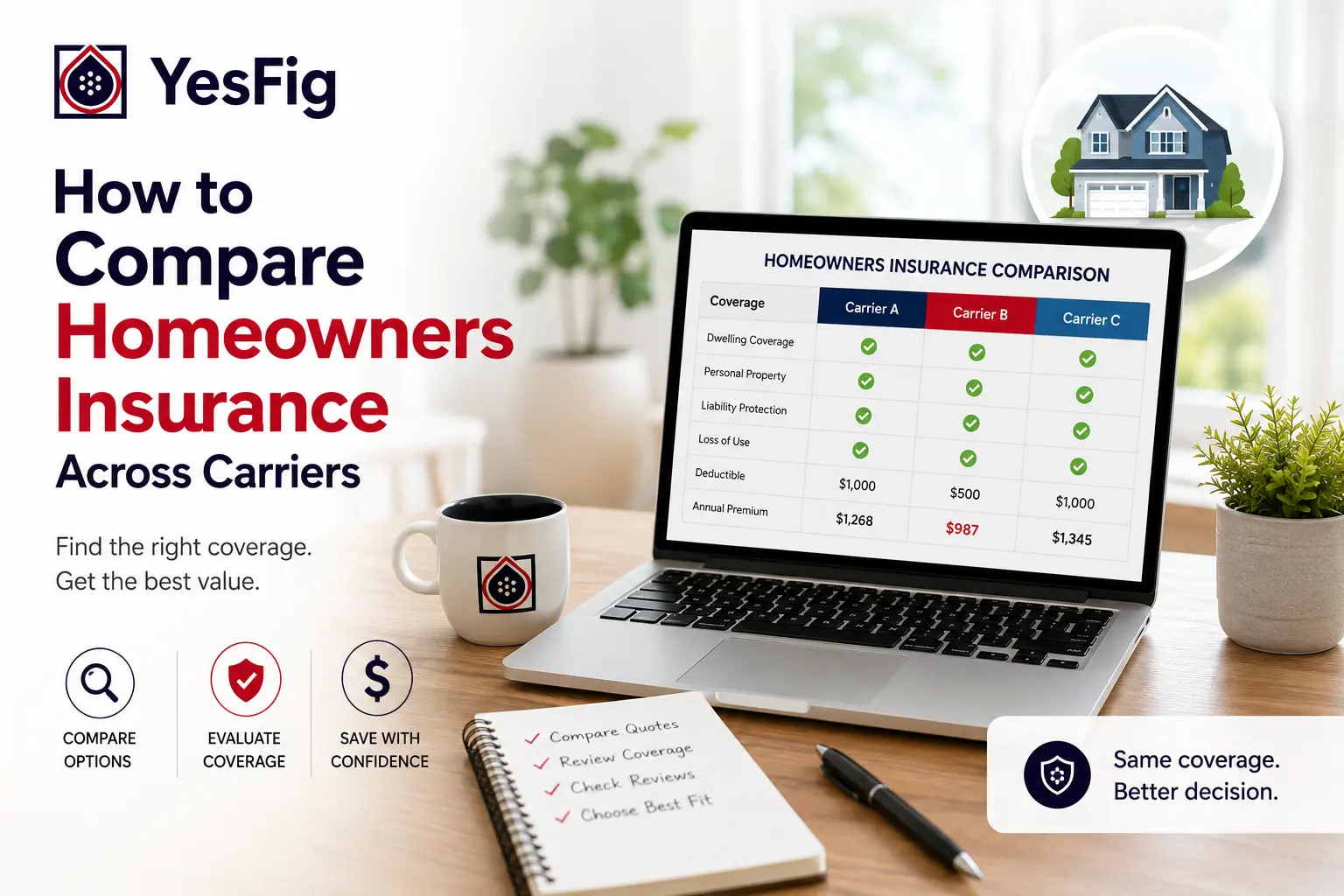
How to Compare Homeowners Insurance Across Carriers
Quick answer: To compare homeowners insurance across carriers, set the same dwelling limit, deductible, and replacement-cost settings on every quote, then read what each policy excludes (in California, earthquake and flood are usually separate). Weigh each carrier's financial strength and complaint record alongside price, not price alone.
Table of contents
- What you're actually comparing
- Why you can't just compare the price
- How to compare homeowners insurance across carriers in five steps
- The fine print that changes everything
- What California adds to the comparison
- How to compare homeowners insurance quotes without overpaying
- Frequently asked questions
Devon in Sacramento has three homeowners quotes open in three browser tabs, and the prices are all over the map. One's cheap. One's nearly double. And he can't tell whether he's looking at the same coverage or three different things wearing the same name. If that's you, the problem isn't picking the lowest number. It's knowing how to compare homeowners insurance so you're actually comparing like for like.
The good news: once you know which lines to line up, the differences get obvious fast. Here's the method.
What you're actually comparing
A homeowners policy isn't one thing. It's a stack of separate coverages, and two quotes can carry the same name while protecting very different amounts. Knowing the parts is what lets you compare them.
- Dwelling (Coverage A) pays to rebuild your home's structure. This should reflect rebuild cost, not market value.
- Other structures (Coverage B) covers detached things like a fence, shed, or garage.
- Personal property (Coverage C) covers your belongings inside.
- Loss of use (Coverage D) pays living expenses if you can't stay home after a covered loss.
- Liability (Coverage E) and medical payments (Coverage F) cover injuries and damage you're responsible for.
When you compare carriers, you're really comparing these six pieces, plus the deductible and the fine print. A cheaper quote often just has smaller numbers hiding in one of these slots.
Drowning in quotes that don't line up?
That's the hardest part of the whole process. Fig can walk you through what each line on a homeowners quote means, so the numbers finally make sense. Start with the basics of homeowners insurance in California before you compare anything.
Why you can't just compare the price
Price is the easiest number to read and the most misleading one to trust. A lower premium usually means lower dwelling limits, a higher deductible, weaker payout terms, or coverage that's quietly missing.
The classic trap is actual cash value versus replacement cost. A cheaper policy may pay only what your damaged roof or belongings are worth today, after years of depreciation. The pricier one may rebuild and replace at current cost. Same loss, very different check.
So the goal isn't the lowest quote. It's the lowest quote at the same protection. Until the coverage matches, you're comparing apples to a grocery list.
How to compare homeowners insurance across carriers in five steps
Here's the order of operations Devon followed to turn three confusing tabs into one clear choice.
- Pin down your rebuild cost and set the exact same dwelling limit on every quote.
- Match the deductibles and the replacement-cost settings so each policy pays out the same way.
- Read what's excluded (earthquake and flood, especially in California) and add endorsements where you need them.
- Check each carrier's financial strength and complaint record, not just the premium.
- Apply discounts and bundling, then compare the real out-the-door number side by side.
Five steps, and step one does most of the heavy lifting. Get the dwelling limit right and the rest falls into place.
Key takeaways
- Compare identical limits and deductibles, or you're not really comparing at all.
- Replacement cost beats actual cash value when you actually need to rebuild.
- In California, earthquake and flood are usually separate policies.
- A carrier's financial strength and claims record matter as much as price.
The fine print that changes everything
The headline numbers get the attention, but the fine print decides what you collect after a loss. A few details to read on every quote:
Deductible type. Some policies use a flat dollar deductible; others use a percentage of your dwelling limit for certain perils, which can be much larger than it looks.
Sub-limits. Standard policies cap payouts on jewelry, electronics, and similar items. If you own something valuable, you may need a scheduled endorsement to cover it fully.
Endorsements and exclusions. Things like water backup, ordinance-or-law coverage, and extended replacement cost aren't always included. Two quotes can differ by hundreds of dollars purely on which add-ons are baked in. The same care pays off when you bundle it with an auto insurance policy, since the discounts and terms vary by carrier too.
What California adds to the comparison
California homeowners have a few extra boxes to check, because the state's risks don't fit a standard policy neatly.
Good to know: A standard California homeowners policy typically excludes earthquake and flood damage. Earthquake coverage is usually a separate policy, often through the California Earthquake Authority, and flood is its own policy too. If you can't find coverage on the open market, the California FAIR Plan is the backstop.
Wildfire risk also shapes availability and pricing in many parts of the state, so quotes can vary more than you'd expect from one carrier to the next. When you compare, confirm how each policy handles wildfire and whether your area affects eligibility. This is exactly where matching coverage matters most, because a cheaper quote may simply be covering less of California's real risk.
How to compare homeowners insurance quotes without overpaying
Once your coverage is matched, you can finally chase savings without cutting protection. A few levers move the price honestly:
Bundling. Pairing home and auto with one carrier usually trims both premiums, and it's the most common discount worth asking about.
Deductible. A higher deductible lowers your premium, as long as you keep enough set aside to actually pay it after a claim.
Carrier quality. A slightly higher premium from a financially strong insurer with a clean complaint record can be the better deal, because the policy is only as good as the company paying the claim. Yesfig Insurance, a brand of Focus Insurance Group based in Los Angeles, writes homeowners coverage in California and five other states, so the comparison stays grounded in your local rules.
Want someone to line the quotes up for you?
Yesfig can put your options side by side at matching coverage levels, so you see the real difference instead of guessing. Compare homeowners coverage the apples-to-apples way, and bring questions to a licensed Yesfig advisor if the fine print gets murky.
Frequently asked questions
What should I look at besides price when comparing homeowners insurance?
Match the coverage first: the same dwelling limit, deductible, and replacement-cost settings on every quote. Then check what's excluded, the sub-limits on valuables, and any endorsements included. Finally, weigh each carrier's financial strength and complaint history, since the cheapest policy is worthless if the company is slow or unable to pay claims.
Does homeowners insurance cover earthquakes or floods in California?
Usually not. A standard California homeowners policy typically excludes both earthquake and flood damage. Earthquake coverage is generally a separate policy, often offered through the California Earthquake Authority, and flood coverage is its own policy as well. When comparing carriers, confirm these are handled separately so you aren't surprised after a loss.
What is replacement cost vs. actual cash value?
Replacement cost pays to repair or replace damaged property at today's prices, with no deduction for age. Actual cash value pays only what the item is worth now, after depreciation, which usually means a smaller check. When comparing policies, replacement cost on both your dwelling and belongings offers stronger protection, though it often costs a bit more.
How much dwelling coverage do I need?
Enough to fully rebuild your home at current construction costs, not its market or purchase price. The two numbers can differ widely. Set the same accurate rebuild figure on every quote so carriers are competing on equal footing, and consider extended replacement cost in case rebuilding prices climb after a widespread event.
Is it cheaper to bundle home and auto insurance?
Often, yes. Most carriers offer a discount for keeping home and auto together, and it's usually one of the largest discounts available. Just make sure the bundled coverage still matches what you'd get separately, since a cheaper bundle isn't a deal if either policy quietly carries weaker limits or terms.
Comparing on purpose, not by accident
Comparing homeowners insurance comes down to one habit: line up the coverage before you look at the price. Match the dwelling limit, the deductible, and the payout terms, read the exclusions, and check who's actually behind the policy. Do that, and like Devon, three confusing tabs turn into one confident choice.
Ready to choose with confidence?
Get a homeowners insurance quote with Yesfig in minutes. A licensed advisor can help you match limits across carriers and make sure nothing important is hiding in the fine print.
About the Author

Mathew Bahadori
CEO, Yesfig Insurance
Leading the company’s mission to make insurance more accessible, modern, and customer-focused. With a passion for innovation and personalized service, he continues to help individuals and families find smarter coverage solutions for life, auto, home, health, and business insurance.