
May 27, 2026
How to Compare Car Insurance Quotes the Right Way
Learn how to compare car insurance quotes the right way: match coverage apples to apples, spot hidden gaps, and find a fair price in California.
How to Compare Car Insurance Quotes the Right Way
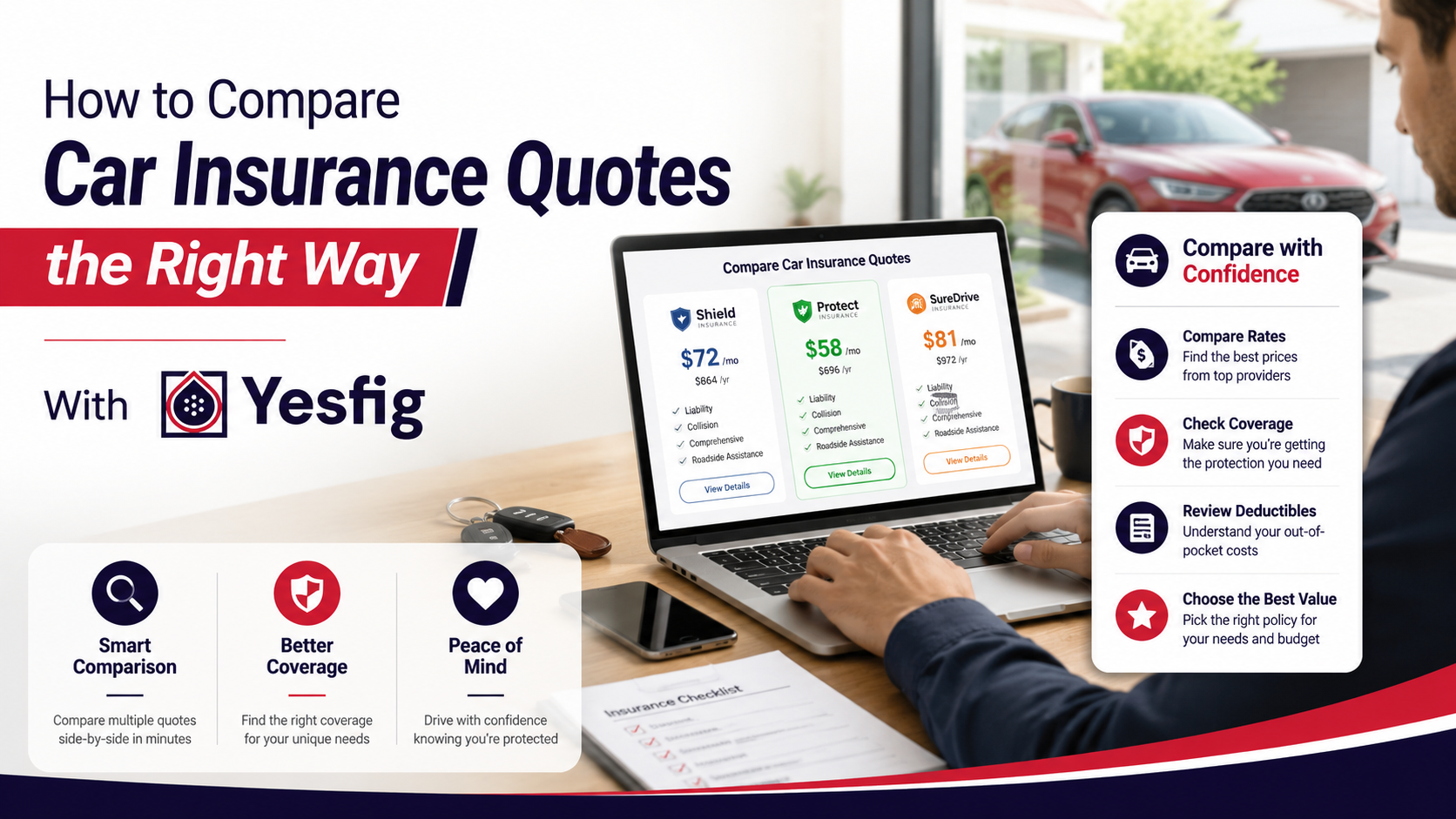
Quick answer: To compare car insurance quotes the right way, line up the same coverage limits, deductibles, and add-ons across every quote before you look at price. The cheapest number often means less protection. Match coverage first, then compare the premium, so you're weighing equal policies, not just chasing a low headline rate.
Table of contents
- Why most quote comparisons go wrong
- Match coverage before you match price
- The six coverage types you're actually comparing
- What California requires at a minimum
- The line items that actually change your premium
- A simple 3-step way to compare
- How to read a quote line by line
- Red flags hiding in a cheap quote
- Discounts and bundling worth asking about
- When to compare, and how often
- Frequently asked questions
You pulled five car insurance quotes, lined up the monthly prices, and circled the lowest one. Feels like smart shopping. It usually isn't. The number at the bottom of a quote tells you almost nothing on its own, because two quotes that look identical can protect you in completely different ways.
The real enemy here is the apples-to-oranges quote, the comparison that looks fair but isn't. It hides behind a low price, swaps out coverage you didn't notice was missing, and shows up months later when you file a claim and find a gap. Beat that one trap, and you'll actually know which car insurance quote is the better deal. This guide walks you through exactly how to do that, from the coverage types to the California rules to the red flags, so by the end you can put any set of quotes side by side and know which one wins.
Why most quote comparisons go wrong
Most comparisons go wrong because people sort by price first and coverage never. A $30/mo quote and a $70/mo quote can look like an easy choice until you realize the cheap one carries bare-minimum liability, a sky-high deductible, and no collision coverage at all. You're not comparing two prices for the same thing. You're comparing two different things that happen to both be called car insurance.
That's the apples-to-oranges trap in action. It thrives on one wrong assumption: that a quote is a quote. In reality, every quote is a bundle of choices, limits, deductibles, and add-ons, and changing any one of them moves the price. Compare the prices without comparing the choices, and you're guessing.
The trap also hides behind formatting tricks. One company shows you a six-month premium, the next shows twelve months, and suddenly the pricier policy looks cheaper at a glance. Another quotes you at a $1,000 deductible while you assumed $500. Same logo, same coverage names, wildly different protection. None of it is illegal or even sneaky. It's just what happens when you let the price column do the thinking.
Still figuring out what you actually need?
No shame in that, car insurance is genuinely confusing. Fig can walk you through the coverage types in plain English and help you understand your California car insurance options before you commit to anything.
Match coverage before you match price
Comparing quotes the right way starts with one rule: match the coverage first, then compare the price. Set the same limits and deductibles across every quote, so you're holding everything equal except the premium. Only then does the price difference mean something.
Here's what to line up across each quote before you look at the cost:
- Liability limits (the part that pays for injury and damage you cause others), shown as three numbers like 30/60/15.
- Collision deductible (what you pay out of pocket before collision coverage kicks in).
- Comprehensive deductible (same idea, for theft, weather, and non-crash damage).
- Uninsured/underinsured motorist coverage, which matters a lot in California.
- Add-ons like roadside assistance, rental reimbursement, and gap coverage.
When all of those match, a price gap is a real signal. When they don't, the gap is just noise. Think of it like comparing two grocery carts: only fair if both hold the same items. Strip three things out of one cart and of course it rings up cheaper.
Good to know: A quote with a $1,000 deductible will almost always look cheaper than the same policy at a $250 deductible. That's not a better deal, it's just a bet that you won't file a claim. Set every quote to the same deductible before you judge the price.
The six coverage types you're actually comparing
Before you can match coverage across quotes, you need to know what each piece does. Most car insurance is built from the same six parts, and a quote is really just a recipe mixing these in different amounts.
- Liability coverage pays for injury and property damage you cause to other people. It's the legally required core of any California policy and splits into bodily injury and property damage.
- Collision coverage pays to repair or replace your own car after a crash, no matter who's at fault. Optional by law, but usually required if you finance or lease.
- Comprehensive coverage covers your car for things that aren't crashes: theft, vandalism, fire, falling branches, and animal strikes.
- Uninsured/underinsured motorist protects you when the other driver has no insurance or not enough. Given how many uninsured drivers share California roads, this one earns its keep.
- Medical payments (MedPay) helps with medical bills for you and your passengers regardless of fault.
- Add-on coverages like roadside assistance, rental reimbursement, and gap coverage round out a policy. Small line items that matter most on the worst day.
When you compare quotes, you're really comparing how much of each type you're getting and at what deductible. A cheap quote often wins by quietly shrinking or removing one of these.
What California requires at a minimum
As of 2026, California requires every driver to carry at least 30/60/15 in liability coverage: $30,000 for injury to one person, $60,000 for total injuries per accident, and $15,000 for property damage. Those minimums rose at the start of 2025, so an old policy you haven't touched in years may now sit under the legal floor without you knowing.
Minimum coverage is the legal floor, not the safe floor. If you cause a serious accident on the 405 and the damage runs past your limits, you pay the difference yourself, and modern medical bills and vehicle repairs blow past $15,000 fast. That's why comparing quotes only at the state minimum can be a false economy. The cheapest legal policy and the cheapest sensible policy are often not the same quote.
This is exactly where the apples-to-oranges trap does its quiet damage: it lets a minimum-coverage quote sit next to a well-protected one as if they're equals. They aren't. One leaves you exposed the moment a claim gets expensive, and that exposure doesn't show up anywhere in the monthly price.
Key takeaways
- Match limits, deductibles, and add-ons across every quote before you look at price.
- California's 2026 minimum liability is 30/60/15, but minimum rarely means enough.
- A cheaper premium usually means a higher deductible or stripped coverage, not a better deal.
- Soft-inquiry quotes don't hurt your credit, so shop freely.
The line items that actually change your premium
Once coverage is matched, a handful of factors explain most of the price differences you'll see between quotes. Knowing them helps you tell a fair quote from a junk one, and helps you understand why two drivers get very different numbers for the "same" policy.
- Deductible level. Higher deductible, lower premium, more risk on you when you file.
- Coverage limits. More protection costs more. That's the tradeoff you're choosing on purpose.
- Your driving record. Tickets and at-fault claims push rates up for years.
- Vehicle make and model. A car that's expensive to repair or commonly stolen costs more to insure.
- Where you live and park. A ZIP code in Los Angeles with heavy traffic and theft rates is priced differently than a quieter suburb.
- Annual mileage. Drive less and many insurers charge less.
- Discounts. Bundling auto with renters or homeowners coverage often trims both premiums at once.
If one quote is dramatically cheaper and every line item looks the same, that's your cue to dig, not to celebrate. Something usually doesn't match. Note that California has its own rules here too: insurers weigh your driving record, years of experience, and miles driven heavily, which is part of why a clean record moves your rate so much in this state.
Want to see how your current policy actually stacks up?
Yesfig reviews the coverage you already have, maps where it's thin or overpriced, and shows you the gaps in plain terms. Compare your car insurance side by side and find out in a few minutes whether you're overpaying.
A simple 3-step way to compare
You don't need a spreadsheet with twenty columns. You need three steps, done in order.
- Set your coverage target once. Decide your liability limits, deductibles, and must-have add-ons before you pull a single quote. This is your fixed yardstick, and it never changes from quote to quote.
- Quote that exact coverage everywhere. Get each quote at the same limits and deductibles. Now the only thing that varies is price and the company behind it.
- Compare price, then service. With coverage equal, pick on premium, claims reputation, and how easy the company is to actually reach when something goes wrong.
Do it in this order and the apples-to-oranges trap simply can't operate, because you've forced every quote onto the same terms. The cheapest matched quote is now genuinely the cheapest, not just the most stripped-down.
Fig tip: Quote your target coverage at two deductible levels, say $500 and $1,000, at the same time. Seeing both side by side shows you exactly what that extra risk is buying you in monthly savings, so you choose with your eyes open instead of guessing.
How to read a quote line by line
When a quote lands in front of you, read it top to bottom and check five things in order. This is how you turn a confusing one-page document into a clear comparison.
First, confirm the policy term: is this premium for six months or twelve? Everything else is meaningless until you know. Second, find the liability limits and make sure they match your target, not just the state minimum. Third, check both deductibles, collision and comprehensive, since a quote can lower its price by raising these without flagging it.
Fourth, scan for what's missing. Cheap quotes love to drop uninsured-motorist coverage or comprehensive entirely. The absence won't be highlighted, so you have to look for the gap yourself. Fifth, read the add-ons and fees: roadside assistance, rental reimbursement, and any policy or installment fees that quietly pad the real cost.
Run every quote through those same five checks and they stop being marketing documents and start being a fair comparison. Anything that doesn't line up is the trap trying to slip past you.
Red flags hiding in a cheap quote
A suspiciously low quote isn't automatically bad, but it earns a second look. Watch for a few specific things before you sign.
The most common red flag is stripped coverage: liability at the bare state minimum, no uninsured-motorist protection, or collision and comprehensive quietly dropped. Another is a deductible you can't actually afford, which makes the monthly price look great until the day you need to come up with $1,500 cash before any repair happens. A third is mismatched terms, a six-month premium displayed next to a twelve-month one, so the cheaper-looking quote is just covering half the time.
Two more worth knowing. Watch for teaser rates that apply only to the first term and jump at renewal, and for inflated "savings" claims that compare a stripped policy to your current full one. None of these show up if you only read the bottom-line price. All of them show up the moment you compare line by line. That's the whole game.
Discounts and bundling worth asking about
Two quotes can carry identical coverage and still land at different prices because of discounts. Before you decide, make sure each quote reflects every discount you actually qualify for, since an un-applied discount can make a fair quote look worse than it is.
Common ones to ask about include bundling (combining auto with homeowners or renters coverage), a clean-driving-record discount, low-mileage discounts if you don't drive much, good-student discounts, and savings for safety features like anti-theft devices. Bundling is often the biggest single lever. If you rent an apartment in California, pairing a renters policy with your auto coverage can lower both, and the same logic applies if you insure your home with the same company.
The point isn't to chase every discount. It's to make sure all your quotes are scored on the same discounts, so once again you're comparing equal policies and not accidentally penalizing one quote for a discount nobody applied.
When to compare, and how often
Compare car insurance quotes at every renewal, and any time your life changes. Rates drift upward quietly, and an old policy won't re-shop itself, so the single easiest way to catch a premium that's crept up is a quick comparison before you renew.
Beyond the calendar, certain life events are natural trigger points: moving to a new ZIP code, buying or paying off a car, adding a teen driver, getting married, or watching an old ticket finally fall off your record. Each of these can change your rate enough that the policy you compared two years ago is no longer the best fit. You can read more practical coverage breakdowns in the Yesfig insurance blog when you want to go deeper on a specific coverage type.
A fair comparison takes minutes now and can save you real money over a year. The trap only wins when you stop checking.
Frequently asked questions
Is the cheapest car insurance quote always the worst choice?
Not always, but a low price by itself tells you nothing. The cheapest quote is a good choice only when it carries the same coverage limits and deductibles as the pricier ones. If it's cheap because it strips protection or raises your deductible, it's not a deal, it's a gap waiting to surface at claim time.
How many car insurance quotes should I compare?
Three to five quotes is usually enough to see the real range for your profile in California. More than that rarely changes the picture and just adds noise. What matters far more than the number of quotes is that every quote uses identical coverage limits and deductibles, so you're comparing equal policies rather than guessing.
Does comparing car insurance quotes hurt my credit?
No. Getting car insurance quotes uses a soft inquiry that doesn't affect your credit score, unlike applying for a loan. You can shop and compare as many auto quotes as you want with no hit to your credit. Insurers may use a credit-based insurance score in pricing, but requesting a quote on its own is harmless.
What coverage do I really need beyond California's minimum?
Many California drivers carry more than the 30/60/15 minimum, often higher liability limits plus uninsured-motorist coverage, and collision and comprehensive if the car has real value. Minimum coverage meets the law but can leave you paying out of pocket after a serious crash. The right level depends on your car, assets, and budget.
How often should I compare car insurance quotes?
Compare at every renewal, usually every six or twelve months, and any time your life changes: a move, a new car, a new driver, or a dropped ticket. Rates drift and your old policy won't re-shop itself. A quick comparison at renewal is the easiest way to catch a premium that's quietly crept up.
Why are two quotes with the same coverage priced differently?
Even with matched coverage, price varies by insurer because each one weighs your driving record, ZIP code, vehicle, mileage, and discounts differently. One company may price your neighborhood or car model more favorably than another. That genuine price gap, on truly equal coverage, is exactly the difference worth shopping for.
Compare on equal terms and the right choice gets obvious
Comparing car insurance quotes isn't really about hunting for the lowest number. It's about forcing every quote onto the same coverage so the price finally means something. Match the limits, match the deductibles, account for the discounts, then compare, and the apples-to-oranges trap has nowhere left to hide. You end up with a policy you understand and a price you know is fair, then you stop thinking about it and get on with your life.
Ready to see a quote done right?
Get a car insurance quote with Yesfig, coverage matched to what you actually need, in minutes. Auto starts at $30/mo, Fig helps you compare on equal terms, and a licensed advisor from Yesfig Insurance, a brand of Focus Insurance Group, is there the moment you want a human in the loop.
About the Author

Mathew Bahadori
CEO, Yesfig Insurance
Leading the company’s mission to make insurance more accessible, modern, and customer-focused. With a passion for innovation and personalized service, he continues to help individuals and families find smarter coverage solutions for life, auto, home, health, and business insurance.