
June 12, 2026
How Pet Insurance Pays Out for an Emergency Vet Visit
How does pet insurance work when your pet needs the ER? See how the claim, deductible, and reimbursement play out after an emergency vet visit.
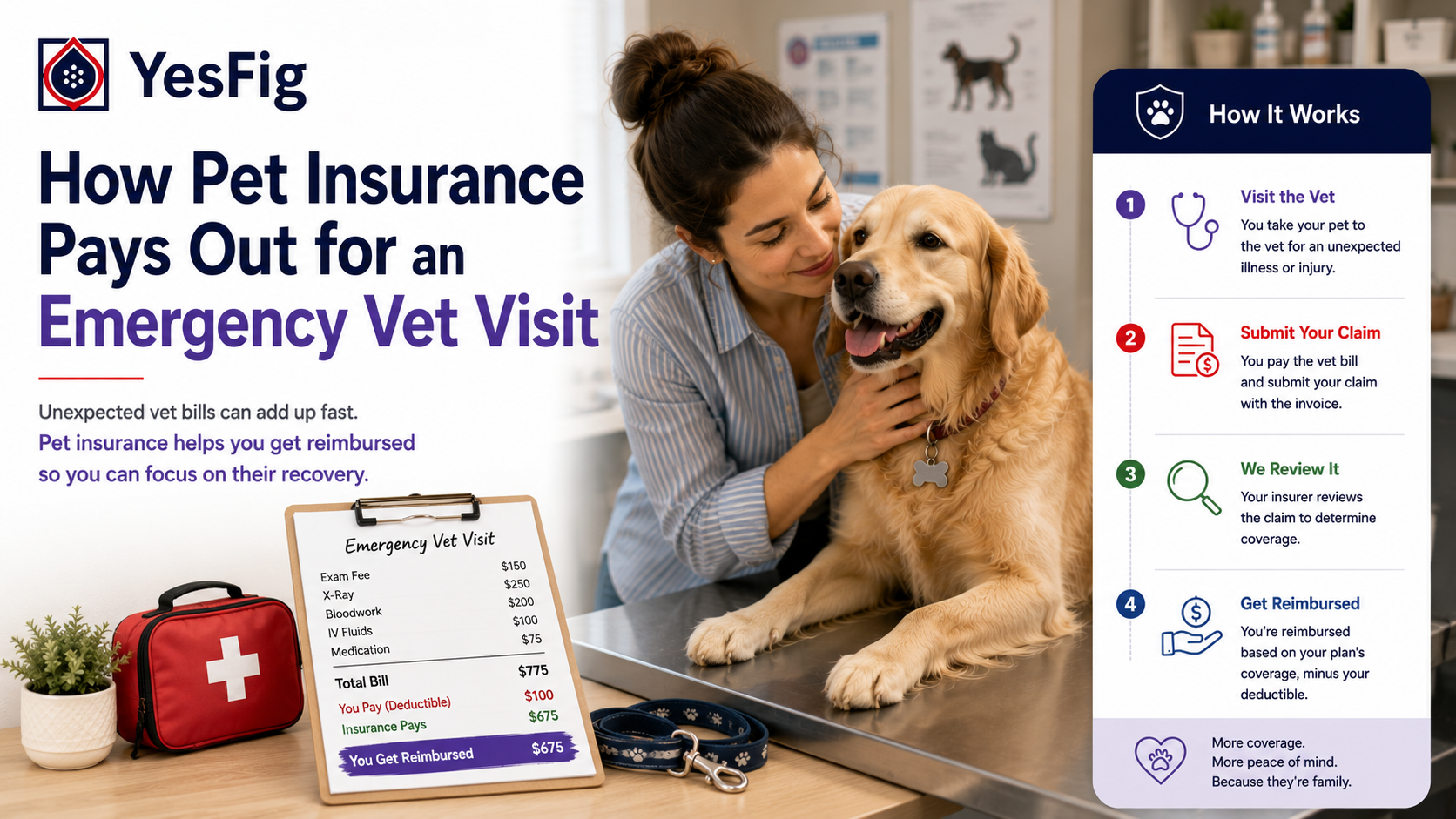
How Pet Insurance Pays Out for an Emergency Vet Visit
Quick answer: Pet insurance usually works by reimbursement. You pay the emergency vet, submit the itemized bill as a claim, and your insurer pays back a percentage of covered costs after your deductible. On a $4,000 emergency with a $250 deductible and 80% reimbursement, you'd typically get about $3,000 back.
Table of contents
- How pet insurance works: the reimbursement model
- Walking through an emergency vet visit, step by step
- The numbers: deductible, reimbursement rate, and limit
- What an emergency visit actually covers
- How fast does pet insurance pay out?
- How pet insurance works best in an emergency: be ready first
- Frequently asked questions
It's 11 p.m. when Dani's cat, Pixel, swallows something he absolutely shouldn't have. The emergency vet in Fresno runs through the options and quotes around $4,000 before they'll start. Dani has pet insurance but has never used it, and in that moment has no idea how it actually helps. If you've wondered the same thing, here's exactly how pet insurance works when your pet needs the ER, from the bill to the reimbursement.
The mechanics are simpler than the panic suggests. Once you know the flow, an emergency stops being a financial mystery on top of a medical one.
How pet insurance works: the reimbursement model
Most pet insurance runs on reimbursement, and this is the part that surprises first-time users. Unlike human health insurance, you generally pay the vet yourself, then your insurer pays you back for the covered portion afterward.
The flow looks like this: you get treatment, pay the bill, and submit a claim with the itemized invoice. The insurer reviews it and reimburses your covered share, usually by direct deposit or check. Some insurers can pay certain vets directly, but that's still the exception, not the rule.
So the policy doesn't make the bill disappear at the counter. It makes most of it come back to you shortly after. Knowing that ahead of time is half the battle, and it's worth confirming the details on a pet insurance policy before you ever need it.
Not sure how your plan would handle an ER bill?
That's worth knowing before 11 p.m. on a bad night. Fig can explain how your reimbursement, deductible, and limits would play out, in plain English. Start with the basics of pet insurance in California.
Walking through an emergency vet visit, step by step
Let's follow Pixel's $4,000 night from start to payout. The sequence is the same for almost any emergency.
- Treatment happens. The vet stabilizes and treats your pet, then presents the bill.
- You pay the vet. You cover the $4,000 upfront, often by card, and get an itemized invoice.
- You file the claim. Snap a photo of the invoice and submit it through your insurer's app or website.
- The insurer reviews it. They confirm the treatment is covered and apply your deductible and reimbursement rate.
- You get reimbursed. The covered share lands back in your account, typically within days to a couple of weeks.
The only part that requires money on the spot is step two. Everything after that is paperwork that puts most of the cost back in your pocket.
The numbers: deductible, reimbursement rate, and limit
Three settings decide your payout, so it helps to see them in action on Pixel's bill.
Deductible. This is what you pay before reimbursement kicks in. With a $250 annual deductible, the first $250 of the eligible bill is yours.
Reimbursement rate. This is the percentage the insurer pays of what's left. At 80%, they cover 80% of the remaining $3,750, which is $3,000.
Annual limit. This is the most your plan pays per year. As long as the bill sits under your limit, it doesn't reduce your payout.
So on a $4,000 emergency, you'd pay the $250 deductible plus the 20% you're responsible for, leaving you out about $1,000 while the insurer reimburses roughly $3,000. Choosing a lower deductible or higher reimbursement rate shifts more of that back to the insurer.
Key takeaways
- Most pet insurance reimburses you after you pay the vet, not before.
- Your payout is the covered cost minus the deductible, times your reimbursement rate.
- Accidents and emergencies are covered on accident-and-illness plans, after waiting periods.
- Filing quickly with an itemized invoice gets you paid faster.
What an emergency visit actually covers
On a solid accident-and-illness plan, the things that drive an ER bill are usually covered: diagnostics like X-rays and bloodwork, emergency surgery, hospitalization, and medications tied to the covered condition.
What's not covered is just as important to know. Pre-existing conditions are excluded, so anything your pet was already diagnosed with won't be paid. Anything still inside a waiting period isn't covered yet, and routine or wellness care typically needs a separate add-on.
Good to know: Most pet insurance works on reimbursement, meaning you pay the vet first and get paid back for the covered portion. Pre-existing conditions aren't covered, so enrolling before an emergency matters. California has consumer-protection rules requiring pet insurers to clearly disclose waiting periods and exclusions. Yesfig offers pet coverage in California and five other states.
This is the strongest argument for enrolling while your pet is healthy: emergencies are exactly when coverage pays off, and only a policy that was already active can help.
How fast does pet insurance pay out?
Faster than most people expect, especially with digital claims. Once you submit an itemized invoice, many insurers process the claim within a few days to a couple of weeks, then send reimbursement by direct deposit or check.
A few things speed it up. Submitting a complete, itemized invoice the first time avoids back-and-forth, and an app submission usually beats mail. If your pet has a history, including the relevant vet records helps the insurer confirm the claim quickly. The cleaner the paperwork, the faster the money comes back.
How pet insurance works best in an emergency: be ready first
The difference between a smooth claim and a stressful one is preparation, and it takes five minutes on a calm day. Before anything goes wrong:
- Know your numbers. Have your deductible and reimbursement rate memorized or saved.
- Keep policy info handy. Store your member details where you can reach them at midnight.
- Plan for the upfront cost. Keep a card or small buffer available, since you'll pay the vet first.
- Know the claim process. Download the app and know how to submit before you need to.
Do that and an emergency becomes a known process instead of a scramble. If you want help setting your deductible and reimbursement rate in the first place, a licensed Yesfig advisor can walk you through the trade-offs. Yesfig Insurance, a brand of Focus Insurance Group based in Los Angeles, makes the setup straightforward.
Comparing plans on more than just price?
Smart, because the reimbursement rate and deductible decide your real payout. Yesfig can line up pet plans so you see how each would handle an emergency. Compare pet insurance options side by side.
Frequently asked questions
How does pet insurance pay out after an emergency?
Most pet insurance reimburses you. You pay the emergency vet, submit the itemized bill as a claim, and the insurer pays back the covered portion after applying your deductible and reimbursement rate. The money typically arrives by direct deposit or check within days to a couple of weeks of an approved, complete claim.
How much will pet insurance reimburse for an emergency vet bill?
It depends on your deductible and reimbursement rate. On a $4,000 emergency with a $250 deductible and an 80% reimbursement rate, the insurer covers 80% of the remaining $3,750, or about $3,000, leaving you around $1,000 out of pocket. A lower deductible or higher reimbursement rate increases what comes back to you.
Do I have to pay the vet upfront?
Usually, yes. Because most pet insurance works on reimbursement, you typically pay the vet first and get paid back after filing a claim. Some insurers can pay certain vets directly, but it's not yet common. It's wise to keep a card or small financial buffer available so an emergency bill isn't a problem at the counter.
How long does a pet insurance claim take to pay?
Often a few days to a couple of weeks after you submit a complete, itemized claim. Digital submissions through an app or website are usually faster than mail. Including all required invoices and any relevant vet records the first time avoids follow-up requests, which is the most common reason a claim takes longer to pay.
Does pet insurance cover emergency vet visits?
Yes, on an accident-and-illness plan, emergency care like diagnostics, surgery, hospitalization, and related medications is generally covered, once any waiting periods have passed. Pre-existing conditions are excluded. That's why enrolling before an emergency happens is so important, since coverage only helps if the policy was already active when the problem arose.
A bad night, handled
When an emergency hits, pet insurance won't erase the bill at the counter, but it puts most of it back in your hands within weeks. Know your deductible, your reimbursement rate, and the claim process, and a $4,000 scare becomes a manageable bill. Like Dani learned with Pixel, the time to understand the payout is before the 11 p.m. emergency, not during it.
Ready to be covered before the emergency?
Get a pet insurance quote with Yesfig in minutes. Setting up coverage now means that when a $4,000 night comes, most of it isn't on you, and a licensed advisor can help you choose your deductible and reimbursement rate.
About the Author

Mathew Bahadori
CEO, Yesfig Insurance
Leading the company’s mission to make insurance more accessible, modern, and customer-focused. With a passion for innovation and personalized service, he continues to help individuals and families find smarter coverage solutions for life, auto, home, health, and business insurance.