
June 4, 2026
Homeowners vs Renters Insurance: Key Differences Explained
Homeowners vs renters insurance: who covers the building, who covers your stuff, and which one you actually need. A plain-English guide for California.
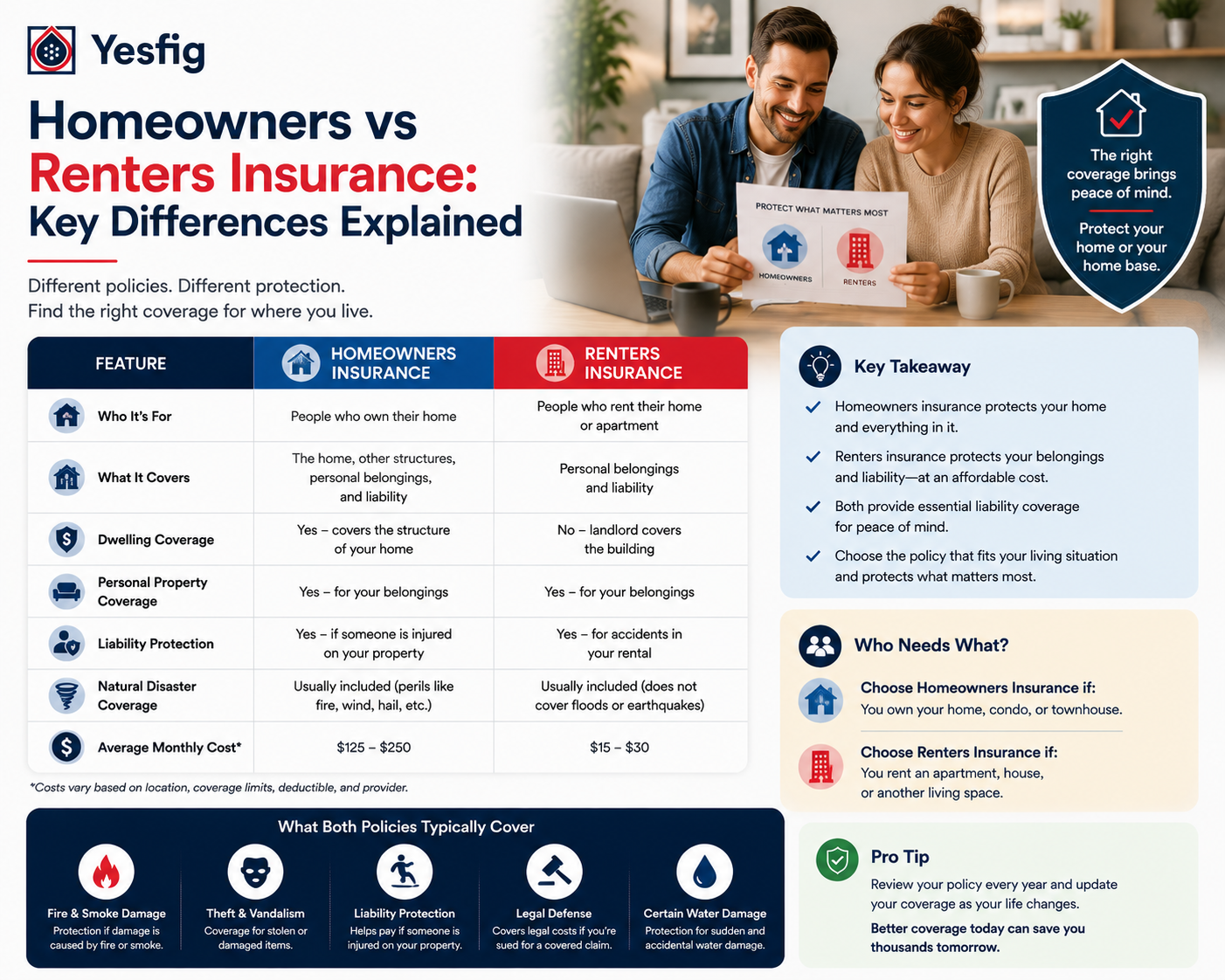
Homeowners vs Renters Insurance: What's Actually Different?
Quick answer: Homeowners insurance covers the building you own plus your belongings and liability. Renters insurance covers only your belongings and liability, since your landlord insures the building. If you own your home, you need homeowners. If you rent, you need renters. The big difference is who's responsible for the structure.
Table of contents
- What does homeowners insurance cover?
- What does renters insurance cover?
- Homeowners vs renters insurance: the side-by-side
- Homeowners vs renters insurance cost in California
- What neither policy covers (and how Californians fill the gap)
- Which one do you need?
- Frequently asked questions
Lena rented in Oakland for six years, then closed on her first house in Sacramento last month. She kept her renters policy the whole time and figured she'd just hold onto it. Then her lender asked for proof of homeowners insurance, and she realized the two policies aren't the same thing at all.
If you're somewhere on that renter-to-owner path, or just trying to sort out homeowners vs renters insurance, the short version is this: one insures a building you own, the other insures your things inside a building someone else owns. The rest is detail, and the detail is where people get caught.
What does homeowners insurance cover?
Homeowners insurance covers the physical structure of the home you own, your belongings inside it, and your liability if someone gets hurt on your property. Because you own the building, a real chunk of the premium goes toward rebuilding the house itself after something like a fire or a storm.
A standard policy usually bundles a few protections:
- Dwelling: the house structure, including walls, roof, and built-in systems.
- Other structures: a detached garage, fence, or shed.
- Personal property: your furniture, clothes, electronics, and the rest of your stuff.
- Liability: legal and medical costs if someone is injured on your property.
- Loss of use: living expenses if your home is unlivable during repairs.
That dwelling piece is the headline difference. When you look at what a California homeowners insurance policy actually protects, the building is the most expensive thing on the list, and it's the part renters never have to insure.
What does renters insurance cover?
Renters insurance covers your personal belongings and your liability, but not the building, because that part is your landlord's responsibility. Their policy protects the structure they own. It does nothing for your laptop, your couch, or a guest who slips in your kitchen.
A typical renters policy gives you three things:
- Personal property: replacement of your belongings after theft, fire, or many kinds of water damage.
- Liability: coverage if you're responsible for someone's injury or for damage you cause.
- Loss of use: temporary housing costs if your rental becomes unlivable.
The most expensive myth in renting is the idea that your landlord's coverage protects your things. It doesn't. A renters insurance policy is what fills that gap, and it's usually the cheapest insurance you'll ever buy.
Still sorting out what each policy does?
That's exactly what Fig is for. See what renters coverage actually includes and get plain-English answers before you commit to anything.
Homeowners vs renters insurance: the side-by-side
The clearest way to see homeowners vs renters insurance is to line them up. Both cover your belongings and your liability. Only homeowners covers the building, and that single line explains most of the price gap.
| What it covers | Homeowners | Renters |
|---|---|---|
| The building / structure | Yes | No (landlord's job) |
| Your personal belongings | Yes | Yes |
| Liability | Yes | Yes |
| Loss of use / temporary housing | Yes | Yes |
| Who it's for | People who own | People who rent |
| Starting price (Yesfig) | from $25/mo | from $5/mo |
Key takeaways
- Homeowners covers the structure; renters doesn't, because the landlord insures the building.
- Both policies cover your personal belongings and your liability.
- You don't really choose between them. You own or you rent, and that decides it.
- Neither standard policy covers earthquakes or floods in California.
Homeowners vs renters insurance cost in California
Renters insurance costs far less than homeowners, mostly because it never has to pay to rebuild a house. With Yesfig, renters coverage starts at around $5/mo and homeowners starts at around $25/mo in California, though your real rate depends on your location, your coverage limits, and what you're insuring. These are starting points, not quotes.
The structure is what drives homeowners pricing up. In wildfire-exposed parts of California, home premiums run higher, and some owners end up on the California FAIR Plan when standard carriers won't write a policy. Renters rarely hit that wall, since you're only insuring contents and liability, not a building.
There's also a money-saving angle people miss. Bundling your home or renters policy with the coverage you use to insure your car can trim both bills, and Fig can compare bundled against separate in real time so you see the actual difference.
Want to see how your current policy stacks up?
Whether you rent or own, Yesfig reviews what you already have, maps the gaps, and shows you where the price or the coverage could be better. Compare your homeowners coverage in a few minutes.
What neither policy covers (and how Californians fill the gap)
Here's where Californians get caught: neither a standard homeowners nor a standard renters policy covers earthquakes or floods. Both perils are excluded by default, and California has no shortage of either.
For quakes, the coverage comes from a separate earthquake policy, often written through the California Earthquake Authority (CEA). For floods, you'd add a separate flood policy, usually through the National Flood Insurance Program. The same logic applies to both renters and owners: if you want that protection, you buy it on top of your main policy.
Good to know: As of 2026, standard homeowners and renters policies in California exclude earthquake and flood damage. If you want either covered, you add it separately. Check what's included before you assume you're protected.
Which one do you need?
This part is simple: if you own your home, you need homeowners insurance; if you rent, you need renters insurance. You don't pick between them based on price or preference. Your living situation makes the call for you.
If you're not sure where to begin, here's the plan:
- Figure out whether you own the building or rent it. That alone tells you which policy applies.
- Add up what it would cost to replace your belongings. That sets your coverage amount.
- Get a quote, compare your options with Fig, and lock in your rate.
The stakes are quiet but real. Skip the coverage and a single break-in or a burst pipe at 2 a.m. means replacing everything out of your own pocket. A right-sized policy turns that from a disaster into a claim.
Frequently asked questions
Can I have both homeowners and renters insurance?
Usually not at the same time for the same place, since one is for owners and one is for renters. You might hold both briefly during a move, like owning a home while renting a temporary apartment. In that case, each policy covers its own property. Most people just need the one that matches where they live.
Does renters insurance cover my apartment building?
No. Renters insurance covers your personal belongings and your liability, not the building itself. Your landlord carries a separate policy on the structure. If a fire damages the building, the landlord's insurance handles repairs to it, while your renters policy replaces your damaged belongings inside the unit.
Is homeowners insurance required in California?
California doesn't legally require homeowners insurance, but your mortgage lender almost certainly will until the loan is paid off. If you own your home outright, it's optional by law, though going without it means covering any major damage yourself. Most owners keep the policy regardless.
How much is renters insurance in California?
With Yesfig, renters insurance starts at around $5 a month in California, though your rate depends on your coverage limits, your location, and your deductible. It's one of the cheapest policies you can buy for the protection it gives you. A quick quote returns a real number for your situation.
Does either policy cover earthquakes?
No. Standard homeowners and renters policies in California exclude earthquake damage. You'd add a separate earthquake policy, often through the California Earthquake Authority, for that protection. Flood damage is excluded too and needs its own policy. Confirm what's included before you ever need to file a claim.
The bottom line
Lena kept her renters policy until the day she got her keys, then switched to a homeowners policy that actually covered her new house. The same idea works for you: match the policy to how you live, cover your belongings either way, and add earthquake or flood protection if your area calls for it. Yesfig Insurance, a brand of Focus Insurance Group based in Los Angeles, can sort out which one fits in minutes.
Ready to get covered?
Get a homeowners insurance quote with Yesfig in minutes. Renting instead? Start a renters quote and you're covered just as fast. Either way, coverage starts low, and a licensed advisor is there if you'd rather have a human walk you through it.
About the Author

Mathew Bahadori
CEO, Yesfig Insurance
Leading the company’s mission to make insurance more accessible, modern, and customer-focused. With a passion for innovation and personalized service, he continues to help individuals and families find smarter coverage solutions for life, auto, home, health, and business insurance.