
July 9, 2026
Homeowners Insurance for Condo Owners vs Single-Family Homes
Condo and house insurance are different policies. See what a condo HO-6 covers, what your HOA's master policy handles, and how single-family coverage differs.
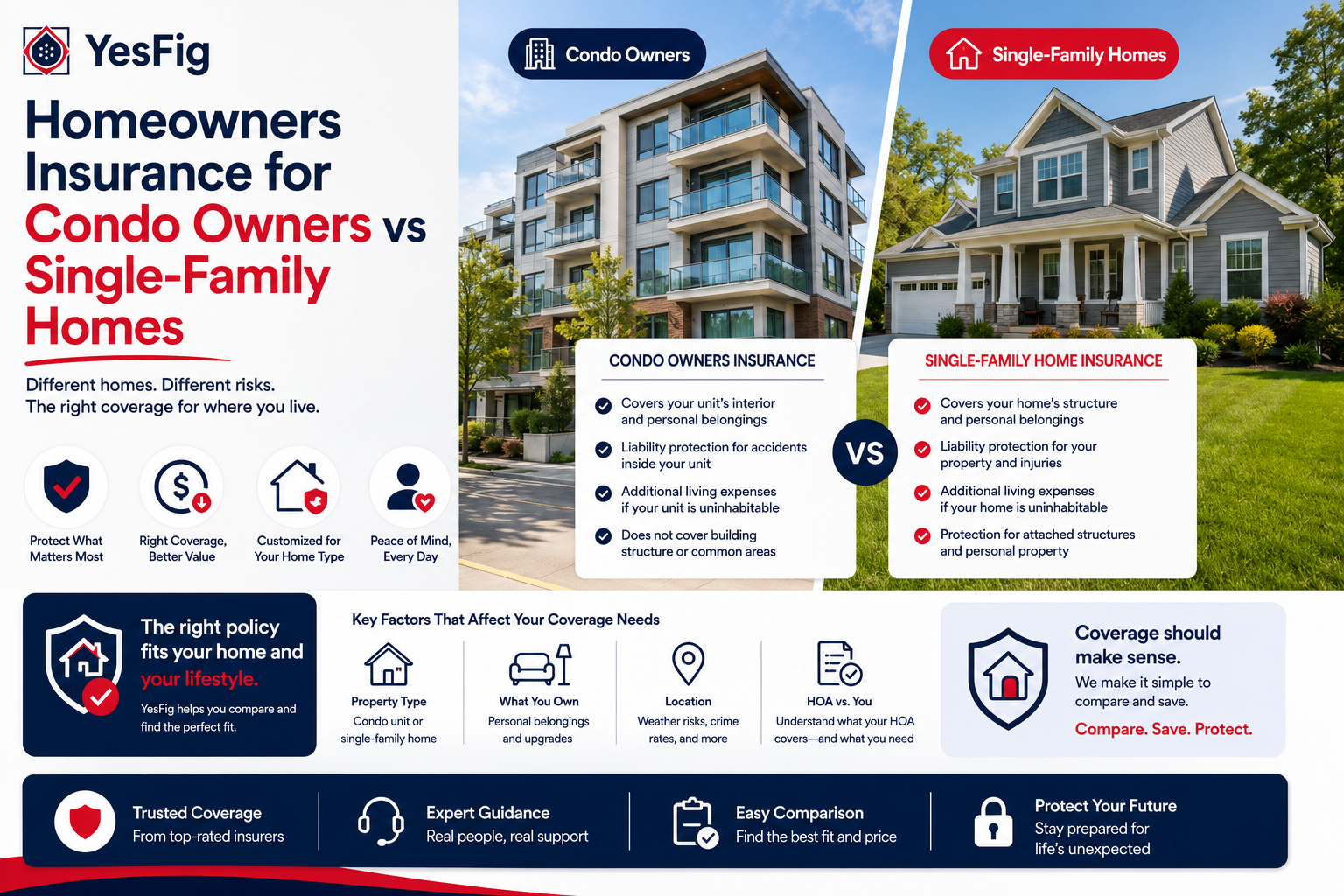
Homeowners Insurance for Condo Owners vs Single-Family Homes
Quick answer: A single-family home policy (HO-3) insures the entire structure, your belongings, and your liability. A condo policy (HO-6) insures only the interior of your unit, your belongings, and your liability, because the association's master policy covers the building. Condo coverage costs less, but you need to know what the master policy leaves to you.
Table of contents
- Why condo and house insurance are different policies
- What single-family home insurance covers
- What homeowners insurance for condo owners covers
- The master policy question that changes everything
- Condo vs single-family: side by side
- Choosing homeowners insurance for condo owners or a house
- Frequently asked questions
Nina bought a condo in Irvine and assumed her insurance would work like her parents' house policy. Then her lender asked for an HO-6, her HOA sent over a master policy document, and she realized she had no idea where her coverage started and the building's ended. That confusion is the heart of the homeowners insurance for condo owners question.
The two policies protect different things, because you own different things. A house owner insures a whole structure. A condo owner insures what's inside their walls, and leans on the association for the rest. Here's exactly where the line falls, what it means for your cost, and the one document you need to read before you buy.
Why condo and house insurance are different policies
It comes down to what you actually own. Buy a single-family home and you own the structure, the roof, the yard, and everything in it, so your policy has to cover all of it. Buy a condo and you own the interior of your unit, while the building, roof, hallways, and grounds belong to the association collectively.
That ownership split creates two policy forms. The HO-3 is the standard single-family policy, built to insure a whole house. The HO-6 is the condo policy, built to insure a unit's interior. Buying the wrong one leaves an expensive gap, which is why lenders ask for the right form by name.
Not sure which policy your place needs?
That's the first thing to sort out. Fig can explain the difference in plain English and show you what a California homeowners policy covers, with no pressure to buy.
What single-family home insurance covers
A standard HO-3 does five jobs. It covers your dwelling, meaning the structure itself, up to its rebuild cost. It covers other structures on your lot, like a detached garage, shed, or fence. It covers your personal property, your liability if someone is hurt on your property, and loss of use if a covered disaster makes the home unlivable.
The big number here is the dwelling coverage, and it should reflect what it costs to rebuild the house, not what you paid for it. Because you're insuring an entire structure plus land improvements, single-family coverage generally costs more than a condo policy for a comparable-value property.
What homeowners insurance for condo owners covers
An HO-6 is narrower, because it starts where the building ends. It covers the interior of your unit, often described as walls-in: things like flooring, cabinets, countertops, fixtures, and built-ins. It also covers your personal property, your liability, and loss of use if you can't live there after a covered event.
Then there's the piece almost nobody knows about. Loss assessment coverage protects you when the association bills unit owners for a shared loss, such as damage to a common area that exceeds the master policy, or the master policy's deductible spread across owners. Without it, an HOA assessment lands squarely on you.
Because you're not insuring the building, a condo policy usually costs less than a house policy. That's the payoff for the narrower scope, and a big reason homeowners coverage is priced so differently for the two.
The master policy question that changes everything
Here's the document Nina had to read, and the reason a condo owner can't buy coverage blind. Your HOA's master policy determines how much interior coverage you actually need, and master policies differ.
A bare walls-in master policy covers only the building structure, leaving everything from the drywall inward to you, including flooring, cabinets, and fixtures. An all-in (sometimes called all-inclusive) master policy covers the original interior finishes too, so your HO-6 mainly needs to handle upgrades and your belongings. Between them sits single entity, which covers original fixtures but not your improvements.
Read yours before you set your dwelling coverage amount. Guess wrong on a bare walls-in building and you could be paying to replace an entire kitchen out of pocket.
Good to know: Ask your HOA for the master policy and its deductible. If the association's deductible is high, it can be passed to unit owners after a shared loss, which is exactly what loss assessment coverage is for. Confirm both before you choose your HO-6 limits.
Want to size your coverage correctly?
That takes reading the fine print together. Yesfig can review what your building covers and what's left to you, then price coverage that fits the gap. Compare California home coverage in a few minutes.
Condo vs single-family: side by side
The differences line up cleanly once you see them together.
| Coverage | Single-family (HO-3) | Condo (HO-6) |
|---|---|---|
| Building structure | You insure it fully | Master policy covers it |
| Unit interior and fixtures | Included in dwelling | You insure it, walls-in |
| Other structures (shed, fence) | Covered | Not applicable |
| Personal property | Covered | Covered |
| Liability | Covered | Covered |
| Loss of use | Covered | Covered |
| Loss assessment | Not applicable | Available and important |
| Typical cost | Higher | Lower |
The pattern: same core protections, very different structural coverage, and one extra piece (loss assessment) that only condo owners need.
Choosing homeowners insurance for condo owners or a house
For a single-family home, sizing coverage is about the rebuild cost of your house. For a condo, it's about the gap between your HOA's master policy and your unit's interior, plus enough loss assessment coverage to absorb a surprise HOA bill.
Both policies also share the same California caveats: standard policies exclude earthquake and flood, both handled separately, and wildfire risk has tightened the market in some areas. If you rent rather than own, renters insurance is the right form instead. Yesfig Insurance, a Los Angeles-based brand of Focus Insurance Group, writes homeowners coverage across California, and a licensed advisor can confirm which policy form fits your property.
Key takeaways
- A single-family HO-3 insures the whole structure; a condo HO-6 insures the interior.
- Your HOA's master policy determines how much interior coverage you need.
- Condo owners should carry loss assessment coverage for shared HOA losses.
- Both exclude earthquake and flood, which are covered separately in California.
Here's the process in three steps:
- Identify your policy form. A house needs an HO-3; a condo needs an HO-6, and your lender will specify.
- Read the master policy if you own a condo. Find out whether it's bare walls-in, single entity, or all-in, and note its deductible.
- Size your coverage to the gap. Insure the rebuild cost for a house, or the interior plus loss assessment for a condo.
Get those three right and your coverage matches what you actually own. For more coverage guidance, the Yesfig blog breaks it down without the jargon.
Frequently asked questions
What's the difference between condo insurance and homeowners insurance?
A single-family homeowners policy (HO-3) insures the entire structure, other structures, your belongings, and liability. A condo policy (HO-6) insures only your unit's interior, belongings, and liability, because the association's master policy covers the building itself. Condo policies also include loss assessment coverage, which house policies don't need.
What does a condo HO-6 policy cover?
It covers the interior of your unit, often walls-in, including flooring, cabinets, fixtures, and built-ins, plus your personal property, your liability, and loss of use if the unit becomes unlivable. Most also offer loss assessment coverage, which helps pay your share when the HOA bills unit owners for a shared loss.
Does my HOA master policy cover the inside of my condo?
It depends on the master policy type. A bare walls-in policy covers only the building structure, leaving the interior to you. An all-in policy covers original interior finishes too. Single entity falls in between. Read your association's master policy before choosing your HO-6 limits, since the type determines how much coverage you need.
Is condo insurance cheaper than homeowners insurance?
Usually, yes. Because a condo policy doesn't insure the building structure, only the unit's interior and your belongings, it typically costs less than a single-family policy for a comparable property. Your actual price depends on your coverage amount, deductible, location, and what the association's master policy leaves you to cover.
What is loss assessment coverage and do I need it?
Loss assessment coverage helps pay your share when a condo association bills unit owners for a shared loss, such as common-area damage exceeding the master policy or the master policy's deductible split among owners. Condo owners should carry it, since an HOA assessment can be significant and isn't covered by standard property protection.
Owning a condo and owning a house are different kinds of ownership, so they call for different insurance. Nina read her master policy, learned her building was bare walls-in, sized her HO-6 to cover the whole interior, and added loss assessment so an HOA bill couldn't blindside her. Match the policy to what you actually own, and the coverage takes care of the rest.
Ready to insure what you actually own?
Get a homeowners insurance quote in minutes with Yesfig. Coverage in California starts at $25/mo, and a licensed advisor can confirm the right policy form for your condo or house and size it correctly. The right coverage, not just any coverage.
About the Author

Mathew Bahadori
CEO, Yesfig Insurance
Leading the company’s mission to make insurance more accessible, modern, and customer-focused. With a passion for innovation and personalized service, he continues to help individuals and families find smarter coverage solutions for life, auto, home, health, and business insurance.