
May 31, 2026
Group Health Insurance for Small Businesses: A Practical Buyer's Guide
Group health insurance for small businesses, explained: what it costs, who qualifies, and how to pick a plan. A practical buyer's guide from Yesfig.
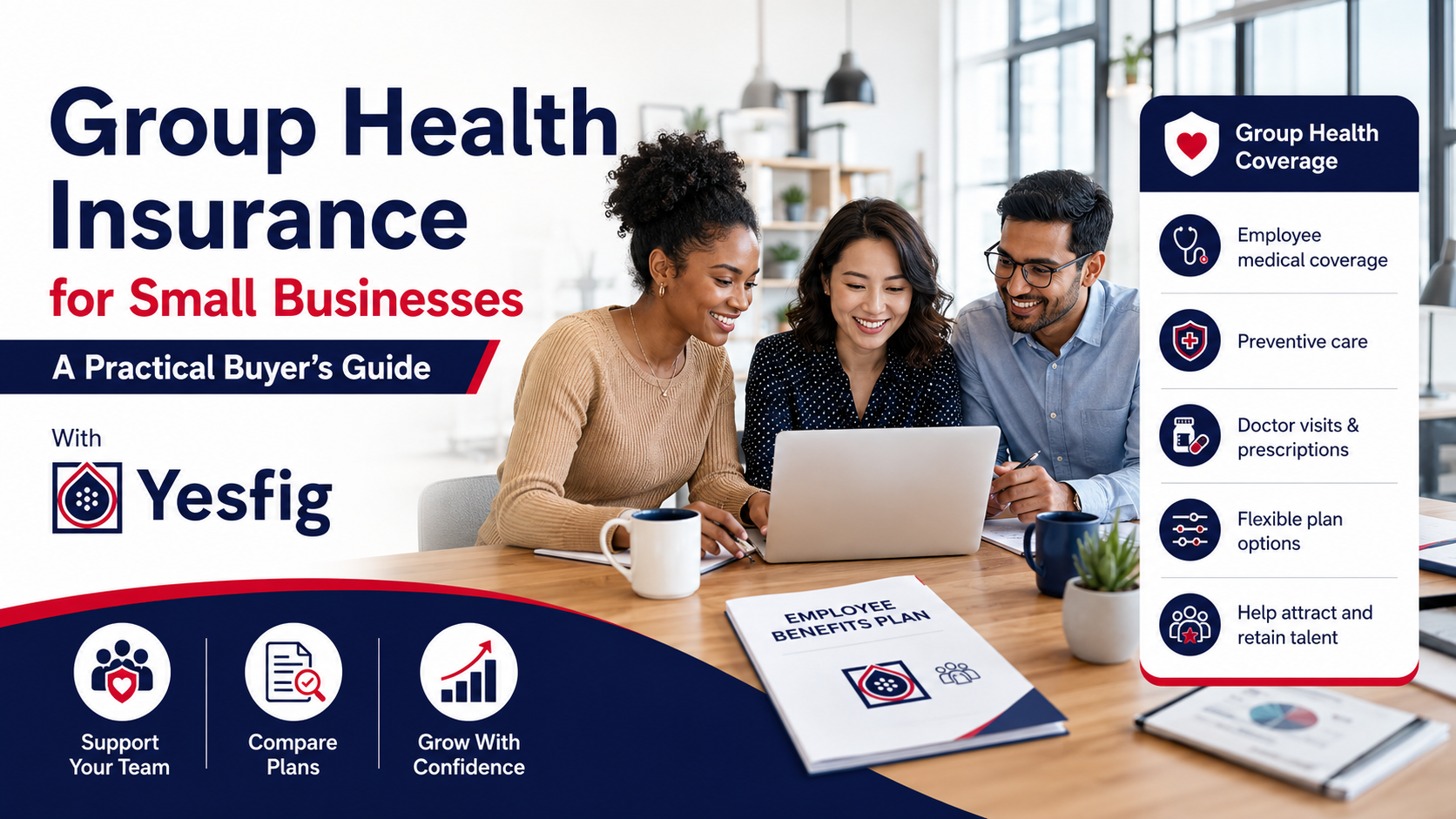
Group Health Insurance for Small Businesses: A Practical Buyer's Guide
Quick answer: Group health insurance for small businesses is a single plan an employer offers to its team, usually cheaper per person than individual coverage. In California, businesses with 1 to 100 employees can buy it, and plans start around $50/month per enrollee. Under 50 employees, it's optional but a strong hiring tool.
Table of contents
- What group health insurance actually is
- Do small businesses have to offer it?
- How much does group health insurance cost?
- The plan types you'll be choosing between
- The tax break most small employers miss
- How to set up a plan in three steps
- Frequently asked questions
Dani runs a six-person design studio in Sacramento. Last month her best developer left for a bigger agency, and the exit interview came down to one line: "They offered health benefits." Now Dani's staring at the same question thousands of California small business owners hit every year. How do you offer group health insurance for small businesses without blowing up a tight budget?
This guide walks the whole decision the way Dani had to, what it is, who has to offer it, what it really costs, and how to pick a plan you can actually afford. No jargon dumps, just the parts that matter.
What group health insurance actually is
Group health insurance is one health plan an employer buys to cover a whole team, instead of each person shopping alone. Because the insurer spreads risk across the group, premiums are usually lower per person than an individual policy, and pre-existing conditions can't bump anyone out.
The cost is typically split: the employer pays a share of the premium (often at least half), and employees pay the rest through payroll. That shared structure is exactly what makes a plan feel generous to your team while staying manageable for you. It's also why a six-person studio like Dani's can offer coverage that rivals what a 200-person firm provides.
In California, a "small group" plan generally means a business with 1 to 100 employees, which covers the vast majority of small companies. So even if it's just you and a couple of hires, you very likely qualify.
Still figuring out whether this is worth it?
That's what Fig is for. Explore your small business health options and get plain-English answers before you commit to a single plan or dollar.
Do small businesses have to offer it?
Most small businesses are not required to offer health insurance. Under the Affordable Care Act, only "applicable large employers" with 50 or more full-time-equivalent employees face the employer mandate. If your team is smaller than that, offering coverage is your choice, not a legal obligation.
So why do it? Because the villain here isn't a regulator, it's turnover. Dani didn't lose her developer to a rule. She lost him to a competitor who offered something she didn't. For small teams, benefits are one of the few levers you have to compete with bigger payrolls for talent.
Good to know: As of 2026, California does not require small employers (under 50 full-time-equivalent workers) to provide group health insurance. The state's individual mandate applies to residents, not to small businesses as employers. Offering a plan is a recruiting and retention move, not a compliance one.
If you do cross 50 full-time-equivalent employees, the calculus changes and the mandate kicks in. Most readers of this guide are well under that line, which means you get to treat coverage as a strategic perk rather than a checkbox.
How much does group health insurance cost?
Group health insurance for small businesses starts around $50 per month per enrollee through Yesfig, though your real number depends on a handful of factors. Premiums rise and fall based on:
- Where your business is located (California regions are rated differently).
- The ages of your employees (older teams cost more to insure).
- The plan tier you pick (a bronze plan costs far less than a platinum one).
- How much of the premium you choose to cover for your team.
The piece you control most is that last factor. Many small employers cover 50 to 70 percent of the premium and let employees pay the balance. You can dial that contribution up or down to hit a monthly cost that fits your books, which is how Dani got a real plan to pencil out for a six-person crew.
One honest caveat: these are starting points, not guaranteed quotes. The only way to see your actual number is to run your real team's details, and that takes minutes, not days.
Key takeaways
- Small businesses under 50 full-time-equivalent employees are not required to offer health insurance, but it's a powerful retention tool.
- In California, businesses with 1 to 100 employees qualify for small group plans.
- Costs start around $50/month per enrollee and scale with location, ages, plan tier, and your contribution share.
- A federal tax credit can return up to 50% of premiums for the smallest employers.
Want to see how a plan fits your budget?
Yesfig reviews your team size, your goals, and what you can spend, then shows you where the numbers land. Compare small business group health plans and see your real options in a few minutes.
The plan types you'll be choosing between
Group plans come in a few flavors, and the difference comes down to how much freedom your team has to pick doctors versus how low the premium is. The main types you'll see:
- HMO (Health Maintenance Organization): lowest premiums, but employees stay in-network and use a primary care doctor for referrals. Great for cost-conscious teams.
- PPO (Preferred Provider Organization): higher premiums, more flexibility to see specialists and out-of-network providers without referrals.
- EPO (Exclusive Provider Organization): a middle ground, in-network only like an HMO, but usually no referral hoops.
- HDHP (High-Deductible Health Plan): low premium, high deductible, often paired with a Health Savings Account for tax-free medical savings.
There's no universally "best" type. A young, healthy team that rarely visits the doctor often does fine on an HDHP or HMO, while a team with families and ongoing care needs tends to value a PPO. The right pick is the one your specific people will actually use, which is worth a quick conversation before you decide.
The tax break most small employers miss
Here's the part that surprises people. If you have fewer than 25 full-time-equivalent employees, pay average annual wages below the federal threshold, and cover at least 50 percent of premiums, you may qualify for the Small Business Health Care Tax Credit. It's worth up to 50 percent of the premiums you pay (up to 35 percent for tax-exempt employers).
To claim it, the plan generally has to be purchased through the SHOP marketplace, which in California is Covered California for Small Business. The credit is available for two consecutive tax years, so it meaningfully lowers the real cost of offering coverage for the smallest teams.
This is the kind of detail that turns a "we can't afford it" into a "wait, we can." For an employer like Dani, a credit on top of a shared-premium structure is often what makes the whole thing viable. A licensed advisor can tell you quickly whether your business clears the bar.
How to set up a plan in three steps
You don't need an HR department to get this done. The path is short:
- Get a quote in minutes. Share your team size, ages, and location to see real plan options and prices.
- Compare your options with Fig. Weigh plan types, premiums, and your contribution share side by side, with a licensed advisor on call if you want a human in the loop.
- Enroll your team and lock it in. Pick a plan, set your contribution, and your employees sign up.
That's it. The same plain-English process applies whether you're insuring 6 people or 60, and it's the same logic Yesfig uses across its individual and family health coverage too. Yesfig Insurance, a brand of Focus Insurance Group based in Los Angeles, offers small business group health in California, Texas, Illinois, Pennsylvania, Ohio, and Florida, so if your team spans one of those states, you're covered.
Frequently asked questions
How many employees do you need for a small business group health plan?
In California, you generally need at least one employee besides the owner to qualify for a small group plan, and the category covers businesses with 1 to 100 employees. You do not need a large team. Many plans are built specifically for businesses with just a handful of workers.
Is a small business required to offer health insurance?
No. Businesses with fewer than 50 full-time-equivalent employees are not required to offer health insurance under the Affordable Care Act. Only applicable large employers with 50 or more face the mandate. For most small businesses, offering coverage is an optional recruiting and retention decision, not a legal requirement.
How much does small business group health insurance cost?
Group health insurance for small businesses starts around $50 per month per enrollee, though your real cost depends on employee ages, business location, plan tier, and how much of the premium you cover. Employers often pay 50 to 70 percent of the premium, with employees covering the rest through payroll.
Can a small business get a tax credit for offering health insurance?
Yes. Businesses with fewer than 25 full-time-equivalent employees, average wages below the federal limit, and at least a 50 percent premium contribution may qualify for the Small Business Health Care Tax Credit, worth up to 50 percent of premiums. The plan usually must be bought through the SHOP marketplace.
What is the difference between an HMO and a PPO for group plans?
An HMO has lower premiums but keeps care in-network and requires referrals from a primary doctor. A PPO costs more but lets employees see specialists and out-of-network providers without referrals. HMOs suit cost-focused teams, while PPOs suit teams that want maximum flexibility in choosing providers.
You can offer real benefits without a big-company budget
Dani's studio now offers a plan, and her next hire said yes partly because of it. That's the quiet payoff of getting group health insurance right: a team that stays, a budget that holds, and one less thing keeping you up at night. You don't have to be big to take care of your people, you just need a plan that fits.
Ready to cover your team?
Get a small business group health quote in minutes with Yesfig. Coverage starts at $50/month per enrollee, and a licensed advisor is there the moment you want a human to walk you through it.
About the Author

Mathew Bahadori
CEO, Yesfig Insurance
Leading the company’s mission to make insurance more accessible, modern, and customer-focused. With a passion for innovation and personalized service, he continues to help individuals and families find smarter coverage solutions for life, auto, home, health, and business insurance.