
June 22, 2026
Comprehensive vs Collision: Which Auto Coverage Do You Need?
Comprehensive vs collision: one covers crashes, the other covers theft and weather. See which auto coverage you actually need and how to choose.
Comprehensive vs Collision: Which Auto Coverage Do You Need?
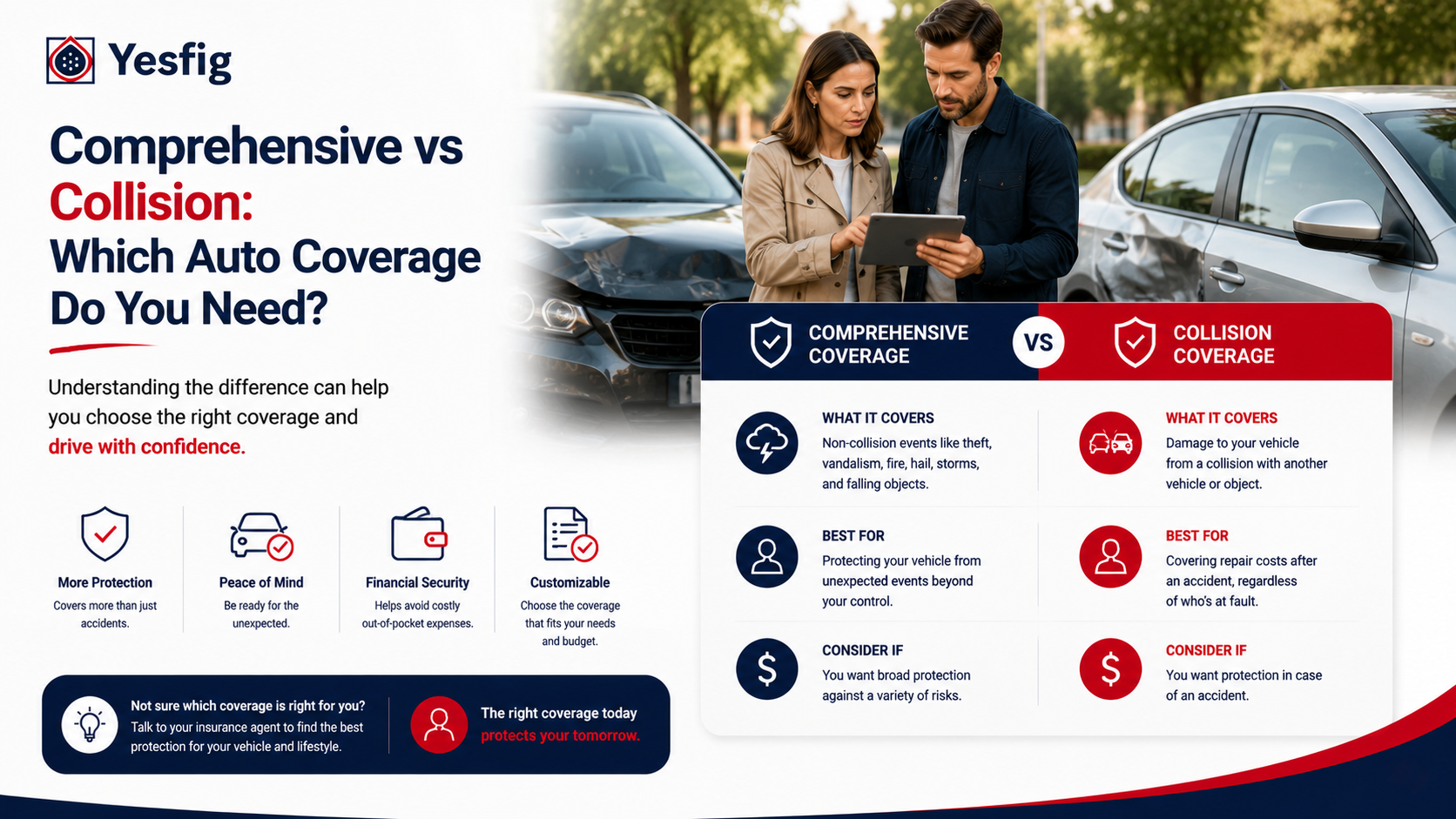
Quick answer: Collision coverage pays to repair or replace your car after a crash, no matter who's driving. Comprehensive covers almost everything else, like theft, fire, vandalism, falling objects, and weather damage. Most drivers with a financed, leased, or newer car need both, while owners of an older, paid-off car may only want one or neither.
Table of contents
- What collision coverage pays for
- What comprehensive coverage pays for
- Comprehensive vs collision: the main differences
- Do you need comprehensive, collision, or both?
- What comprehensive and collision don't cover
- Comprehensive vs collision: how to choose your coverage
- Frequently asked questions
Renee drives a paid-off 2014 sedan around Long Beach, and at renewal she found herself staring at two line items she'd never really understood: comprehensive and collision. She's not alone. The comprehensive vs collision question trips up plenty of California drivers, mostly because the names don't explain what each one actually does.
Here's the short version, then the details. One covers your car in a crash. The other covers your car when something other than a crash goes wrong, like theft or a storm. Which you need comes down to your car, your loan, and your budget.
What collision coverage pays for
Collision coverage pays to repair or replace your car after a crash, no matter who caused it. That includes hitting another vehicle, running into an object like a guardrail or a pole, or a single-car rollover. If your car gets damaged because it collided with something, this is the coverage that handles it.
You pay a deductible first (the amount you cover before insurance kicks in), and the policy pays the rest up to your car's value. So if you have a $500 deductible and $4,000 in repairs, you pay $500 and coverage handles the other $3,500. Collision doesn't care whose fault the crash was, which is the part most people get wrong.
What comprehensive coverage pays for
Comprehensive coverage handles almost everything that isn't a collision. Think theft, fire, vandalism, falling objects, floods, hail, and even hitting an animal like a deer. In California, that also means real risks like wildfire damage and break-ins, which is why a lot of drivers keep it.
Like collision, comprehensive comes with a deductible and pays up to your car's value. One quirk surprises people: if you swerve and hit a deer, that's usually comprehensive, but if you swerve and hit a fence, that's collision. The trigger is what your car made contact with, and how.
Not sure which coverages you're paying for?
It's worth a look. Fig can walk through your current setup in plain English and show you what a California auto policy includes, with no commitment needed.
Comprehensive vs collision: the main differences
Side by side, the split is easier to see. The same event is almost always covered by one or the other, rarely both. Here's how the most common situations break down.
| What happened | Collision | Comprehensive |
|---|---|---|
| You rear-end another car | Covered | Not covered |
| You hit a pole or guardrail | Covered | Not covered |
| Your car rolls over in a single-car crash | Covered | Not covered |
| A tree limb falls on your parked car | Not covered | Covered |
| Your car is stolen or broken into | Not covered | Covered |
| You hit a deer on the highway | Not covered | Covered |
| Hail, fire, or flooding damages your car | Not covered | Covered |
| A rock cracks your windshield | Not covered | Covered |
Notice the pattern: if your car hit something, that's collision. If something happened to your car, that's comprehensive.
Do you need comprehensive, collision, or both?
This is where it gets personal. If your car is financed or leased, the answer is usually both, because your lender or leasing company almost always requires it until the loan is paid off. Skip it and you'd be breaking your loan agreement, and a single bad crash could leave you paying off a car you can no longer drive.
If you own your car outright, you've got room to choose. The older and cheaper the car, the weaker the case for collision, since the most it ever pays out is the car's current value minus your deductible. Many drivers keep comprehensive longer than collision, because theft and weather can total even a modest car. Yesfig Insurance, a Los Angeles-based brand of Focus Insurance Group, lets you adjust each piece separately, so you can compare California auto insurance options and keep only what fits.
For Renee and her paid-off 2014 sedan, that meant a close look at the car's actual value before deciding. If a repair bill could approach what the car is worth, collision stops earning its keep.
Think you might be over- or under-covered?
That's exactly what a quick review catches. Yesfig looks at what you carry now, spots gaps or overlap, and shows where you can adjust price or protection. Compare your auto coverage in a few minutes.
What comprehensive and collision don't cover
Here's the catch that costs people: neither comprehensive nor collision pays for injuries or damage you cause to others. That's liability coverage, and it's a completely separate part of your policy. Comprehensive and collision only protect your own car.
Liability is also the part California actually requires by law. If you bundle auto with other coverage, like adding it to your renters insurance, you can often simplify both. Gap insurance is another add-on worth knowing about if you owe more on a financed car than it's currently worth.
Good to know: As of 2025, California's minimum liability is 30/60/15, which means $30,000 in bodily injury per person, $60,000 per accident, and $15,000 in property damage. Comprehensive and collision sit on top of that liability base, they don't replace it.
Comprehensive vs collision: how to choose your coverage
You can settle this in three quick steps:
- Check your loan or lease. If you're still paying it off, plan on carrying both comprehensive and collision.
- Weigh your car's value. Look up what your car is actually worth today, then compare that to your premium and deductible.
- Keep what protects you, drop what doesn't. Hold onto coverage that could save you a real loss, and trim coverage that costs more than it returns.
That's the whole decision. For more on building a policy that fits, the Yesfig insurance blog breaks down coverages without the jargon.
Frequently asked questions
What's the difference between comprehensive and collision insurance?
Collision covers damage to your own car from a crash, whether you hit another vehicle, an object, or roll over. Comprehensive covers almost everything else that isn't a collision, like theft, fire, vandalism, falling objects, animal strikes, and weather. You can carry one, both, or neither, depending on your car and situation.
Do I need both comprehensive and collision?
Not always. If your car is financed or leased, your lender usually requires both until it's paid off. If you own an older car outright, you might keep only one or drop both, especially once the yearly premium and deductible start to rival the car's value. It's a personal call.
Is comprehensive or collision required by law in California?
No. California only requires liability coverage, not comprehensive or collision. As of 2025, the state minimum is 30/60/15, meaning $30,000 bodily injury per person, $60,000 per accident, and $15,000 property damage. Comprehensive and collision are optional under the law, though a lender or lessor can require them.
What does "full coverage" car insurance mean?
Full coverage isn't an official policy type. It usually means liability plus both comprehensive and collision, so your own car and other people's are protected. There's no single legal definition, so always check the actual coverages and limits rather than relying on the label alone. A licensed advisor can confirm what's included.
Should I drop collision on an older car?
Maybe. A common rule is that if your annual collision premium plus the deductible adds up to more than about 10 percent of the car's value, the coverage may not be worth it. If the car is paid off and not worth much, dropping collision can make sense, but weigh the risk of paying for repairs yourself.
The comprehensive vs collision choice isn't about buying the most coverage, it's about matching protection to your actual car and risk. Renee kept comprehensive for theft and weather, looked hard at collision against her sedan's value, and walked away confident she wasn't overpaying. You can do the same once you know what each one really does.
Ready to get the right auto coverage?
Get an auto insurance quote in minutes with Yesfig. Coverage in California starts at $30/mo, and you can mix comprehensive, collision, and liability to fit your car, with a licensed advisor on hand if you want one.
About the Author

Mathew Bahadori
CEO, Yesfig Insurance
Leading the company’s mission to make insurance more accessible, modern, and customer-focused. With a passion for innovation and personalized service, he continues to help individuals and families find smarter coverage solutions for life, auto, home, health, and business insurance.