
July 30, 2026
Auto Insurance for Classic Cars and Daily Drivers Compared
A classic car needs different insurance than your daily driver. Learn how classic car insurance and standard auto coverage compare, and why you may need both.
Auto Insurance for Classic Cars and Daily Drivers Compared
Quick answer: A classic car needs classic car insurance, not a standard policy. Classic coverage uses an agreed value, so a total loss pays the amount you and the insurer set, instead of a depreciated value. The tradeoff is usage limits, like restricted mileage and pleasure-only driving. Most enthusiasts need both a classic policy and a standard one for their daily driver.
Table of contents
- Why a classic car needs different insurance
- How classic car insurance compares to standard coverage
- The agreed value advantage
- The tradeoff: usage restrictions
- What California drivers should know
- Which policy do you actually need?
- Frequently asked questions
Marco keeps a restored 1968 muscle car in his garage in Sacramento and drives a sensible sedan to work every day. When he tried to insure the classic on his regular auto policy, he learned the two cars aren't the same insurance problem at all. Classic car insurance exists because collector vehicles and everyday cars carry completely different risks and values, and covering a prized classic like a commuter car can leave you badly underinsured.
Understanding the difference protects both your investment and your wallet. Here's how classic coverage compares to a standard policy, why the two are built on opposite assumptions, and which one, or both, you actually need.
Own a classic and a daily driver?
That's exactly the situation to sort out. Fig can explain how each type of coverage works and show you what California car insurance looks like for your daily driver, with no pressure to switch.
Why a classic car needs different insurance
The core issue is value. A standard auto policy assumes your car loses value over time, so it pays based on depreciated worth. A classic or collector car often does the opposite, holding or gaining value, so a standard policy's depreciated payout could be a fraction of what the car is actually worth.
The usage is different too. You drive your daily car constantly, in all conditions, for every errand and commute. A classic is typically driven rarely, for pleasure, shows, or club events, and stored carefully the rest of the time. Because the risk and the value are so different, insurers treat the two as separate products, and trying to force a collector car onto an everyday policy usually means paying more for worse protection.
How classic car insurance compares to standard coverage
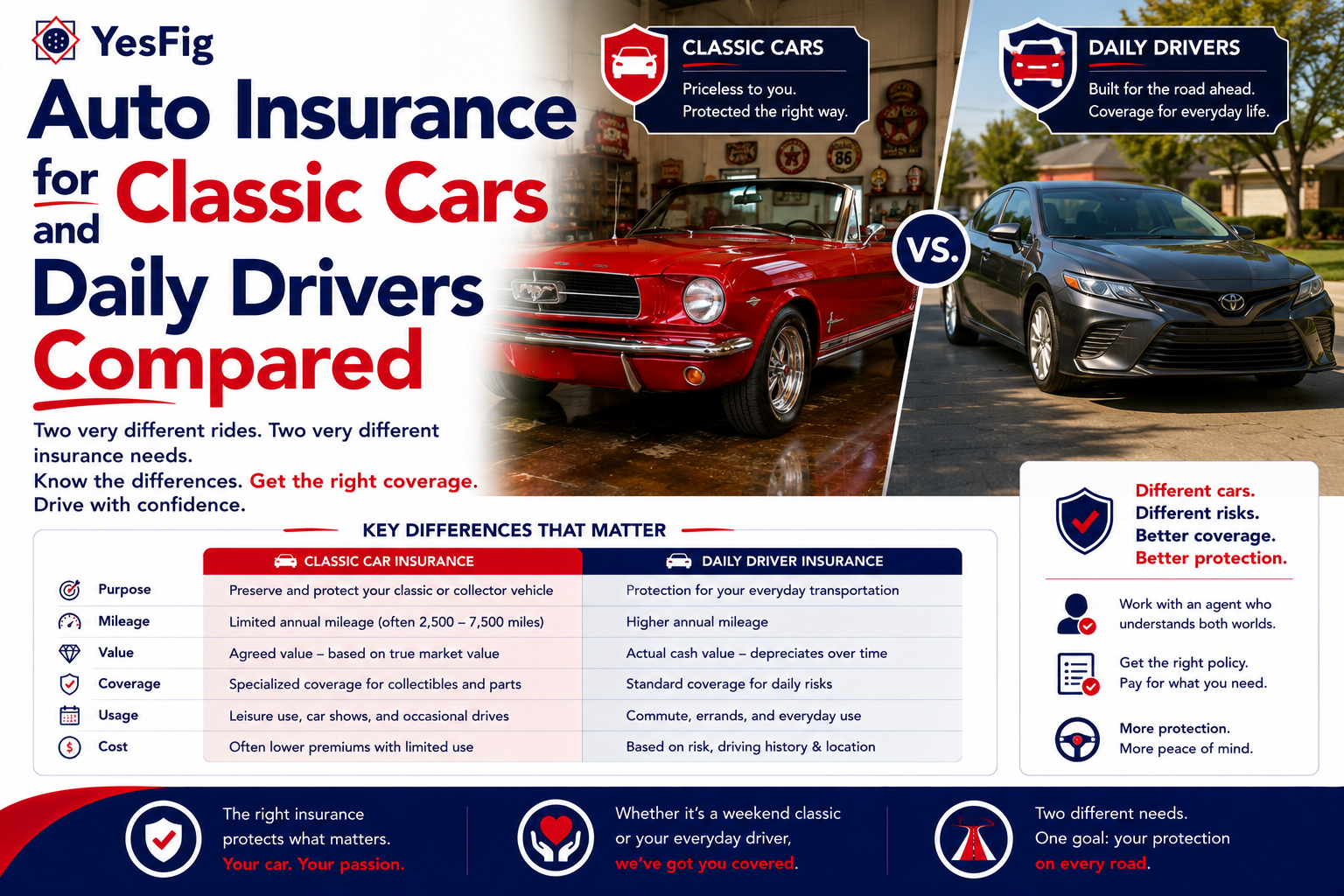
Side by side, the differences are clear. Standard coverage is built for frequent, unrestricted driving and values your car at its depreciated cash value, which suits a car that loses worth as it ages. It's what your daily driver needs, and a standard auto policy is designed for exactly that.
Classic car insurance is built for limited, careful use and values your car at an agreed amount that reflects its collector worth. Because collector cars are driven little and stored well, classic policies often cost surprisingly less than standard ones despite covering more valuable vehicles. The catch is that this affordability comes with conditions on how you use the car, which is the heart of the tradeoff.
The agreed value advantage
This is the feature that makes classic coverage worth it. Standard policies pay actual cash value, the depreciated worth of the car, after a total loss. For a collectible that has appreciated, that can fall far short of its real value, and you'd be fighting the insurer over what a rare car is worth after it's already gone.
Classic policies use agreed value instead. You and the insurer agree on the car's value upfront, usually documented with photos and sometimes an appraisal, and that's the amount paid if the car is totaled, with no depreciation applied. For a restored or rare vehicle, that certainty is the whole point, since it guarantees you're paid what the car is actually worth rather than a formula's guess.
Good to know: Standard auto insurance pays a depreciated value after a total loss, which can be a fraction of a classic car's real worth. Classic car insurance uses an agreed value set upfront, so you're paid the full amount you and the insurer agreed on, no depreciation fight after the car is gone.
Want the right coverage for your everyday car?
That's a quick comparison. Yesfig can price standard coverage for your daily driver and confirm you're properly protected. Compare your car insurance in a few minutes.
The tradeoff: usage restrictions
Classic coverage is affordable for a reason, and this is it. To qualify and keep the low rate, you agree to usage restrictions. Most classic policies cap your annual mileage, since a car driven a few hundred miles a year is far lower risk than a daily commuter.
They also typically require the car to be used for pleasure only, meaning shows, club events, and occasional drives, not commuting or errands. Secure, often enclosed storage is usually required as well. On top of that, insurers generally require you to have a separate everyday vehicle, so the classic isn't your only transportation. These conditions are exactly what make classic coverage cheap, and they're also why it can't replace a standard policy for the car you drive every day.
What California drivers should know
California has features that fit the classic-plus-daily setup well. The state offers distinct registration for historical vehicles, generally cars 25 years or older, and qualifying older vehicles can be exempt from smog checks, which aligns naturally with a limited-use collector car.
For your daily driver, standard rating rules still apply. Under Proposition 103, your everyday car's rate is built around your driving record, mileage, and experience, and you always choose your own insurer. So a common California setup is a limited-use classic policy for the collector car and a standard policy for the daily driver. Yesfig Insurance, a Los Angeles-based brand of Focus Insurance Group, offers auto coverage across California for your everyday vehicle.
Key takeaways
- A classic car needs classic car insurance, not a standard auto policy.
- Classic coverage uses agreed value, paying the car's real worth after a total loss.
- The tradeoff is usage limits: capped mileage, pleasure-only driving, and secure storage.
- Most enthusiasts need both a classic policy and a standard one for their daily driver.
Which policy do you actually need?
For most enthusiasts, the honest answer is both, matched to each car. Here's how to decide in three steps:
- Insure your daily driver with standard coverage. Your everyday car needs a normal policy built for frequent, unrestricted use.
- Insure your classic with a collector policy. If your car qualifies as a classic and you drive it rarely, agreed-value coverage protects its real worth affordably.
- Confirm you meet the classic requirements. Check the mileage cap, pleasure-only use, storage, and separate-vehicle conditions before choosing a classic policy.
Do that and each car is covered the right way, your investment and your commute both. For more on managing your coverage, the Yesfig blog breaks it down without the jargon.
Frequently asked questions
Can I insure a classic car on my regular auto policy?
Usually not well. A standard policy values your car at its depreciated cash value, which can be far below a collector car's real worth, leaving you underinsured after a total loss. Classic cars need classic car insurance, which uses an agreed value and is designed for limited, careful use. Trying to use a standard policy often costs more for worse protection.
What is agreed value coverage?
Agreed value is a feature of classic car insurance where you and the insurer set the car's value upfront, often with photos or an appraisal. If the car is totaled, you're paid that agreed amount with no depreciation applied. This protects appreciating collector vehicles, since a standard policy's depreciated payout could fall far short of the car's real worth.
Why is classic car insurance often cheaper than standard coverage?
Because collector cars are lower risk. They're driven rarely, used for pleasure rather than commuting, and stored carefully, so they're far less likely to be in an accident. Those usage restrictions let insurers charge less even though the cars are more valuable. The low rate depends on you following the mileage and usage limits.
Do I need a daily driver to get classic car insurance?
Usually, yes. Most classic car insurers require you to have a separate everyday vehicle, so the classic isn't your only transportation. This supports the low mileage and pleasure-only use that make classic coverage affordable. If the collector car were your daily driver, you'd need standard coverage instead, since it wouldn't meet the classic policy's restrictions.
Can I drive my classic car every day with classic insurance?
No. Classic car insurance requires limited, pleasure-only use, so daily commuting and regular errands aren't covered and would violate the policy's terms. If you drive a car every day, it needs standard coverage. That's why many enthusiasts carry both: a classic policy for the collector car and a standard policy for their daily driver.
Insuring a classic and a daily driver isn't a choice between two policies, it's usually a matter of getting each car the coverage it needs. Marco kept his everyday sedan on a standard policy and moved his muscle car to agreed-value classic coverage, protecting the car's real worth for a surprisingly low premium. Match each vehicle to the right policy, and both your investment and your commute are covered.
Ready to cover your daily driver the right way?
Get a car insurance quote in minutes with Yesfig. Coverage in California starts at $30/mo, and a licensed advisor can make sure your everyday vehicle has the protection it needs alongside your classic. The right policy for every car you own.
About the Author

Mathew Bahadori
CEO, Yesfig Insurance
Leading the company’s mission to make insurance more accessible, modern, and customer-focused. With a passion for innovation and personalized service, he continues to help individuals and families find smarter coverage solutions for life, auto, home, health, and business insurance.