
July 9, 2026
Why Bundling Auto and Home Insurance Saves Money (Usually)
Bundling auto and home insurance usually lowers your premium, but not always. Learn when the bundle wins, when it loses, and how to check your total.
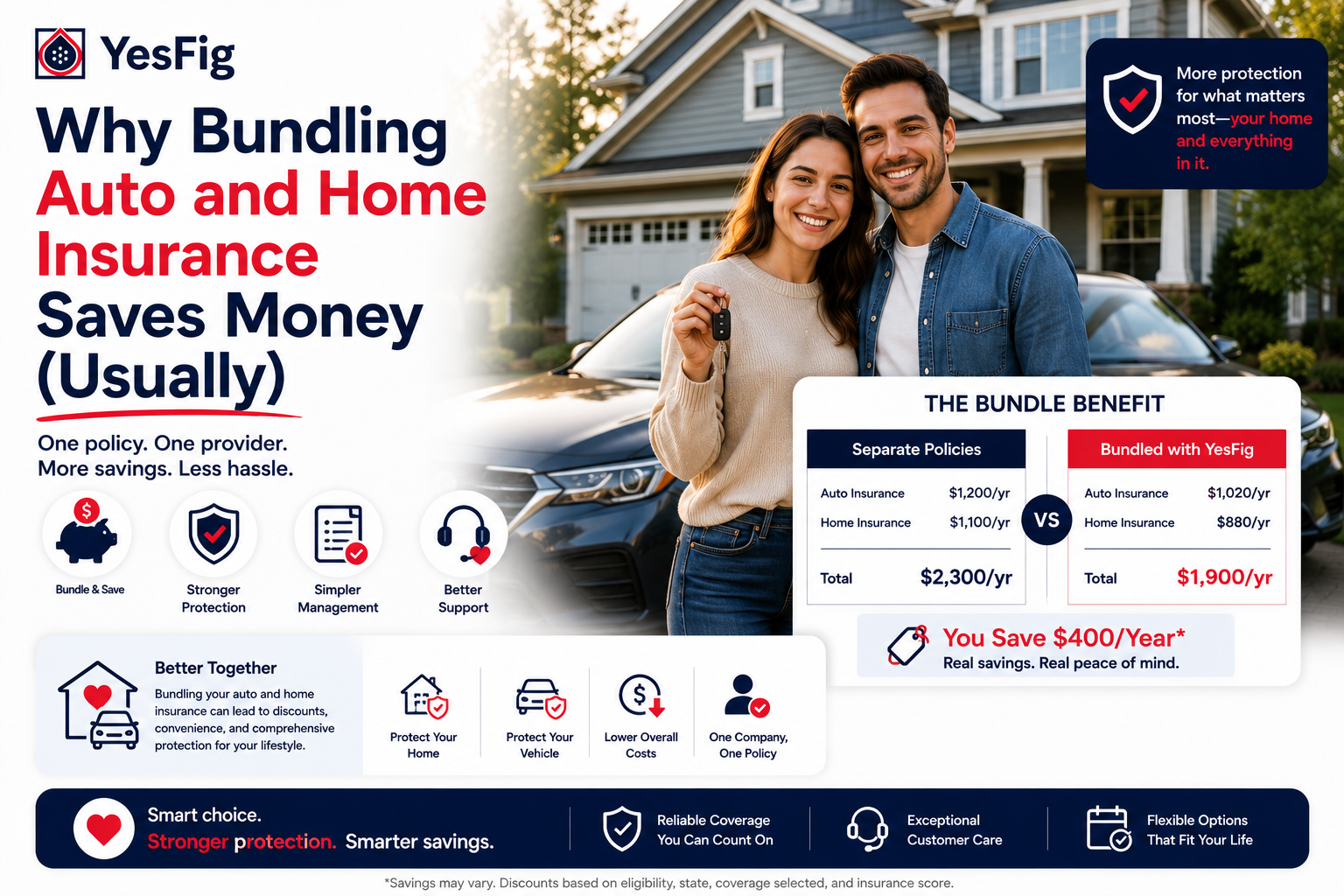
Why Bundling Auto and Home Insurance Saves Money (Usually)
Quick answer: Bundling auto and home insurance means buying both from one insurer to earn a multi-policy discount, which usually lowers your combined premium. It doesn't always win, though. A discount applied to a higher base rate can still cost more than two cheaper standalone policies, so always compare the bundled total against separate quotes.
Table of contents
- How bundling auto and home insurance saves money
- The benefits beyond the discount
- When bundling auto and home insurance doesn't save
- The trap: a discount on a higher base rate
- What California homeowners should know
- How to bundle auto and home insurance the smart way
- Frequently asked questions
Hugo owns a house in Pasadena and drives a car he insures somewhere else entirely, and every renewal he wonders whether he should just put both with one company. It's the most common money question in insurance, and the usual answer is a confident "yes, bundle." Bundling auto and home insurance really does lower most people's premiums, and it simplifies your life while it's at it.
But "usually" is doing real work in that sentence. Bundling is the right call most of the time, not all of the time, and the difference is worth a few minutes of your attention. Here's how the discount works, when the bundle wins, and the specific cases where two separate policies quietly beat it.
How bundling auto and home insurance saves money
The savings come from a multi-policy discount. When one insurer carries both your car and your house, it usually cuts the price on each, because keeping all your business is worth more to them than winning just one policy. It costs an insurer far less to keep an existing customer than to find a new one, and part of that saving gets passed to you.
There's a risk angle too. Insurers see multi-policy customers as more stable and less likely to leave, so they price accordingly. For Hugo, moving his car and home under one roof would mean a lower rate on both, without changing a single coverage limit on either policy. That's the appeal: the same protection, a smaller combined bill.
Not sure if a bundle would beat what you pay now?
That's the right question. Fig can explain how the multi-policy discount works and show you what California car insurance looks like as part of a bundle, with no pressure to switch.
The benefits beyond the discount
Money isn't the only reason people bundle. With both policies at one company, you get one insurer, one account, one renewal date, and one number to call. That simplicity saves real hassle over a year of paperwork and reminders.
There's a practical claims benefit too. Some insurers offer a single deductible when one event damages both your home and your car, like a tree falling on your house and the vehicle parked beside it, so you pay one deductible instead of two. Not every company does this, so ask before you assume it. Many insurers also add loyalty perks, like accident forgiveness or claim-free rewards, for customers who carry multiple policies.
When bundling auto and home insurance doesn't save
Here's where the "usually" earns its place. A bundle can lose in a few specific situations, and they're worth knowing before you commit.
| Situation | Bundle usually wins | Worth checking carefully |
|---|---|---|
| Both policies priced competitively | Yes | |
| One insurer is a specialist that undercuts everyone | Yes | |
| Your home is in a high-risk area | Yes | |
| You have a claim or violation on one line | Yes | |
| Clean records, standard home, standard car | Yes | |
| You never re-shop after bundling | Yes |
A few patterns stand out. A specialist insurer can sometimes beat the bundled price on one line, especially if it focuses on drivers or homes like yours. A recent claim or a violation on one policy can raise the price of both when they sit with the same company. And bundlers tend to stop shopping, letting premiums creep up year after year on autopilot.
Want to see your bundled total, not just the discount?
That's exactly the comparison that matters. Yesfig offers auto and home coverage together in California, so you can price the real bundled total and weigh it against what you pay now. Compare a bundled quote in a few minutes.
The trap: a discount on a higher base rate
This is the single most useful thing to understand about bundling, and most people miss it. A discount percentage tells you nothing on its own. If an insurer's starting prices are high, a generous multi-policy discount can still leave you paying more than two cheaper standalone policies would have cost.
Picture it simply: a big discount off an expensive base can land above a small discount off a cheap one. So don't shop for the biggest discount, shop for the lowest total. Add up what the bundle actually costs per year, compare it to the best separate price for each policy, and let that number decide. It's the only comparison that tells you the truth.
Good to know: Bundling combines your policies, not your deductibles. You still have a separate deductible for your auto and your home unless your insurer specifically offers a single-deductible feature for one event. Confirm this before you assume a bundle changes how claims work.
What California homeowners should know
California adds a real wrinkle to the bundling math. In areas with elevated wildfire risk, home insurance has become harder to place, and some carriers won't write homeowners coverage there at all. If your home lands in that category, you may end up with the FAIR Plan or a specialty carrier for your house, which means there's no bundle to be had, since bundling requires one insurer for both lines.
The practical move is to price your home coverage first, since it's the harder policy to place, then see whether the insurer that will cover your house also offers competitive auto. Yesfig Insurance, a Los Angeles-based brand of Focus Insurance Group, writes both homeowners coverage and auto insurance across California, which makes bundling straightforward for standard homes.
Key takeaways
- Bundling auto and home insurance earns a multi-policy discount that usually lowers both premiums.
- Compare the bundled total against separate quotes, not the discount percentage.
- A specialist insurer, a recent claim, or a high-risk home can beat or break the bundle.
- Bundling doesn't merge your deductibles unless the insurer offers that feature.
How to bundle auto and home insurance the smart way
Here's the whole decision in three steps:
- Quote your home first. It's the harder policy to place, so start there and find insurers that will cover your house.
- Price the bundle and the alternative. Get one bundled total, then get the best standalone quote for each line.
- Compare totals and re-shop yearly. Choose whichever total is lower with the coverage you need, then check again at renewal.
That third step is the one people skip. Bundling is a great deal right up until you stop checking whether it still is. For more ways to save without cutting coverage, the Yesfig blog breaks it down without the jargon.
Frequently asked questions
Does bundling auto and home insurance actually save money?
Usually, yes. Insurers offer a multi-policy discount when you carry both with them, lowering the price on each. Most people pay less bundled than they would with two separate insurers. The savings vary by company and location, though, so compare the bundled total against separate quotes before switching.
When is bundling auto and home insurance not worth it?
When the bundled total costs more than two standalone policies. That can happen if an insurer's base rates are high, if a specialist insurer undercuts them on one line, or if a recent claim or violation raises both policies at once. If your home is high-risk and needs a specialty carrier, bundling may not be possible.
Does a bigger bundling discount mean a lower price?
Not necessarily. A discount percentage is applied to that insurer's base rate, so a large discount off an expensive starting price can still cost more than a small discount off a cheap one. Always compare the actual annual total you'd pay, not the size of the discount being advertised.
Do bundled policies share one deductible?
Usually not. Bundling combines your policies with one insurer, but your auto and home deductibles remain separate. Some insurers offer a single-deductible feature when one event damages both your home and your car, but it isn't standard. Ask your insurer directly before assuming a bundle changes how your deductibles work.
Can I bundle if my home is in a wildfire risk area?
Maybe not. In high-risk California areas, some insurers won't write homeowners coverage, which can push you toward the FAIR Plan or a specialty carrier for your house. Since bundling requires one insurer for both lines, that can rule it out. Price your home coverage first, then see what auto options that insurer offers.
Bundling your car and house with one company is a good default, and for most people it's the easiest money they'll save this year. Hugo quoted his home first, priced the bundle against two standalone policies, and went with whichever total actually came out lower. Do that, keep checking at renewal, and you get the bundle's savings without ever taking the discount on faith.
Ready to see what your bundle would really cost?
Start a bundled quote with Yesfig, which offers auto and homeowners coverage together in California. Auto starts at $30/mo and home at $25/mo, and a licensed advisor can price both so you compare the real total, not just the discount.
About the Author

Mathew Bahadori
CEO, Yesfig Insurance
Leading the company’s mission to make insurance more accessible, modern, and customer-focused. With a passion for innovation and personalized service, he continues to help individuals and families find smarter coverage solutions for life, auto, home, health, and business insurance.