June 30, 2026
ACA Marketplace Plans vs Private Health Insurance Compared
ACA marketplace vs private health insurance: the big difference is subsidies. See how coverage, cost, and protections compare for your situation.
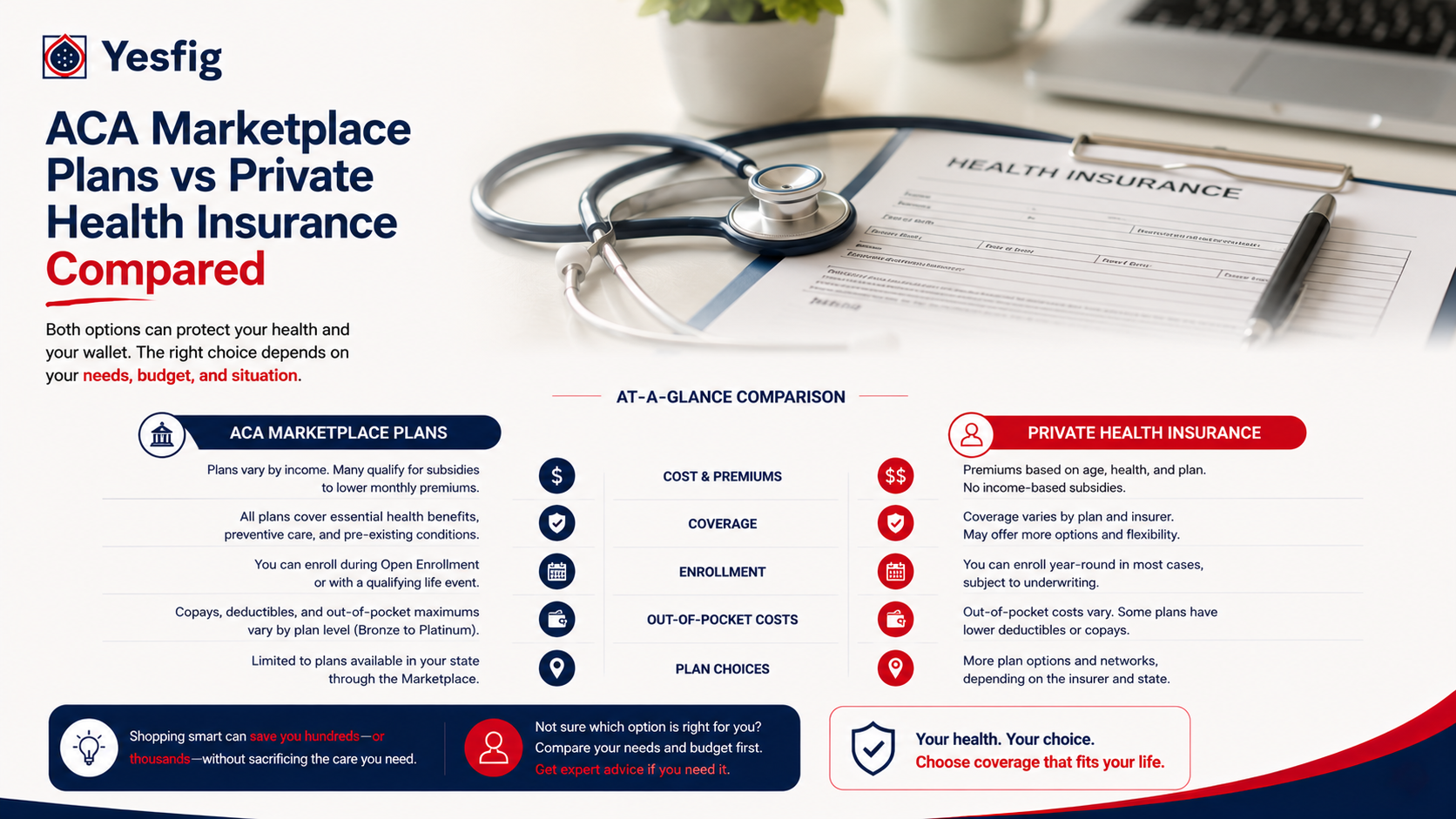
ACA Marketplace Plans vs Private Health Insurance Compared
Quick answer: ACA marketplace plans and private health insurance can offer the same coverage, but only marketplace plans qualify for income-based subsidies. Private plans bought off the marketplace skip the subsidy but may offer more plan choices. If your income qualifies you for help paying premiums, the marketplace is usually cheaper. If not, private plans are worth comparing.
Table of contents
- ACA marketplace vs private health insurance: clearing up the terms
- What ACA marketplace plans give you
- What private health insurance gives you
- How the two compare side by side
- ACA marketplace vs private health insurance: which fits you?
- How to choose your health plan in three steps
- Frequently asked questions
Camila, a freelance graphic designer in Los Angeles, lost her employer health plan when she went solo, and now she's stuck on a question that confuses a lot of people: should she buy through the government marketplace or go with a private plan? The ACA marketplace vs private health insurance choice sounds simple, but the terms hide some important differences that affect both your coverage and your cost.
The good news is the decision gets clear once you know what each one really means. Here's how marketplace and private plans actually differ, side by side, so you can pick the right fit for your budget and your health needs.
ACA marketplace vs private health insurance: clearing up the terms
The first thing to untangle is what "private" even means, because it gets used two ways. ACA marketplace plans are bought through the government exchange, which is Covered California in this state. They're the plans where you can qualify for income-based subsidies.
Private health insurance usually means a plan bought outside the marketplace. That can be an ACA-compliant plan purchased directly from an insurer or broker, with the same core protections but no access to subsidies. It can also mean a non-ACA plan, like a short-term policy, which is cheaper but covers far less. Coverage you get through a small employer is a separate path again, often a group health plan.
Not sure which type of plan you're looking at?
That confusion is common. Fig can explain the difference in plain English and help you see your California health plan options clearly, with no pressure to pick today.
What ACA marketplace plans give you
Marketplace plans come with built-in guarantees. They have to cover the essential health benefits, like doctor visits, hospital care, prescriptions, and preventive care. They can't deny you or charge more for pre-existing conditions, and they're sorted into metal tiers, Bronze through Platinum, that trade off premiums against out-of-pocket costs.
The headline feature is financial help. Depending on your income, you may qualify for premium tax credits that lower your monthly cost, sometimes substantially. You enroll during Open Enrollment, or during a Special Enrollment Period if you have a qualifying life event like losing job-based coverage.
Good to know: Premium tax credits are only available on the marketplace, never on private off-exchange plans. If your income qualifies you for a subsidy, the marketplace is almost always the cheaper route, even when a private plan looks similar on paper.
What private health insurance gives you
Private plans trade the subsidy for flexibility. An off-exchange ACA-compliant plan carries the same essential benefits and pre-existing protections as a marketplace plan, and sometimes gives you access to specific insurers, networks, or plan designs the exchange doesn't list. The catch is you pay full price, with no tax credits.
Then there are non-ACA options like short-term plans and health sharing arrangements. They can be much cheaper, but they don't have to cover essential benefits and can exclude pre-existing conditions. Worth knowing: California heavily restricts short-term health plans, so in this state, private mostly means full ACA-compliant coverage bought off the exchange.
Want to compare your real options?
That's exactly what a quick review does. Yesfig can line up marketplace and off-exchange plans for your situation and show you the true cost of each. Compare California health coverage in a few minutes.
How the two compare side by side
Here's the short version, laid out plainly.
| Feature | ACA marketplace plan | Private (off-exchange) plan |
|---|---|---|
| Income-based subsidies | Yes, if you qualify | No |
| Covers essential health benefits | Yes | Yes, if ACA-compliant |
| Pre-existing conditions covered | Yes | Yes if ACA-compliant, often no if not |
| Plan and network choices | Set by the exchange | Sometimes broader |
| When you can enroll | Open or Special Enrollment | Often anytime for non-ACA plans |
| Best for | Anyone who qualifies for subsidies | Those who don't, wanting specific plans |
The pattern is clear: if you qualify for a subsidy, the marketplace usually wins on cost. If you don't, private plans become more competitive.
ACA marketplace vs private health insurance: which fits you?
Your income is the deciding factor for most people. If you might qualify for premium tax credits, start at the marketplace, since a subsidy usually makes it the cheaper choice for the same coverage. It costs nothing to check your eligibility there first.
If your income is too high for subsidies, or you want a specific insurer or network the exchange doesn't carry, an off-exchange private plan is worth a close look. For Camila, who wasn't sure where her freelance income landed, the smart move was comparing both before deciding. Yesfig Insurance, a Los Angeles-based brand of Focus Insurance Group, can help you compare California health plans across both routes so you see the real numbers side by side.
Key takeaways
- Marketplace plans can qualify for income-based subsidies; private plans can't.
- Off-exchange ACA-compliant plans share the same core protections, minus the subsidy.
- Non-ACA private plans are cheaper but cover less, and California restricts them.
- If you qualify for a subsidy, start at the marketplace; if not, compare private plans.
How to choose your health plan in three steps
You can settle this with three quick steps:
- Check your subsidy eligibility. Look at the marketplace first to see if your income qualifies you for premium tax credits.
- Compare matching coverage. Line up a marketplace plan against an off-exchange plan with similar benefits and networks.
- Weigh total cost, not just premium. Factor in the subsidy, the deductible, and the out-of-pocket maximum before you choose.
If your situation is complicated, a licensed advisor can run the comparison with you. For more plain-English coverage guidance, the Yesfig blog is a good place to keep reading.
Frequently asked questions
What's the difference between ACA marketplace and private health insurance?
Marketplace plans are bought through the government exchange and can qualify for income-based subsidies. Private health insurance is bought outside the marketplace, either as an ACA-compliant plan with the same protections but no subsidy, or a non-ACA plan that costs less and covers less. Subsidies are the biggest difference.
Is private health insurance better than ACA marketplace plans?
It depends on your income. If you qualify for premium tax credits, a marketplace plan is usually cheaper for the same coverage. If you don't qualify, or you want a specific insurer or network not on the exchange, an off-exchange private plan can be a better fit. Compare both before deciding.
Can I get a subsidy with private health insurance?
No. Premium tax credits and other cost-sharing help are only available on the government marketplace. Private plans bought off the exchange, even ACA-compliant ones, do not qualify for subsidies. If your income makes you eligible for help paying premiums, you generally need to buy through the marketplace to use it.
Are off-exchange health plans ACA-compliant?
Many are, but not all. An off-exchange plan can be fully ACA-compliant, covering essential benefits and pre-existing conditions just like a marketplace plan, only without subsidies. Others, like short-term plans, are not ACA-compliant and cover less. Always check whether a private plan meets ACA standards before you enroll.
When can I enroll in a marketplace or private health plan?
Marketplace plans are available during Open Enrollment, or a Special Enrollment Period if you have a qualifying event like losing job-based coverage. Off-exchange ACA plans generally follow similar windows. Non-ACA private plans, like short-term coverage, can often be purchased anytime, though they offer fewer protections in exchange.
The ACA marketplace vs private health insurance decision really comes down to one question: do you qualify for help paying your premium? Camila checked her subsidy eligibility first, compared a marketplace plan against an off-exchange option, and chose the one that gave her real coverage at a price she could sustain. Knowing the difference is what turns a confusing choice into an easy one.
Ready to find the plan that fits?
Get a health insurance quote in minutes with Yesfig. Coverage in California starts at $50/mo, and a licensed advisor can compare marketplace and private options so you choose with the full picture in front of you.
About the Author

Mathew Bahadori
CEO, Yesfig Insurance
Leading the company’s mission to make insurance more accessible, modern, and customer-focused. With a passion for innovation and personalized service, he continues to help individuals and families find smarter coverage solutions for life, auto, home, health, and business insurance.